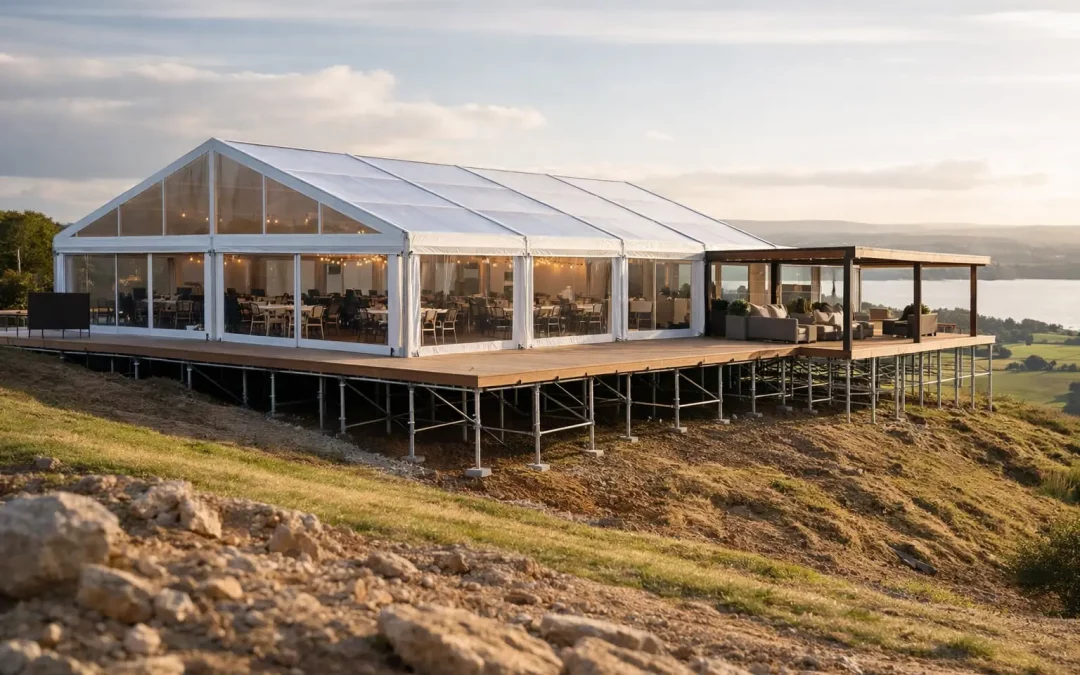
A flat, open field is the exception, not the rule. Most live event sites have a fall across the ground, soft patches after rain, hidden services, awkward access routes or a mix of hardstanding and grass. That is exactly why marquee logistics for uneven sites needs to be treated as an operational discipline, not a last-minute workaround.
For event organisers, the real issue is rarely just whether a marquee can stand on a slope. It is whether the whole site can function safely and efficiently once the structure is in place. Guests still need level floors, contractors still need vehicle access, and your programme still has to run to time. On uneven ground, every one of those elements becomes more technical.
Why marquee logistics for uneven sites starts early
When a site has levels, cambers or inconsistent ground conditions, the build plan has to start much earlier than it would on a simple open field. The structure itself may be only one part of the challenge. Access for plant, delivery sequencing, flooring tolerances, drainage, emergency routes and public circulation all need to be considered together.
A useful site visit is not just a walkaround with a tape measure. It should establish where the gradient sits, how the ground behaves under load, whether there are pinch points for lorries, and what happens if the weather turns during build week. A site that looks manageable in dry conditions can become slow and costly if access roads soften or vehicle turning areas begin to rut.
This is where experienced planning makes the difference. It is one thing to confirm that a marquee can be installed. It is another to design a build that protects the ground, maintains programme certainty and avoids expensive changes once crews are on site.
The main site variables that affect delivery
Gradient and level change
Not all slopes create the same issue. A gentle, consistent fall across a site may be straightforward to manage with the right flooring system and setting-out plan. More awkward are sites with irregular level changes, dips, banks or terraces, where the finished structure has to accommodate multiple conditions within one footprint.
The key question is not simply how steep the site is. It is how that gradient interacts with the event use. A hospitality marquee with catering, formal dining and high footfall demands a different floor finish from a back-of-house storage structure. The more premium or public-facing the environment, the less tolerance there is for noticeable level variation.
Ground bearing and weather exposure
Uneven sites often come with mixed ground conditions. One section may be firm enough for plant movement, while another becomes soft after a single night of rain. If heavy equipment is moving in for installation, dismantle or generator placement, bearing capacity matters just as much as the slope itself.
Weather exposure also has a direct impact on logistics. Sloping sites can channel surface water towards access points or under flooring areas. On exposed rural sites, wind can affect crane operations, material handling and safe working times. Good planning takes account of these factors before the build starts, not once they begin to cause delay.
Access and vehicle movement
An uneven event site may still be workable if access is strong. Equally, a moderate slope becomes a serious constraint if every delivery has to pass through a narrow gate, cross soft ground and reverse into a tight build zone. In practical terms, marquee logistics often come down to how efficiently materials, machinery and crews can move around the site.
That means assessing entry widths, overhead obstructions, turning circles, passing places and temporary roadways. It also means sequencing deliveries with care. If the floor system, structure components, plant and ancillary infrastructure all arrive without a clear order, even a technically suitable site can become congested very quickly.
Flooring is usually where the project is won or lost
On uneven ground, flooring is not a finishing touch. It is one of the main engineering and operational decisions in the project.
A raised or levelled floor can create a stable internal environment where the external ground is anything but level. That improves guest comfort, protects the event standard and makes everything else inside the marquee work properly, from furniture layouts to catering operations. The trade-off is that more complex flooring systems bring greater cost, more labour and, in some cases, longer build periods.
There is no single right answer. For some sites, a cassette floor or integrated substructure will be the best route to a level finish. For others, the site may allow a simpler approach if the intended use is less formal or the ground variation is modest. The decision should be based on what the event needs the finished space to do, not just on reducing immediate cost.
A common mistake is underestimating how much uneven floors affect the live event once doors open. Bars, kitchens, staging, furniture lines and toilet access all rely on a floor that behaves properly under use. If the floor solution is treated as an afterthought, the problems tend to appear at the worst possible point in the programme.
Build sequencing matters more on difficult ground
On a challenging site, build order is not administrative detail. It affects safety, productivity and whether the programme holds.
Ground protection may need to go in before any major delivery begins. Plant may need a defined route and a protected working area. Some structures need to be set out with particular reference points to account for fall across the site. If services, welfare units, fencing and generators are all being installed as part of the wider event compound, each element has to be coordinated so crews are not working across one another.
This is especially important on high-pressure projects with fixed opening dates. The more uneven the site, the less room there is for wasted movement or reactive decision-making. A detailed build schedule, clear site management and close communication between suppliers become critical.
Safety, compliance and public use
Uneven sites create practical risks that need to be addressed properly in both planning and paperwork. Slips, trips, vehicle movement, drainage, temporary steps, ramp interfaces and emergency egress all become more sensitive when the ground is inconsistent.
For public events, the standard has to go beyond basic installation. The structure must integrate with pedestrian routes, barrier lines, fire points, back-of-house operations and any accessibility requirements on site. If the marquee is part of a larger event footprint, it should not be planned in isolation from the rest of the infrastructure.
This is where technical documentation and methodical delivery are valuable. Risk assessments, build methods, site plans and load considerations are not simply compliance exercises. They help organisers understand where the pressure points are and allow issues to be managed before they affect programme or safety.
What experienced organisers should ask before sign-off
If you are reviewing marquee logistics for uneven sites, the useful questions are practical ones. How will crews and plant reach the build area in poor weather? What flooring system is proposed, and what finish will it deliver? Where will water go if conditions change? How will deliveries be sequenced? What temporary ground protection is required? How will the structure connect to the rest of the event layout?
You should also ask what the compromise points are. On some sites, the best answer may be a different orientation, a revised footprint or a change in internal use. On others, the project can proceed exactly as planned, but only if enough time and budget are allowed for the groundwork and floor build. Good suppliers will be clear about that. They will not pretend difficult sites are simple.
For major events across Scotland and the north of England, that honesty matters. Rural estates, city-centre spaces, showgrounds and temporary compounds all bring their own version of uneven terrain. The strongest outcomes come from treating the site as it is, not as everyone wishes it would be.
Purvis Marquee Hire works on that basis – looking at access, levels, structure design, flooring, ancillary infrastructure and live-site practicality as one joined-up delivery exercise. That approach is often what keeps a difficult site workable.
The best time to solve an uneven site is before the first lorry arrives. If the planning is right, the ground does not have to dictate the quality of the event.