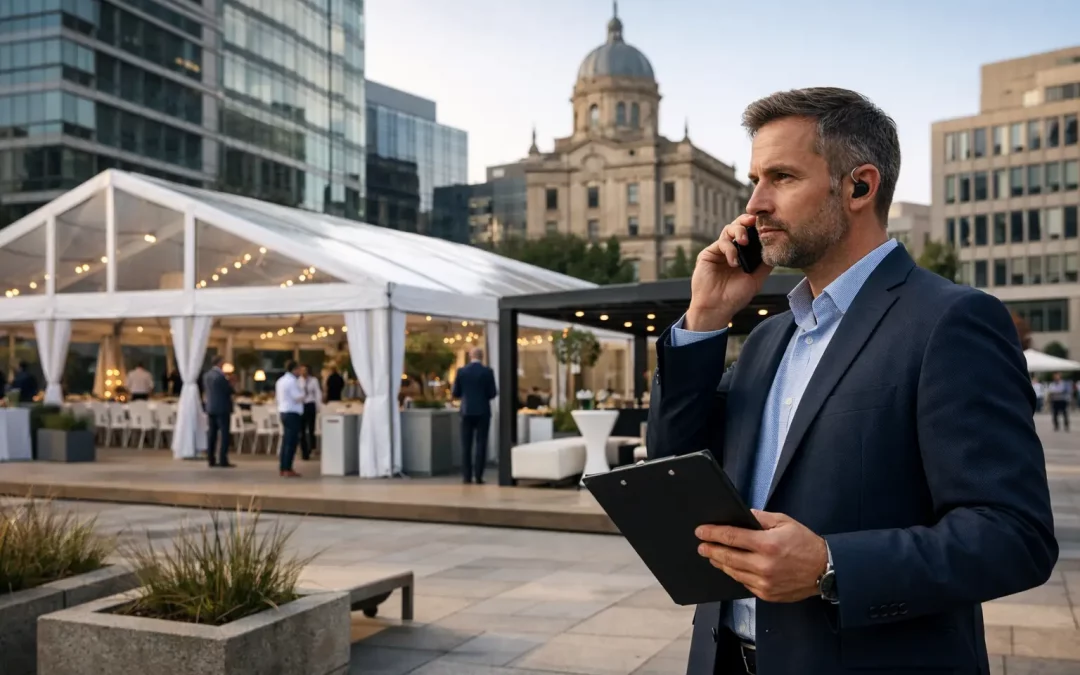
A city square can look generous on a plan and feel very different at 6am when build crews, council teams, security, catering, production and traffic management all arrive at once. That is the reality of city centre event structures. They have to perform in tight footprints, under public scrutiny, with little room for delay, error or improvisation.
For event organisers, the structure is rarely just a covered space. It is often the operational backbone of the event itself – the front-of-house arrival point, the hospitality environment, the production base, the welfare area, the media compound or the public-facing branded feature that has to look right from the first opening hour. In a city centre setting, those roles are harder to deliver because access, timing, compliance and stakeholder management all carry more weight.
Why city centre event structures are different
A greenfield site gives you options. A city centre site usually gives you constraints. Access windows may be limited to early mornings or overnight periods. Vehicle movements may need to be marshalled to the minute. Public transport routes, loading bays, emergency access, pedestrian flows and neighbouring businesses all shape what can be built and how it can be delivered.
That changes the planning process from the start. The question is not simply what size structure you want. It is whether that structure can be installed safely, whether the ground and surrounding surfaces can take the load, how the build sequence will work, and what supporting infrastructure is needed to keep the site operational throughout the event.
There is also the issue of visibility. City centre events are rarely hidden from view. They sit in the middle of active public space, often beside retail units, civic buildings, offices or transport hubs. A structure has to meet practical requirements, but it also has to present well, respect the setting and support the event’s brand without looking temporary in the wrong sense of the word.
Planning city centre event structures from the ground up
The most reliable projects start with a proper site assessment. That sounds obvious, but city locations can be deceptive. Paved surfaces may hide service covers, basements or underground utilities. Kerb heights, bollards, trees, street furniture and level changes can affect everything from lorry access to final floor levels. A site that appears straightforward for a public gathering may be far less straightforward for a temporary structure build.
Ground conditions matter even on hardstanding. Load distribution, surface protection and anchoring methods all need to be considered carefully. In some city centre locations, traditional staking is not possible at all, so ballast solutions and engineered fixing plans become part of the design from an early stage. That has implications for footprint, vehicle requirements and installation time.
The layout also needs to work harder in an urban environment. You may be fitting a reception area, catering prep, storage, technical control and public circulation into a tighter envelope than you would on a rural site. Internal planning is therefore not a finishing touch. It is a core part of making the structure useful. Flooring, clear spans, door positions, emergency exits, back-of-house routes and branding locations all need to be resolved before build day.
Access, timing and the build sequence
In city work, the build sequence can make or break the job. A structure may be technically suitable and still prove difficult if the delivery programme has not been matched to the site. Restricted access windows often mean materials need to arrive in a tightly controlled order. There is little value in having stock capacity if the wrong components reach the site first and block the working area.
This is where experience shows. Crews need to understand not just how to erect the structure, but how to operate around barriers, public interfaces, nearby occupiers and live traffic management measures. Sometimes smaller vehicles or split loads are required. Sometimes the programme has to be broken into short working periods around peak pedestrian hours or city restrictions. None of that is unusual, but it does need to be built into the plan rather than treated as a site-day problem.
The same goes for derig. Many organisers put understandable focus on opening day, but city centre strip-out can be just as sensitive. Neighbours may be less tolerant after the event than before it. Waste removal, surface protection recovery and traffic reinstatement all need proper coordination if you want to leave the site cleanly and protect future permissions.
Compliance is not separate from delivery
High-profile urban events tend to involve more stakeholders, and that means more scrutiny. Local authorities, landowners, safety advisory groups, venue managers and production leads all need confidence that the temporary infrastructure has been designed and planned correctly. For city centre event structures, paperwork is not an add-on. It is part of the delivery.
That includes structural calculations where required, method statements, risk assessments, fire planning, emergency access provision, capacity considerations and clear build documentation. If power, heating, lighting, generators, fencing or toilet provision form part of the temporary site, those elements need to be coordinated as one operational package.
A common mistake is to treat the marquee or structure as one supplier package and all site services as separate decisions. That can work on simpler events. In a city centre setting, it often creates friction. Cable runs clash with pedestrian routes, plant sits where branding should be, and service areas end up in the wrong place because nobody planned them as part of the same temporary environment.
Design still matters, but practicality comes first
Professional event buyers understand that appearance matters. Sponsors want visibility, stakeholders want confidence and guests notice quality. But the strongest city centre structures are not the ones that only photograph well. They are the ones that continue to function when weather turns, footfall builds and the schedule tightens.
That means making sensible choices about finishes and specification. Glazed elements may be right for premium hospitality or public engagement areas, but they need to suit the site and season. Solid walls may offer better control for branding, security or weather resilience. Cassette flooring can create a strong finished interior, but floor build-up needs to suit thresholds and surrounding levels.
Heating and cooling should be decided with occupancy and usage in mind. A daytime press launch, an evening hospitality event and a week-long festive activation all place different demands on the same footprint. There is no single right answer. The right specification depends on dwell time, audience profile, catering load, electrical demand and the practical limits of the site.
Managing the public interface
One of the defining features of city events is proximity to the public. Even when a site is ticketed or controlled, the build often happens in open view. So does part of the event itself. That raises the standard for hoarding, fencing, signage and on-site management.
Pedestrian flow has to be protected at all times. Emergency routes must remain clear. Deliveries cannot be allowed to drift into public space because the footprint is under pressure. For organisers, that means choosing a structure partner who understands that crowd-facing sites need discipline as much as speed.
It also means thinking beyond the main event envelope. Queue lines, accreditation points, welfare provision, plant screening and service access all influence how the structure is experienced. If those elements are poorly handled, the event can feel cramped or improvised even when the main build is technically sound.
What experienced organisers look for
When buyers are procuring city centre event structures, they are usually not just comparing square metre rates. They are assessing who can carry risk sensibly, who can coordinate with production and local stakeholders, and who will stay calm when the programme comes under pressure.
That is why stock range on its own is not enough. What matters is the ability to translate a site brief into a workable infrastructure plan. On some projects, the best answer is a large clearspan structure with integrated flooring, power distribution and formal hospitality fit-out. On others, it is a combination of smaller linked structures that better suit access limitations and phased installation.
The supplier’s attitude matters too. City centre work rewards teams that are practical, communicative and realistic about constraints. It is better to challenge an unworkable layout early than to promise too much and start redesigning on site. A dependable contractor will ask difficult questions before the build, because that is what protects the event later.
Purvis Marquee Hire works in exactly these conditions across Scotland and the north of England, where access, compliance and presentation all need to come together under live event pressure.
The value of joined-up delivery
The more complex the event, the more useful it is to have a structure provider who can also support the wider temporary infrastructure. When flooring, lighting, climate control, branding, fencing, toilets, ground protection and build management are being treated as part of one delivery plan, the result is usually cleaner and more efficient.
That does not mean every project needs the same level of package support. Some organisers have strong internal production teams and only need a specialist structure partner. Others want a supplier who can carry more of the temporary site responsibility. The key is clarity. Everyone should know who owns each element, how interfaces are managed and what the critical path looks like.
City centre events rarely reward last-minute fixes. They reward preparation, honest conversations and teams who know how to build in tight spaces without losing sight of the public, the programme or the bigger operational picture.
If you are planning a city-centre event, the best starting point is not the brochure image. It is the site, the schedule and the realities around them. Get those right, and the structure can do what it is there to do – support the event properly from first vehicle in to final clear-up.