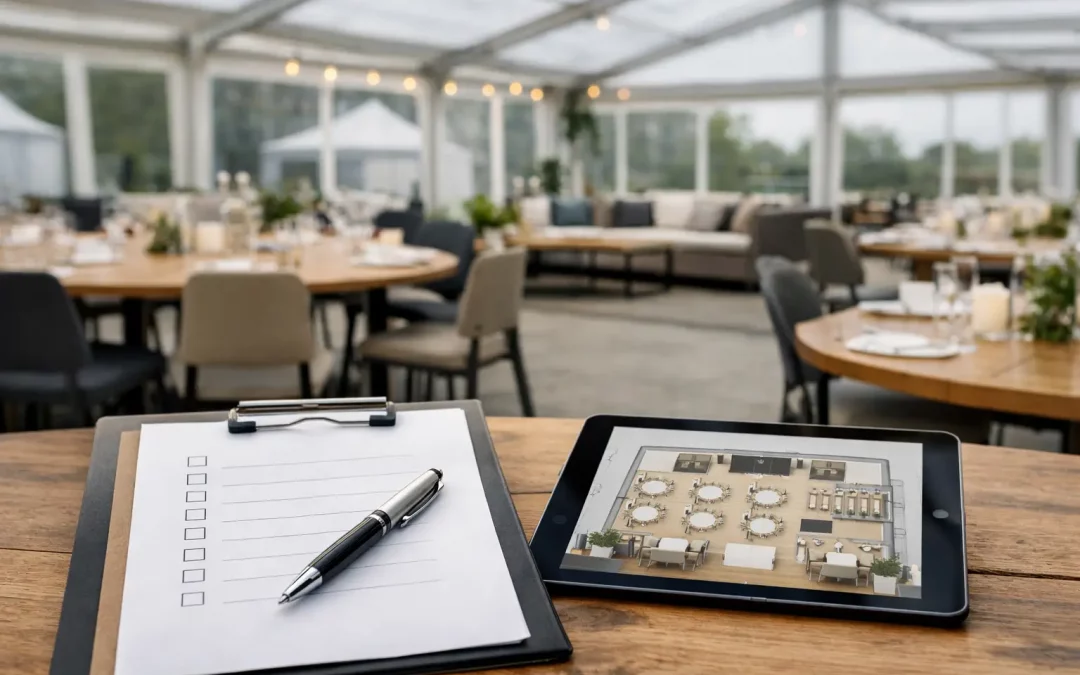
The marquee is often the most visible part of an event site. The procurement decision, however, has to account for much more than size, style and hire price. A proper marquee procurement checklist gives your team a practical way to test whether a proposed structure, supplier and delivery plan will work under live-event conditions.
For a corporate hospitality build, agricultural show, city-centre activation or public festival, the structure has to fit the site, support the operational plan and be ready when every other contractor needs access. A missed detail at procurement stage can quickly become a compromised layout, delayed build or avoidable safety issue on site.
Start the marquee procurement checklist with the event brief
Begin by defining what the structure must enable, rather than specifying a marquee in isolation. Guest numbers matter, but so do the activities taking place inside. A dining layout, exhibition, production office, broadcast compound, catering operation and back-of-house storage area all make different demands on space, flooring, power and access.
Set out the required capacity at peak occupancy, the intended internal layout and the operational zones that must remain separate. Consider entrance and exit points, registration, queues, emergency egress, accessible routes, service corridors and vehicle interfaces. If a structure is expected to support branded hospitality, identify where graphics, feature lighting, catering equipment and furniture will sit before a supplier prices the shell.
Timings should be equally clear. Record the dates and hours for site possession, build, fit-out, event operation, breakdown and final site handback. Large structures may need a phased installation, particularly where flooring, electrics, furniture and production teams must work in sequence. The cheapest proposal is not necessarily the best value if it leaves no workable time for other contractors.
Confirm the site before committing to a design
Site conditions shape the solution. A clear, level grass field offers options that a sloping park, historic estate, tight urban square or working showground does not. Ask for a site visit early, with the event manager, venue contact and key suppliers involved where possible.
Access planning should cover the route from the public road to the build location, including gate widths, turning circles, bridge limits, overhead obstructions and ground loading. A marquee supplier may need articulated lorries, forklifts, telehandlers and plant trailers to deliver structural components, flooring and ancillary equipment. It is not enough for a vehicle to reach the site entrance if it cannot safely reach the working area.
Ground conditions need the same scrutiny. Check the gradient, drainage, underground services, ground bearing capacity and any restrictions on staking. On protected ground or hardstanding, a ballast-based solution may be required. That can affect structure choice, footprint, transport, labour and cost. Ground protection may also be essential where vehicle movements could damage turf, paths or a venue’s existing surface.
Weather exposure should be considered honestly. An open site on the coast or high ground may require a different structural approach from a sheltered courtyard. Wind loading, rainwater management, door positions and anchoring methods all need to be appropriate to the location and time of year.
Specify the structure and operational package together
A marquee quote can look comparable at first glance while covering very different levels of delivery. Establish whether the price includes the complete operational package or simply the structure, then assess the omissions against your event plan.
For complex events, the procurement scope commonly needs to address:
- the structure, including eaves height, clear-span requirements, doors, linings and glazing;
- cassette or raised flooring, ramps, steps and accessible thresholds;
- power distribution, emergency lighting, internal lighting and generator coordination;
- heating, cooling and ventilation appropriate to occupancy and season;
- toilets, fencing, crowd-management barriers and welfare facilities;
- signage, branding positions, interior finishes and furniture coordination; and
- build management, on-site supervision, breakdown and waste arrangements.
The right specification depends on the event. A summer reception may only need light environmental control, while a winter awards dinner can require insulated linings, reliable heating and careful management of entrance doors. A public event may prioritise circulation and resilience, whereas a premium hospitality event may place more emphasis on finishes, concealed services and guest arrival experience.
Ask suppliers to describe their assumptions. If power is excluded, who is responsible for calculating demand and providing distribution? If flooring is included, does it cover the full usable area, including kitchens and service spaces? If a structure is supplied with standard doors, are they suitable for expected footfall and accessibility requirements? Clear answers protect both programme and budget.
Build compliance into the procurement decision
Temporary structures operate within a wider safety and compliance framework. Your chosen partner should be able to provide the documentation needed for the event, venue, insurer and relevant authorities, in a format that supports your planning process rather than appearing at the last minute.
Request details of structural design information, installation procedures, risk assessments, method statements, fire safety provisions and relevant electrical certification. For public-facing events, consider how the supplier’s work integrates with the wider event management plan, including emergency procedures, fire lanes, evacuation routes and crowd management.
Responsibilities must be clear where multiple contractors are involved. The marquee team may install the structure and flooring, while an electrical contractor, caterer, production supplier and furniture company all work inside it. Agree who controls the work area, who signs off each stage and when the structure becomes available for fit-out. This reduces the risk of unsafe overlap between plant movements, working at height and internal installation activity.
Welfare is not an afterthought. Build crews, production teams and event staff need suitable facilities during long installation periods. Consider toilets, handwashing, rest areas, lighting and safe routes around the site, especially on remote or exposed locations.
Test supplier capability, not just the proposal
The best procurement process tests how a supplier will perform when the site changes, the weather turns or a delivery slot moves. Ask about experience with comparable event types, structure scale, site constraints and live operational environments.
It is reasonable to ask who will manage the project from enquiry through to handback, how site decisions are communicated and what cover is available outside normal hours during the event. A project-led supplier should be able to explain its approach to build sequencing, vehicle management and coordination with your production schedule.
Stock capacity matters for major dates. A supplier may offer an attractive design, but you need confidence that the specified structure, flooring, doors, linings and associated equipment are available together. This is particularly relevant during the summer event season, when multiple large-scale builds can be running at once.
At Purvis Marquee Hire, this operational detail is treated as part of the structure solution. The objective is not simply to put a marquee on a site, but to provide an infrastructure package that gives the wider event team a safe, workable platform for delivery.
Compare costs on a like-for-like basis
A clear commercial comparison should separate hire charges, transport, labour, plant, site preparation, ancillaries and any standby or out-of-hours requirements. Look closely at what could change the final cost: restricted delivery access, ballast, extended build periods, additional crew, weather-related ground measures or late design amendments.
Avoid treating contingency as a sign of poor planning. On sites with uncertain ground conditions or limited access windows, a sensible allowance can be more responsible than a low initial price built around optimistic assumptions. The key is transparency: your team should understand what is included, what is provisional and who authorises variations.
Before issuing the purchase order
Before appointing a supplier, make sure the final scope reflects the latest site plan, event schedule and stakeholder requirements. Confirm drawing approval, build dates, delivery routes, points of contact, documentation deadlines and the process for managing changes.
A marquee procurement checklist is most valuable when it is used as a live project document, not a box-ticking exercise. Keep it with the programme, site plan and contractor schedule, then revisit it as decisions are made. That discipline gives your event team more control long before the first lorry reaches site.