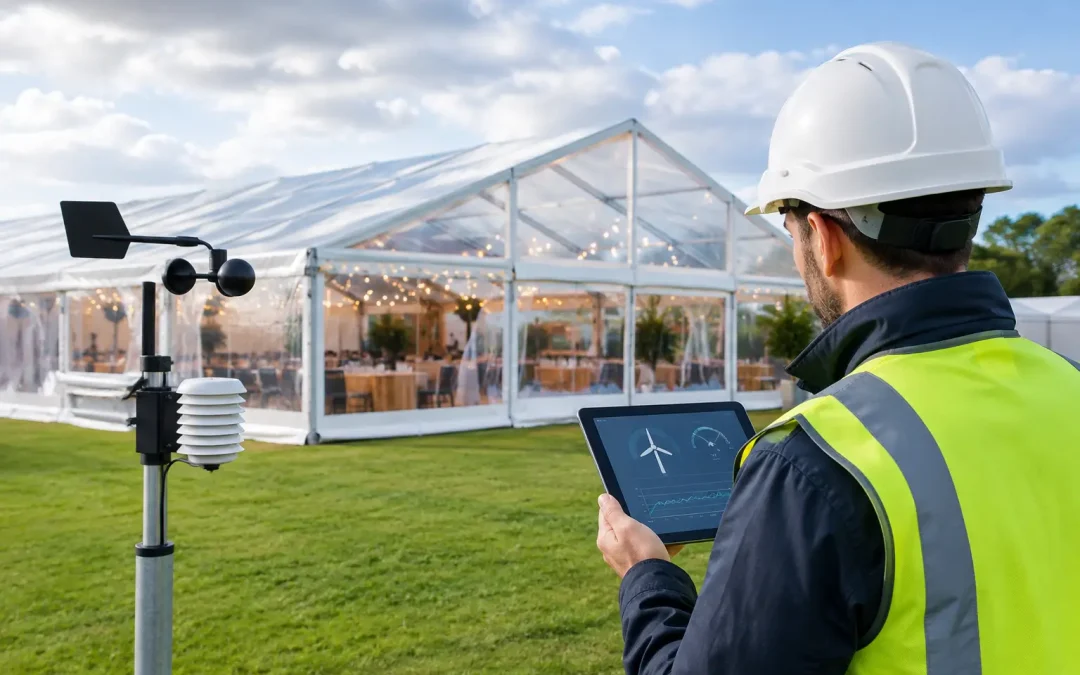
A guide to event wind monitoring is not simply about watching a weather app and reacting when conditions feel uncomfortable. For a live event, it is a planned control measure: one that connects the forecast, the structure’s design information, site conditions, operational decisions and a clear chain of command. When marquees, temporary grandstands, signage, fencing and public areas are in use, wind needs to be managed with the same discipline as access, power distribution and crowd movement.
Wind can change quickly across an event site. A rural showground, an exposed coastal venue, a city-centre square and a parkland hospitality site will all behave differently. Buildings, mature trees, slopes and temporary structures can channel or accelerate gusts, while conditions that appear manageable at ground level may be more significant at roof height. The right approach is therefore site-specific, documented and understood by the people making decisions on the day.
A guide to event wind monitoring starts before build
The monitoring plan should begin during technical planning, not when the first gust arrives. Review the site survey alongside the proposed structure layout. Consider prevailing wind direction, exposure, local topography, the shelter offered by permanent features and whether that shelter could create turbulence instead. A marquee placed beside a large building may not be protected from wind in every direction.
The structure supplier’s engineering information is central to this process. Every temporary structure has its own design assumptions, ballast or anchoring requirements, and operating limitations. These may change according to span, eave height, sidewall configuration, doors, lining, attached equipment and ground conditions. Do not apply one wind limit across an entire event because it was used successfully on another site or for another structure.
It is also important to consider the elements around the marquee. Flags, banners, branded façades, temporary fencing, scaffold systems, catering units, LED screens and decorative features can all be affected by wind differently. A main structure may remain within its operating parameters while a loose sign, unstable fence run or unsecured furniture creates the immediate risk. The wind plan needs to cover the whole operational footprint, not just the largest tent.
Forecasting should start far enough in advance to support practical decisions. That may include changing a layout, increasing anchorage where design allows, revising vehicle movements, scheduling build activity differently or arranging additional site personnel. Forecasts are indicators, not guarantees, but they give the project team time to prepare rather than make avoidable last-minute compromises.
Measure conditions where decisions are being made
A fixed anemometer is generally the most reliable way to build a record of conditions throughout an event. It should be installed in a location that is representative of the exposure affecting the structure, rather than wherever it is easiest to mount. A sensor hidden behind a marquee gable or close to a high wall may report lower readings than the conditions acting on the site.
Height matters. Wind speed normally increases with elevation, and a reading at waist height may not reflect conditions at roof level, on a raised deck or around a tall sign. The sensor position should be agreed with the competent person responsible for the temporary structure and recorded within the event documentation. It also needs to be protected from accidental interference without obstructing its exposure to the wind.
Handheld anemometers can be useful for checks around particular areas, especially where the site has varied terrain or temporary installations are spread across a large footprint. They are not, however, a substitute for a properly positioned primary monitor and a consistent recording process. Readings need context: the time, location, average speed, peak gusts and the direction of travel all help to explain what is happening.
For larger or higher-risk sites, assign a named individual or team to monitor weather information and on-site readings. That responsibility should not sit vaguely with “the event team”. In a pressured situation, clear ownership prevents the common problem of several people assuming somebody else is watching the wind.
Use trigger levels, not judgement alone
Wind monitoring is valuable only when it leads to agreed actions. Set trigger levels in advance using the structure manufacturer’s or supplier’s guidance, the event risk assessment and the particular site conditions. These levels should distinguish between heightened awareness, operational changes, restricted access and the point at which areas must be cleared or structures taken out of use.
The exact response will depend on the installation. Closing marquee doors may reduce wind entering a structure in one scenario, while opening particular exits may be necessary to manage people safely in another. Sidewalls, furniture, suspended décor and operational equipment all need to be considered. There is no useful universal number that can replace project-specific technical information.
A practical escalation plan should identify what happens at each stage. For example, an early trigger may require more frequent readings, a check of all doors and anchorage points, and communication with suppliers. A higher trigger may suspend work at height, stop the movement of lightweight temporary fencing, remove loose external furniture or close a vulnerable hospitality area. The final trigger may require the controlled evacuation of a structure or the wider site.
The key is to avoid waiting for visual signs of failure. If fencing is lifting, signage is moving violently or guests are struggling to walk comfortably, conditions may already be beyond the point where a controlled response is easy. Pre-agreed thresholds allow the team to act early, calmly and with authority.
Build wind checks into daily site operations
Wind management should become part of the event rhythm. At the start of each day, review the forecast and confirm the expected timing of stronger conditions. Repeat this at production meetings, before opening gates and before any significant programme change. A dry, calm morning can create false confidence when a frontal system is due later in the afternoon.
Physical inspections remain essential. Check anchor points, ballast, straps, tensioning systems, doors, sidewalls, gutter connections and any equipment attached to the structure. Ground conditions can alter after heavy rain, vehicle movement or repeated public footfall. A system that was secure at handover may need reassessment if the ground has softened or if another contractor has disturbed the area.
Communication matters just as much as measurement. Security, stewards, front-of-house teams, caterers and venue staff should know who to contact if they spot a problem. They do not all need to interpret wind data, but they should understand the signs that require prompt reporting: a loose panel, lifting flooring, unstable fencing, a door that will not remain secured or an item becoming airborne.
For complex events, radio terminology and decision authority should be agreed in the event control plan. If an area needs to close, teams need a clear instruction, a route for moving people, and an understanding of who can reopen it. Conflicting instructions create delay, particularly where the public, contractors and production staff are working alongside one another.
Keep a record that supports safe decisions
Wind logs are not paperwork for paperwork’s sake. They provide a factual record of what was observed, when action was taken and why. This is particularly useful where conditions change repeatedly or a decision is challenged after the event.
Record forecast updates, anemometer readings, peak gusts, inspection findings, actions taken and the name of the responsible person. Where a structure is temporarily closed, note the time, reason and the checks completed before reopening. Photographs can also help document any visible issue, provided they do not delay an urgent safety response.
At Purvis Marquee Hire, the practical value of this approach is clear on large and exposed builds: the structure, site team and event management need to work from the same operating picture. Monitoring data without a delivery plan is of limited use. Equally, a well-written plan will not protect an event if nobody is checking conditions and communicating the result.
Plan for the difficult call
The most challenging decisions are often commercial as well as operational. Stopping a programme, moving guests or closing a hospitality area can affect sponsors, ticket holders and broadcast schedules. That pressure is precisely why escalation actions should be agreed before the site is busy and the weather deteriorates.
A sensible plan gives decision-makers the confidence to act on evidence rather than optimism. It also makes clear that reopening should be as controlled as closure. Once wind levels reduce, inspect the affected structures and surrounding equipment, confirm conditions are stable, and communicate the decision through the same command route used to close the area.
Good wind monitoring is quiet preparation that becomes visible only when it is needed. Put the right measurements, people and actions in place early, and even a difficult weather window can be managed with control rather than disruption.