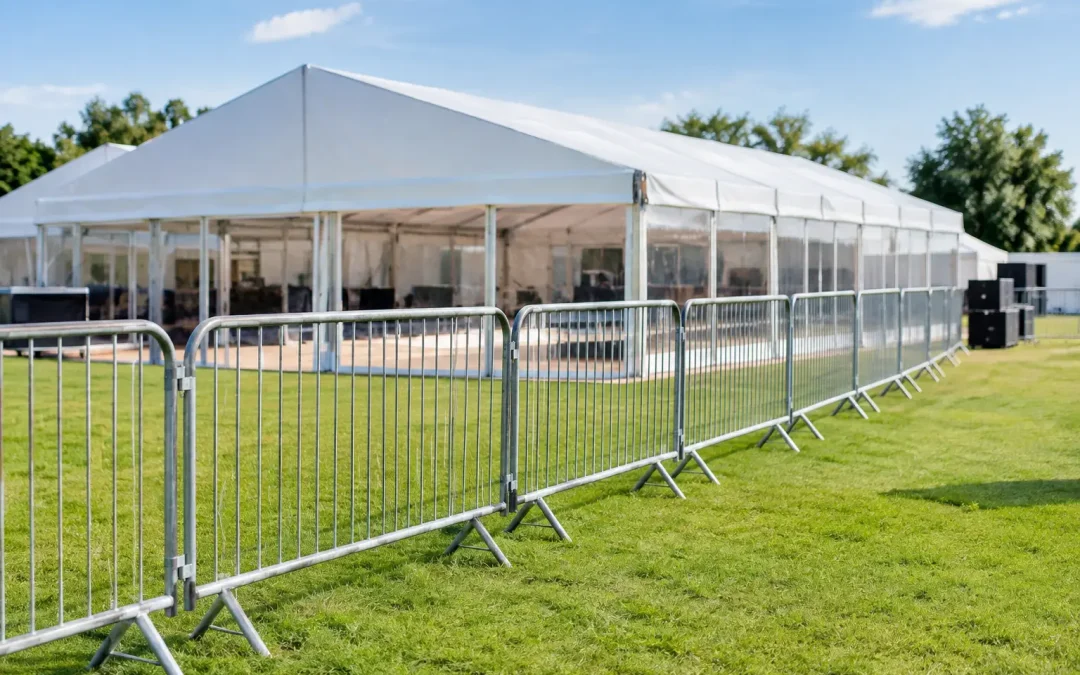
A good event fencing review begins long before the first panel reaches site. For major public events, fencing is not a finishing touch around the marquee or arena. It defines how people arrive, where vehicles can work, which areas require credentials, and how the site remains controlled when weather, crowds and delivery schedules put the plan under pressure.
The right fencing solution depends on what the boundary needs to achieve. A countryside agricultural show, a city-centre activation, a ticketed festival and a televised hospitality event may all require temporary fencing, but their access routes, public interface and operational risks will be very different. Reviewing the requirement properly is what prevents a secure-looking site becoming a difficult site to run.
Event fencing review: start with site function
The first question is not which fencing product to hire. It is what each line of fencing is intended to do. Perimeter fencing may be there to establish a controlled event footprint and deter unauthorised access. Internal fencing may separate guests from build areas, protect generators, form queues, manage hospitality access or keep the public away from vehicle routes.
Where a fence has more than one role, those roles need to be compatible. For example, a public-facing pedestrian boundary may need to look presentable, carry branding and withstand sustained contact from crowds. A contractor compound needs more emphasis on secure gates, restricted access and practical movement for plant or stock. Treating both as the same specification can create avoidable compromises.
The review should also identify whether the boundary is temporary for build and breakdown only, required throughout the live event, or needs to change as the programme develops. At a multi-day show, a route that works for installation lorries may be unsuitable once exhibitors and visitors arrive. Fencing layouts should support each phase rather than forcing the operations team to work around them.
Map people, vehicles and pressure points
A fencing drawing is most useful when it is based on real movement, not simply on the edge of the available field or hardstanding. Consider every route into, through and out of the site: public entry, accessible access, emergency egress, staff arrival, caterer servicing, exhibitor deliveries, waste collection and emergency vehicle routes.
Entrances deserve particular attention. Gates must be wide enough for their intended use, positioned to avoid queues spilling into roads or public areas, and staffed or secured appropriately. A pedestrian entrance close to a vehicle gate may look efficient on plan but become hazardous during a busy delivery window. Separating the two is often the better operational decision, even where it requires additional fencing and stewarding.
Queueing areas should be designed around likely demand rather than average footfall. Ticket checks, bag searches, accreditation points and wristband collection can all slow arrivals. Temporary barriers and fencing need sufficient length to contain queues safely, while maintaining clear routes for emergency access and avoiding pinch points around marquee doors, toilets or catering concessions.
On exposed sites, assess where visitors are likely to lean, gather or push forward. Front-of-stage barriers, viewing enclosures and high-traffic entrance lanes need a different level of planning from a quiet rear boundary. The expected crowd behaviour, ground conditions and stewarding model should inform the specification together.
Choose the fencing type for the job
Heras-style temporary fencing remains a practical option for many site perimeters, back-of-house zones and contractor compounds. It is quick to install, adaptable around irregular footprints and readily combined with gates, stabilisers and screening. It is not, however, the answer to every requirement.
Where public presentation matters, solid hoarding, branded fence scrim or more refined temporary systems may be appropriate. Screening can improve the appearance of a working site and reduce views into storage or service areas, but it also changes how wind acts on the fence line. A screened run in an exposed Scottish location requires careful assessment, suitable support and a realistic response to forecast conditions.
Pedestrian barriers are useful for channelling movement and forming managed queues, but should not be treated as a substitute for secure perimeter fencing. Similarly, crowd-control systems around stages or demonstration areas require appropriate design, connection and load considerations. The distinction matters: a barrier that guides people in normal conditions may not be suitable where crowd pressure is foreseeable.
The finish should match the event environment. A premium hospitality event may need discreet fencing that protects the guest experience. A large public festival may prioritise clear boundaries, durable access points and straightforward wayfinding. An industrial or broadcast site may require tighter segregation around equipment, cabling and vehicle operations. There is no single best system, only a system suited to the conditions.
Ground conditions can change the specification
Temporary fencing is only as dependable as its installation. Soft grass, uneven ground, sloping terrain, cobbles, tarmac, compacted stone and temporary trackway each affect how panels can be positioned and stabilised. A site visit or detailed ground review is particularly valuable where terrain is exposed, access is restricted or the event is being built around existing buildings and services.
Wind is a major consideration. Open fields, coastal locations and urban wind tunnels can place significant loads on temporary structures. Fence scrim, banners and solid infill increase the surface area exposed to gusts. The appropriate response may include additional stabilisation, shorter runs, revised orientation, removing screening in poor weather, or selecting an alternative boundary treatment.
Ground protection also has a part to play. If fencing needs to cross a sensitive lawn, sports surface or heritage site, the installation method should be agreed with the venue or landowner. Protecting the surface at the outset is usually less disruptive than repairing damage after a high-profile event has finished.
Build security into the programme
The event perimeter often needs to be functional before the main infrastructure build is complete. Once marquees, power equipment, catering units and production kit begin arriving, the value of a defined and controlled site increases quickly. This means fencing should be planned as an early work package, with gates and access routes coordinated around the delivery schedule.
It is equally important not to close the site too soon. Lorry turning circles, telehandler access, emergency routes and crane operations may all require temporary openings. These should be identified in advance, controlled while open, and reinstated without delay. An improvised gap in a perimeter is rarely just a security issue – it can also create confusion about who is responsible for access control.
During the live period, the fence line should be inspected as part of routine site management. Look for moved feet, loose couplers, damaged panels, unauthorised gaps, overloaded gates and areas where queues are placing unexpected pressure on the system. A practical event fencing review does not end at handover; it continues through the conditions of the event.
Documentation and ownership matter
For public-facing sites, fencing should be considered within the wider event safety plan. Drawings need to align with fire and emergency arrangements, evacuation routes, traffic management, security deployment and accessibility provisions. Where relevant, the event team should be able to show why a boundary, gate or exclusion zone is located where it is.
Clear ownership is just as important. Someone needs authority to approve changes to the fence line, unlock restricted gates and respond when a delivery driver requests access outside the planned window. This is often shared between the event manager, security lead, site manager and infrastructure supplier, but the responsibilities should be agreed rather than assumed.
At Purvis Marquee Hire, fencing is planned alongside the structure, flooring, power and wider site layout. That joined-up approach is valuable because access routes, emergency exits and service areas are not separate design exercises. They are part of one operating site.
Ask the questions that reveal weak points
Before approving a fencing plan, test it against the busiest and least forgiving moments of the event. What happens if guests arrive early while a supplier is still unloading? Can an ambulance reach the relevant area without removing panels? Where does a queue go if entry is paused? Can a gate be secured when a shift changes? Is the boundary still suitable if heavy rain makes the ground soft or high winds affect screened sections?
These questions are not designed to make a plan more complicated. They expose the details that determine whether a site remains safe and manageable under pressure. The strongest fencing layouts are rarely the most elaborate. They are the ones with clear purpose, sensible access, appropriate equipment and a team ready to manage the reality of a live event.
A perimeter should give your event team control without getting in the way of the people doing the work. When fencing is reviewed as operational infrastructure rather than a last-minute hire item, it supports a calmer build, a safer public environment and a more dependable event day.