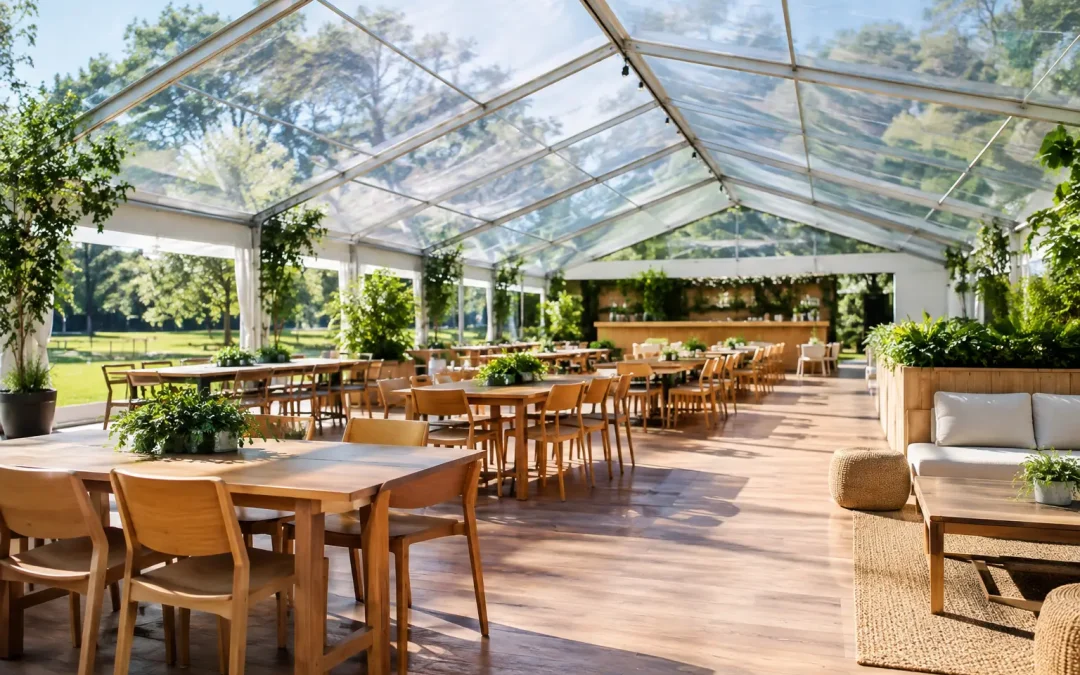
A temporary venue can look immaculate on opening morning while carrying an unnecessarily heavy environmental footprint behind the scenes. The lorries, generators, ground preparation, fit-out materials and end-of-show clear-down all count. For professional organisers, marquee sustainability trends are therefore becoming less about a single ‘green’ product and more about making better operational decisions from the first site meeting onwards.
That shift is welcome, but it needs a practical approach. A sustainable choice on paper is not always the right choice for an exposed site, a tight build window or an event with thousands of visitors. The strongest plans reduce avoidable impact while protecting safety, guest experience and delivery certainty.
Marquee sustainability trends start with better planning
A temporary structure should not be treated as a blank canvas that can be redesigned repeatedly once the build has begun. Late changes create additional vehicle movements, rushed procurement, wasted materials and pressure on crews. They can also compromise an otherwise efficient site layout.
Early technical planning is one of the most effective sustainability measures available. It allows the event team to assess access routes, ground conditions, build sequence, welfare requirements, service runs and emergency egress before equipment is dispatched. It also helps establish the right footprint. Hiring a structure that is significantly larger than operationally required wastes heating, lighting and flooring capacity, while an undersized structure often leads to costly and impractical additions.
The question is not simply, ‘What size marquee will fit?’ It is, ‘What is the minimum infrastructure needed to run this event safely and well?’
1. Reusable structures are replacing one-off solutions
The marquee industry has always had an inherent advantage over permanent construction: a quality temporary structure is used repeatedly across many events. The sustainability benefit, however, depends on extending that life through correct handling, maintenance and storage.
Modular clearspan structures can be configured for hospitality, exhibition, production, catering, welfare and back-of-house functions without commissioning a new build for every requirement. Internal walls, doors, linings, flooring and lighting can also be selected as reusable components rather than disposable event dressing.
This does not mean every element can be reused indefinitely. Some branding, graphics and soft furnishings may have a shorter useful life. The sensible target is to identify which elements must be event-specific and make the core infrastructure work hard across multiple projects.
2. Energy planning is moving beyond generator size
Power remains one of the most visible challenges on temporary event sites. A generator that is too large can run inefficiently, while a generator that is too small risks disruption to catering, production or safety-critical systems. The answer is not simply to specify the newest available unit. It starts with an accurate load schedule.
Organisers are increasingly separating essential and non-essential loads, identifying peak demand and scheduling equipment use. Heating, catering, AV, refrigeration and site lighting should be considered together rather than added in isolation by different suppliers. This gives the infrastructure team a clearer basis for selecting generator capacity, battery support or an available mains connection.
LED lighting, zoned circuits, timed controls and appropriately specified heating and cooling all make a material difference. Yet comfort cannot be ignored. At a winter reception or an agricultural show in poor weather, reducing heating at the expense of guest welfare is not a credible sustainability plan. Better insulation, sensible entrance arrangements and tighter control of the heated area are usually more effective than asking people to tolerate a cold venue.
3. Transport and site logistics are becoming part of the carbon conversation
A large event rarely arrives in one vehicle. Structure, flooring, furniture, power equipment, toilets, fencing and branding can generate substantial movement if deliveries are poorly coordinated. Consolidated loads and a realistic build programme can reduce unnecessary journeys without placing unreasonable pressure on access routes or crews.
This is particularly relevant for rural estates, city-centre locations and live public environments where vehicle access may be limited to specific hours. A plan that reduces lorry movements but leaves no contingency for weather, traffic or restricted loading slots is fragile. Operational resilience still comes first.
The practical opportunity is to coordinate suppliers around a single site logistics plan: designated delivery zones, timed arrivals, shared lifting equipment where appropriate, clear vehicle routes and an agreed collection sequence. Fewer aborted visits and less waiting with engines running benefit both the site and the programme.
4. Ground protection is being specified earlier
Ground conditions determine far more than whether a marquee can be built. They affect vehicle access, surface damage, drainage, pedestrian safety and the amount of reinstatement required after the event. On grassland, parkland and agricultural sites, ground protection is now rightly considered as part of the initial design rather than an emergency response after rain.
Appropriate trackway and pedestrian flooring can protect sensitive surfaces, reduce mud transfer into public areas and provide a safer route for guests, crew and service vehicles. The correct solution depends on soil type, anticipated traffic, gradients, weather exposure and the duration of the event.
There is a trade-off. Installing extensive protection uses material and transport capacity. But where it prevents turf damage, limits recovery works and allows a site to remain usable, it can be the lower-impact decision over the full event cycle. The key is proportionate specification, not blanket coverage.
5. Circular fit-out is challenging disposable event culture
The drive for polished, branded environments can create a surprising amount of short-life material. Single-use carpets, foam boards, vinyl graphics and custom-built decorative features are often difficult to recover or reuse once the event closes.
A more circular fit-out starts with design decisions. Can floor coverings be hired, retained for future use or selected for recycling routes? Can signs use interchangeable panels rather than a completely new frame? Can event branding be designed to work across a season rather than a single date? These questions need to be raised while creative concepts are still flexible.
For premium hospitality and broadcast environments, visual standards remain high. Reuse does not have to look compromised. It does require production, creative and infrastructure teams to agree dimensions, finishes and fixing methods early enough to avoid last-minute fabrication.
6. Waste plans are extending beyond the public-facing bins
Visitor recycling points matter, but they are only one part of event waste management. Significant volumes can arise during the build and clear-down through packaging, cable ties, protective wrapping, catering supplies and surplus fit-out materials.
A useful waste plan identifies likely waste streams before site opens, provides practical segregation space for contractors and appoints clear ownership for collection. If recycling facilities are placed where nobody working on the build can reach them, they will not perform as intended. Equally, a supplier should not be expected to retain materials that the client has no plan to collect or reuse.
Food service is another area where operational detail matters. Water refill points, appropriately sized catering back-of-house areas and collection arrangements can reduce waste, but only if they are integrated with guest flow and servicing access.
7. Measurement is becoming more credible, and more useful
Clients increasingly ask for evidence behind sustainability claims. This is a positive development, provided reporting is based on information that can actually be measured and improved. Vehicle movements, generator run hours, fuel use, material reuse, waste volumes and mains power consumption are all useful starting points.
Not every event needs a complex carbon assessment. A smaller corporate gathering and a multi-day public show have very different reporting needs. What matters is establishing a sensible baseline, recording key delivery data and using it to improve the next event. A claimed reduction without a defined scope can be misleading; a clear record of fewer vehicle movements or reduced generator hours is far more valuable.
At Purvis Marquee Hire, that means treating sustainability as part of project delivery: asking the operational questions early, specifying infrastructure to suit the site, and keeping the build practical under live-event conditions.
Make the next brief more specific
The most useful sustainability brief is not a demand for ‘eco-friendly’ infrastructure. It sets priorities: protect this ground, reduce generator running, minimise deliveries, reuse branding where possible, record waste, maintain guest comfort and preserve a safe working site. Give the project team those parameters early, and they can turn broad intent into decisions that hold up when the first lorry arrives and the weather changes.