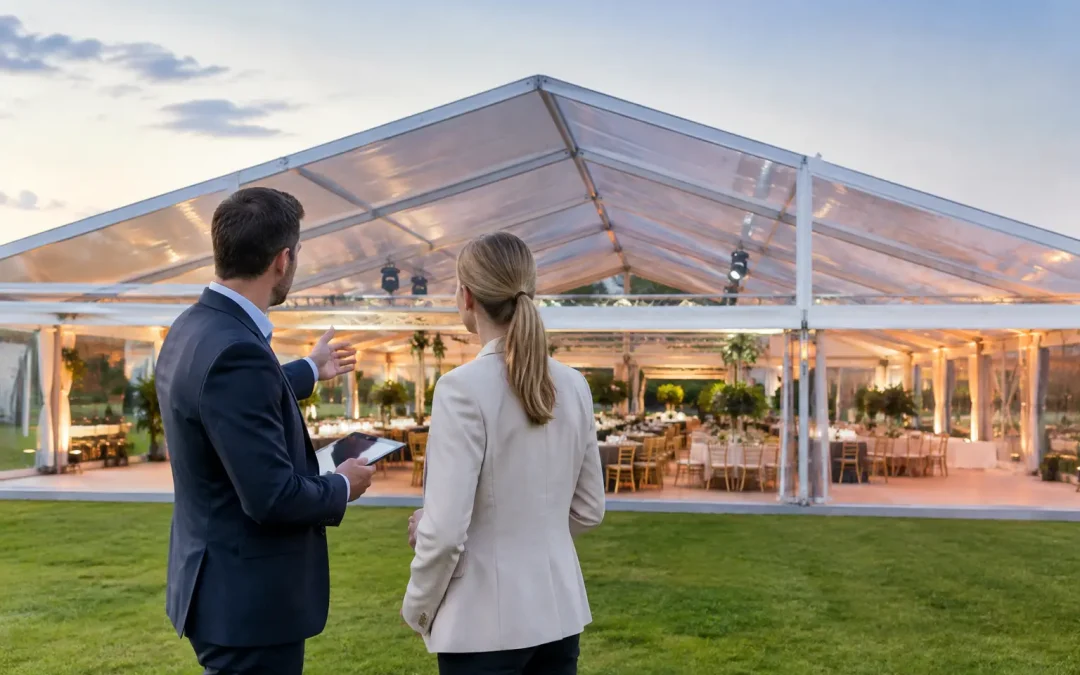
A temporary structure can be on site for only a few days, but the risk around it begins long before the first lorry arrives. Marquee insurance requirements are not a standard tick-box exercise for major events. They need to reflect the structure, the site, the build programme, the public, the suppliers working within it and the contractual responsibilities agreed between all parties.
For event managers, venues and production teams, the key issue is not simply whether insurance is in place. It is whether each risk has a clearly identified owner, sufficient cover and evidence that can stand up to scrutiny from a landowner, local authority, venue, client or insurer.
Why marquee insurance requirements need project planning
A large marquee is part of a wider temporary event environment. It may include raised flooring, power distribution, catering areas, heating, toilets, fencing, branded finishes and high volumes of guest traffic. On an exposed agricultural site, a city-centre footprint or a heritage venue, the risk profile can change significantly.
That is why a generic certificate of insurance rarely tells the full story. A policy may provide public liability cover, for example, but the organiser still needs to understand the indemnity limit, any exclusions, the insured activities and whether the policy applies to the particular event, location and operational period.
Insurance should be considered alongside the site plan, construction phase plan where applicable, risk assessments, method statements, traffic management arrangements and emergency procedures. These documents do different jobs. Safety documentation helps demonstrate that risks have been assessed and controlled; insurance responds if an insured loss or claim arises. One does not replace the other.
The core cover to establish
The exact insurance arrangement depends on the contract and the event model. A corporate garden party with a managed guest list is different from a public festival, agricultural show or televised sporting event. However, several areas normally require early clarification.
Public liability insurance
Public liability insurance is usually the first document requested by venues, landowners and event organisers. It is intended to cover legal liability for injury to third parties or damage to third-party property arising from the insured party’s operations.
For a marquee project, there may be separate public liability policies held by the organiser, marquee contractor, caterer, production supplier, security provider and other specialist contractors. Each party should be responsible for its own work and staff. The organiser’s policy should not be treated as a substitute for a contractor maintaining suitable cover, and vice versa.
The required indemnity limit will often be set by the venue or client contract. Higher-profile public events, local authority sites and busy urban locations may require a higher limit than a private event. Check the requirement before appointment, rather than discovering it during the build when a supplier’s policy cannot meet it.
Employers’ liability insurance
Any business employing staff will generally need employers’ liability insurance, subject to limited legal exceptions. This matters during the build and breakdown as much as during live operation. Marquee installation involves physical work, plant movement, loading, working at height in some circumstances and changing site conditions.
Organisers should obtain evidence from contractors, but should also make sure the workforce plan is realistic. Insurance cannot compensate for poor site coordination. Segregated vehicle routes, controlled unloading zones, competent supervision and clear communications remain fundamental controls.
Cover for the structure, equipment and hired-in items
Responsibility for the marquee, flooring, furniture, lighting, generators and other equipment should be explicit in the hire agreement. A supplier may insure its own stock, while the hirer may remain liable for loss or damage in its care, custody or control. This can vary considerably between contracts.
Ask what happens if equipment is damaged by a guest, a vehicle, a third-party contractor or severe weather. Also establish who is responsible if access restrictions delay collection, or if the site cannot be safely entered after an event. These details are particularly relevant where a build includes expensive interior finishes, temporary power systems or equipment supplied by multiple parties.
Event cancellation and disruption cover
Cancellation insurance is not a replacement for good contingency planning, but it can be relevant where significant revenue, ticket sales, sponsorship commitments or non-recoverable costs are at stake. Cover may be considered for cancellation, abandonment, curtailment or postponement caused by specified circumstances.
Terms matter here. Weather, communicable disease, supplier failure, civil authority action and terrorism may be treated differently, limited or excluded depending on the policy. Event teams should involve their broker early and avoid assuming that a difficult operating day will automatically be insured.
Weather, ground conditions and site damage
Scotland and the north of England offer outstanding event settings, but sites can be exposed to wind, heavy rain and soft ground. These conditions affect not only the safe use of a marquee, but also insurance exposure and the likelihood of damage claims.
A proper pre-event survey should identify ground bearing capacity, underground services, slope, drainage, access routes and any restrictions on staking or anchoring. If the ground cannot be penetrated, ballasting may be required, which changes transport, lifting and footprint considerations. Where heavy vehicles are necessary, ground protection and a planned delivery sequence can prevent avoidable damage to lawns, parkland and hardstanding.
Responsibility for reinstatement should be agreed with the landowner. Damage to turf, utilities, gates, kerbs or historic surfaces can become a costly issue after the event if photographic records, access routes and responsibilities were not established at the outset.
Evidence clients and venues commonly request
Documentation requirements differ, but experienced event buyers will usually ask for more than a policy schedule. They need confidence that the proposed infrastructure can be built and operated safely within the site rules.
Before work begins, the project file may need to include:
- current public and employers’ liability certificates from relevant contractors;
- risk assessments and method statements for build, breakdown and operational activities;
- structural information for the proposed marquee and any temporary flooring or platforms;
- fire safety information, emergency access plans and occupancy considerations;
- electrical certification and plans for temporary power distribution; and
- traffic, delivery and pedestrian management arrangements.
The value of this information is in the coordination. A fire plan that does not match the final layout, or an access plan that ignores the turning requirements of articulated lorries, creates a problem regardless of how comprehensive the insurance certificate appears.
Avoid gaps between organiser and contractor responsibilities
The most common insurance issue is not necessarily inadequate cover. It is uncertainty over who was responsible for a particular part of the operation.
Consider a catering contractor fixing equipment to a marquee frame, an AV supplier running cables across an entrance route, or a client team bringing in displays after the structure has been handed over. Each change can alter the risk. It should be reviewed, approved where necessary and recorded. Temporary structures are carefully engineered systems, not blank spaces for uncontrolled additions.
The contract should distinguish between the supplier’s installation responsibilities and the organiser’s operational responsibilities once the space is in use. It should also set out processes for reporting damage, managing adverse weather, restricting unauthorised access and approving alterations. Where several contractors share the site, a coordinated programme and named on-site contacts are essential.
For complex projects, it is sensible to discuss insurance responsibilities during the design stage, not after the layout is signed off. Purvis Marquee Hire approaches this alongside practical matters such as access, build sequencing, safety documentation and site management, because the best time to resolve a risk is before it becomes an on-site constraint.
A practical check before committing to a build
Before confirming a marquee package, event teams should be able to answer a few straightforward questions. Who insures the structure and hired equipment? What cover does the organiser need to hold? Do every contractor’s liability limits meet the venue’s requirement? What happens if weather, ground conditions or site access disrupt the programme? And who has authority to make decisions on site?
The answers should be documented in the contract and reflected in the operational plan. If a requirement is unclear, ask the insurer or broker rather than relying on a previous event’s arrangements. Similar-looking projects can carry very different risks.
A well-insured event is not one with the largest pile of certificates. It is one where the structure, the people, the site and the responsibilities have been properly planned, with no uncertainty left waiting at the gate on build day.