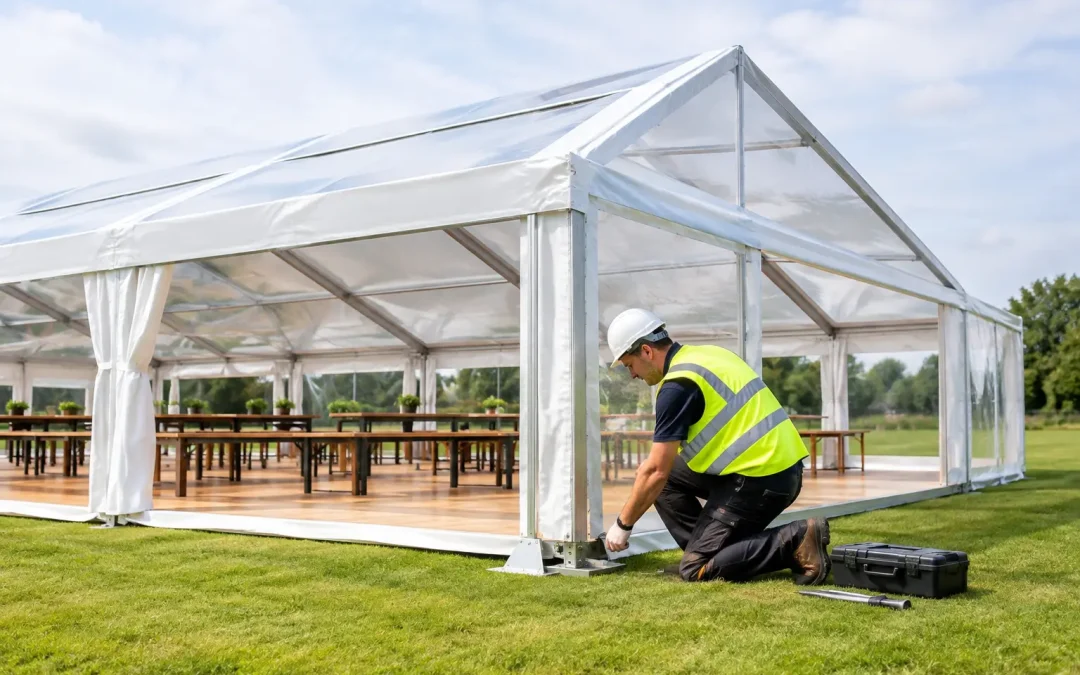
A structure can look complete, signed off and ready for guests, then become the most urgent item on site when the wind rises, ground softens or an unauthorised vehicle reaches the build area. Knowing how to secure temporary structures is therefore not simply a question of adding ballast or closing a gate. It is a planned process that starts before the first lorry arrives and continues until the last component leaves site.
For major events, temporary structures must work alongside public movement, service access, production schedules, utilities and changing weather. The right approach protects people, preserves the programme and gives organisers clear control when conditions change.
Start with the site, not the structure
Security and stability are dictated by the site as much as the marquee, temporary building or covered walkway itself. A detailed pre-build survey should establish the ground conditions, slopes, underground services, drainage routes, overhead hazards, vehicle access and likely public interfaces.
Ground that appears firm in a dry site visit may behave very differently after several days of rain and repeated plant movements. Similarly, a hardstanding area may prevent conventional staking, requiring ballast calculations and a layout that takes account of load limits, kerbs, drainage channels and existing infrastructure. There is no universal fixing method that suits every location.
The survey should also identify where the site is exposed. Open showgrounds, coastal venues, hilltop sites and city-centre squares each create different wind effects. Nearby buildings can provide shelter, but they can also channel gusts around corners and through access routes. Build teams need this information before deciding structure orientation, anchoring arrangements, door locations and emergency procedures.
How to secure temporary structures through proper anchoring
Anchoring is the primary defence against uplift and movement, but it must be designed for the specific structure and conditions. The manufacturer’s instructions, engineering information and approved loading requirements should always lead the decision.
On suitable grass, soil or agricultural ground, ground anchors or stakes may be used where permitted and where service searches confirm the area is clear. Their depth, spacing and holding capacity matter. A stake placed into shallow, disturbed or waterlogged ground cannot be treated as equivalent to one installed in verified, stable soil.
Where stakes are not possible, ballast may be required. Concrete blocks, water weights and other approved systems must be correctly positioned and connected, with the total ballast allowance calculated rather than estimated. Ballast is not a cosmetic precaution. It is part of the structural system, and it must not be moved later to make room for catering units, branding or vehicle routes without technical approval.
Mixed sites are common. A structure may sit partly on grass and partly on tarmac, or require different fixing methods across its footprint. In these situations, an experienced supplier should develop a coherent arrangement rather than treating each leg in isolation. The load path across the full structure needs to remain clear and consistent.
Treat wind as an operational risk
Wind management is often where strong site planning separates a controlled event from a reactive one. The structure may be engineered to a stated wind speed, but the operational plan must explain what happens well before that limit is reached.
A sensible wind plan includes a reliable weather forecast, site-specific monitoring, nominated decision-makers and agreed actions at defined thresholds. These actions may include closing doors, lowering or removing temporary signage, securing loose furnishings, stopping work at height, clearing exterior areas or moving guests away from glazed or open-sided spaces.
The condition of the structure should be inspected throughout the event, not only at handover. Crews should look for loosened tensioning, movement at anchoring points, pooling water, damaged fabric, unsecured doors and items that could become airborne. Flags, fascia panels, temporary branding, heaters, furniture and waste containers all add to the risk picture in strong winds.
Do not assume that a fully enclosed marquee is automatically safer in every condition. Closed sides can alter wind loading, while open entrances can create localised pressure changes. The correct configuration depends on the structure design and prevailing conditions, so changes should be authorised by the responsible technical team.
Control access around the build and event footprint
A temporary structure cannot be considered secure if vehicles, contractors or members of the public can interfere with its anchoring, fabric or emergency exits. Site security begins with a clear boundary around the working area and a practical plan for managing access.
During build and breakdown, this normally means segregating pedestrians from plant and lorry movements, using barriers, marshals and timed delivery slots. The build zone should allow enough room for lifting, unloading and safe assembly without forcing crews to work around parked vehicles or through public routes.
Once the event is live, the focus shifts to controlled entry, emergency egress and protection of back-of-house areas. Doors, service entrances and perimeter fencing should support the event’s security operation without obstructing escape routes. Cable routes, generator compounds, plant rooms and storage areas also need protection from public access and accidental damage.
For high-footfall events, consider how queues will form outside the structure. A crowd pressing against an entrance, particularly in poor weather, can affect door operation and block circulation. Queue lanes, stewarding positions and weather cover should be part of the site layout from the outset, not added after the gates open.
Secure the details that affect safe operation
The main frame attracts attention, but many failures begin with smaller items left unmanaged. Temporary flooring must be level, properly connected and suitable for expected traffic, including wheelchairs, trolleys, service equipment and high heels where relevant. Ramped transitions need to remain clear and stable as ground conditions change.
Electrical distribution should be installed, tested and protected against water ingress, vehicle damage and unauthorised access. Cables crossing pedestrian routes require suitable protection, while generators and fuel arrangements must be positioned with fire safety, ventilation, noise and service access in mind.
Heating, cooling and catering equipment create further interfaces. Ducting, fuel lines, flues and external plant must be restrained and kept clear of exits. Internal layouts should retain the circulation widths required for guests, staff and emergency evacuation, even after furniture, production equipment and last-minute branding have been installed.
Fire points, emergency lighting, exit signs and escape routes must remain visible and accessible throughout the event. This sounds straightforward, but a late delivery, a photo backdrop or stacked hospitality stock can quickly compromise a route that was clear at the original inspection.
Build inspection into the programme
A secure temporary structure is the result of disciplined checks. Before handover, the delivery team should inspect the frame, anchoring, covers, doors, flooring, electrical systems, exits and surrounding site conditions. The event organiser should know who has responsibility for the structure after handover, who can approve changes and how concerns are reported.
Documentation is valuable when it reflects the real site. Depending on the project, this may include risk assessments, method statements, structural information, fire planning, electrical certification, site plans and inspection records. These documents should be available to the people who need them, including venue teams, local authorities and event control, rather than sitting unread in a folder.
Daily checks are particularly valuable on multi-day events, festival sites and agricultural shows. Rain, wind, vehicle activity and high attendance can change conditions quickly. A brief walk-round at the start and end of each day gives the team an opportunity to spot issues while they are still straightforward to resolve.
Assign clear responsibility when conditions change
The most detailed plan still needs people who can make decisions on site. Agree in advance who monitors weather, who contacts the structure provider, who controls public access and who has authority to pause activity or evacuate an area. If the decision chain is unclear, valuable minutes can be lost when conditions deteriorate.
This is where a full-service infrastructure partner adds practical value. At Purvis Marquee Hire, build management is treated as part of the delivery, not an add-on after the structure is standing. The aim is to ensure that the marquee, site logistics, utilities and safety arrangements operate as one coordinated system.
The best time to secure a temporary structure is before an issue has appeared on the forecast or the site radio. Give the build team accurate event information, protect the approved layout from casual changes and keep a trained eye on the conditions around the structure. That preparation leaves everyone free to focus on the event itself.