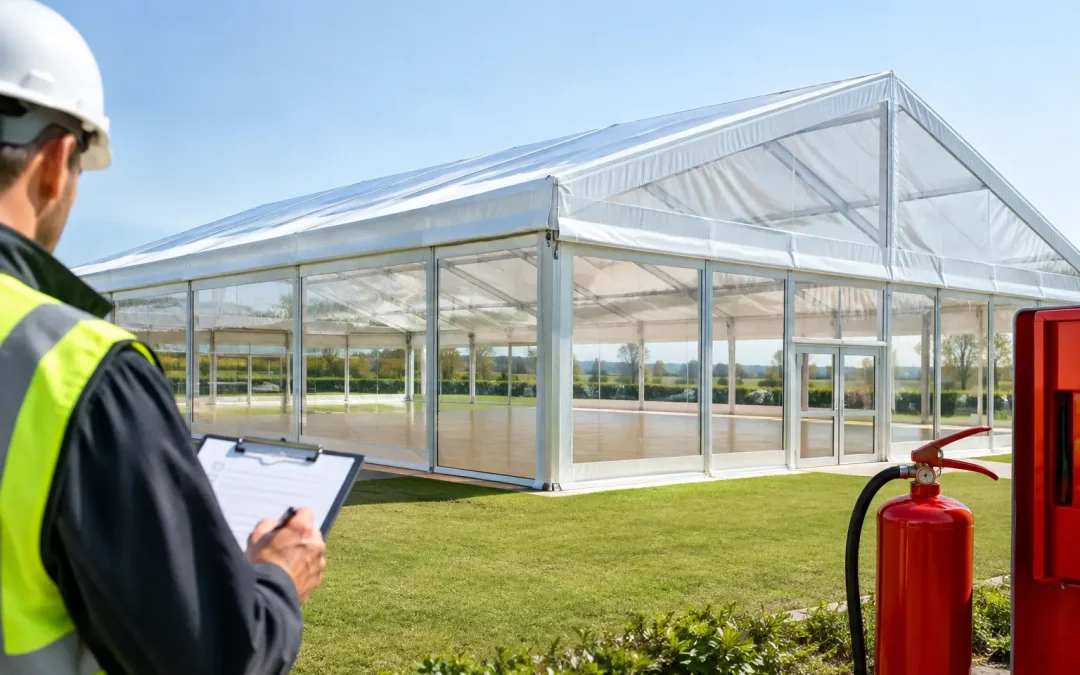
A marquee may look like a straightforward temporary structure, but its fire performance is a live operational issue from the first site plan to the final breakdown. When organisers ask, how are marquees fire rated, they are usually asking two related questions: whether the structure’s fabric has been tested for flame resistance, and whether the finished event environment can be operated safely if a fire occurs.
Those are not the same thing. A certificate for the roof and wall material is essential, but it does not make an event fire-safe on its own. Heating, catering, electrical distribution, escape routes, occupancy, furnishings and the site layout all affect the real-world risk.
What “fire rated” means for a marquee
In event infrastructure, a fire-rated marquee generally refers to a structure made with flame-retardant textile fabric that has been tested to an applicable recognised standard. For temporary marquees in the UK, certification to BS 7837 is commonly requested. This standard concerns the flammability of textile fabrics used in the manufacture of tents, marquees and similar temporary structures.
The practical point is that flame-retardant material is intended to resist ignition and limit the spread of flame when exposed to a small ignition source. It is not non-combustible, and it is not a guarantee that a fire cannot start or develop elsewhere in the structure.
That distinction matters on busy sites. A clearspan marquee with certified PVC fabric can still become an unsafe environment if exits are blocked by furniture, catering equipment is poorly positioned, electrical equipment is damaged, or internal linings and décor have not been considered within the fire plan.
Fire resistance is not the same as fireproof
“Fireproof” is a phrase best avoided in event planning. A marquee fabric can be flame retardant, but it remains part of a temporary structure containing other materials, people and ignition sources. Flooring, furniture, bars, signage, exhibition stands, drapes, generators and temporary kitchens must all be assessed as part of the wider installation.
For a small private gathering, the risk profile may be relatively simple. For a public event, agricultural show, festival hospitality area or city-centre installation, the standard of planning needs to rise accordingly. Attendance numbers, restricted access, high winds, overnight use and multiple contractors all add operational considerations.
How are marquees fire rated in practice?
The process starts with the manufacturer or supplier. The roof, walls and associated fabric components should be supplied with current flame-retardancy certification relevant to the material being installed. Event organisers, venues and licensing teams may ask to see this evidence as part of the event safety file.
A professional supplier should be able to identify the fabric specification and provide documentation for the structure being used. This is particularly important where several structures, bespoke linings, connecting walkways or older stock are involved. Documentation should be checked before build, rather than requested when the site is already live.
However, certification is only one layer of control. The final temporary structure must also be planned around safe evacuation and managed in accordance with the event’s fire risk assessment. Depending on the location and event type, this may sit within venue requirements, local authority licensing conditions, landowner rules, insurer expectations and the relevant fire-safety legislation.
In Scotland, organisers should consider their duties under the Fire (Scotland) Act 2005 and associated fire safety regulations. In England and Wales, the Regulatory Reform (Fire Safety) Order 2005 is commonly relevant. The responsible person and the precise obligations will depend on the event arrangement, but the underlying principle is consistent: risks must be identified, reduced so far as reasonably practicable and properly managed.
The structure is only one part of the fire strategy
A credible fire strategy for a marquee considers how people enter, use and leave the space. It also considers how emergency services would reach the site, particularly on rural estates, uneven showgrounds or constrained urban locations.
Escape routes and exit provision
Exit positions and widths need to suit the anticipated occupancy, use of the space and layout of tables, bars, exhibition stands or seating. Routes should be direct, clearly signed and kept free from stored equipment, queue barriers and decorative features.
For larger events, exit doors may need panic hardware, emergency lighting and visible signage. The exact provision depends on the risk assessment and event plan, but the operational rule is simple: nobody should need to search for a way out or negotiate an obstacle to reach it.
The layout can change quickly during fit-out. A final walk-through after furniture, branding and production equipment are in place is therefore as important as reviewing the drawing at the planning stage.
Heating, cooking and power
Heating is a common concern in Scottish and northern English event seasons. Indirect-fired heaters are often selected because combustion takes place outside the occupied space, with warm air ducted into the marquee. This can reduce risk and improve comfort, but duct routes, fuel storage, refuelling arrangements and equipment clearances still need careful control.
Open-flame appliances and catering equipment demand particular attention. Cooking should be located and ventilated appropriately, with suitable extinguishers, trained operators and a clear separation from guest areas and escape routes. A temporary kitchen may require a more detailed assessment than the main marquee itself.
Electrical distribution should be designed for the expected load, protected from damage and installed by competent people. Cables crossing public routes need suitable protection, while generators must be positioned with access, noise, fumes, fuel and emergency response in mind. Improvised power arrangements are not acceptable on a live event site.
Furnishings, linings and temporary décor
The fire rating of the main canopy does not automatically extend to everything installed beneath it. Ceiling linings, drapes, stage backdrops, carpet, furniture covers, display materials and branded elements can all affect fire spread and smoke production.
Ask suppliers for flame-retardancy evidence where applicable, particularly for fabric décor and exhibition features. This is not simply a paperwork exercise. A heavily dressed awards dinner, for example, creates a different internal fire load from an open-sided reception structure with minimal furniture.
Documentation event teams should expect
For complex projects, fire safety should be visible within the wider event documentation rather than treated as a stand-alone certificate. A well-prepared package usually brings together the structural information, fire-risk controls, site plan and management arrangements.
Event teams should normally be able to account for the following:
- current flame-retardancy certification for marquee fabric and relevant internal materials;
- a site layout showing exits, emergency routes, fire points, catering areas and emergency vehicle access;
- a fire risk assessment proportionate to the event, attendance and activities;
- plans for emergency lighting, signage, extinguishers, alarms or communications where required; and
- named responsibilities for inspections, incident response and liaison with venue teams or emergency services.
The level of detail should reflect the event. A single hospitality marquee on a managed venue is not the same as a multi-structure public event with ticketed entry, temporary kitchens, production compounds and several thousand visitors. Good planning is proportionate, but it should never be casual.
Common gaps that create avoidable risk
The most frequent issue is assuming that a fabric certificate closes the matter. It does not. Fire safety can be undermined by late changes to the floorplan, unapproved décor, a catering contractor arriving with additional equipment, or an exit becoming a convenient place to store cases and stock.
Another gap is failing to account for site access. On a wet field or historic estate, a fire appliance route may be affected by ground conditions, parked vehicles, fencing and service runs. Access needs to be discussed early, not after the event footprint has been fixed.
Finally, do not overlook the build and de-rig phases. These periods can involve plant movement, temporary power, packaging waste and multiple trades working at pace. Housekeeping, smoking controls, welfare arrangements and clear contractor briefings are all part of responsible site management.
Build fire safety into the brief from day one
The best time to address fire provision is when the event footprint is still flexible. Share expected attendance, operating hours, catering requirements, production plans and site constraints with the marquee supplier at the outset. That allows the structure size, door positions, heating approach, power plan and emergency arrangements to work together rather than compete for space later.
At Purvis Marquee Hire, that joined-up approach is central to delivering large temporary environments under pressure. The marquee, flooring, power, heating, access and safety paperwork need to function as one managed installation, particularly where public safety and fixed deadlines leave no room for last-minute compromises.
A fire-rated fabric certificate is the right starting point. The safer outcome comes from turning that certificate into a properly planned, clearly managed event space that gives guests and crews a straightforward route to safety if it is ever needed.