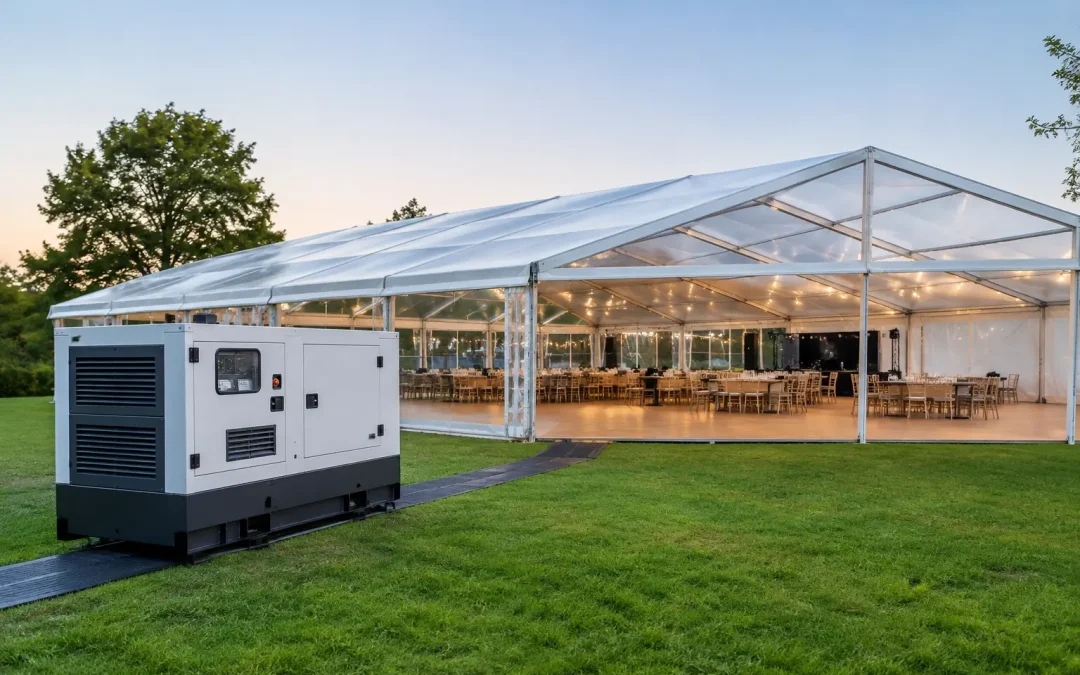
A generator that looks adequate on a hire schedule can become the weak point of an entire event build. When catering comes online, production adds temporary lighting, or a wet-weather plan changes the operating hours, power demand can move quickly. Knowing how to choose event generators starts with treating temporary power as a site-wide operational system, not a single piece of equipment.
For major events, the right decision affects public safety, build access, customer experience and the ability of every contractor to do their job. The generator itself matters, but so do distribution, cable routes, fuel management, noise control and a clear plan for what happens if equipment fails.
Start with a realistic load assessment
The first question is not how large the generator should be. It is what must be powered, when it will be powered, and how those demands overlap. A site may require power for a marquee, catering compound, production office, site lighting, toilets, ticketing, traders, security, refrigeration and AV. Each has a different usage pattern.
Ask suppliers for the running load and start-up load of every item, particularly motors, refrigeration, pumps and kitchen equipment. A catering unit may draw far more power as it starts than it does once operating. Likewise, lighting circuits and audio equipment have very different sensitivities to voltage variation.
A proper schedule separates essential and non-essential loads. Essential services might include emergency lighting, medical provision, site communications, refrigeration or safety-critical operations. This distinction informs the backup strategy and stops a fault in one area from affecting the whole site.
Avoid selecting a generator solely by adding up nameplate ratings. That approach can lead to an oversized unit running inefficiently, or an undersized unit that struggles under start-up demand. An experienced temporary-power provider will assess diversity, peak demand and the practical timing of each load before recommending capacity.
How to choose event generators for the site
Generator size must suit both the electrical requirement and the physical reality of the venue. A festival field, city-centre square, country estate and agricultural showground all create different constraints.
Consider where the generator can be delivered, positioned and refuelled. A large unit may provide useful capacity, but it is of little value if the access route has weak ground, tight gates, low branches or a conflict with public routes. Delivery vehicles, telehandlers and fuel bowsers need room to operate before, during and after the event.
The position should also account for prevailing wind, nearby accommodation, hospitality areas and neighbouring properties. Even a silenced generator produces sound, especially when several units are operating or when plant is placed on hardstanding that reflects noise. For corporate hospitality, ceremonies and broadcast environments, locate power generation well away from guest-facing spaces where possible.
Cable distance is another practical factor. Placing a generator far from the point of use can increase cable runs, introduce crossing points and complicate voltage management. The most efficient arrangement is not always one central generator. Larger sites may benefit from zoned generation or separate supplies for production, catering and public infrastructure.
Plan distribution, not just generation
A generator does not deliver safe usable power on its own. Temporary distribution must be designed around the event layout, load profile and public movement.
Distribution boards should be correctly rated, protected and positioned where authorised personnel can access them without creating an obstacle. Cable routes need to be planned alongside pedestrian paths, vehicle tracks, emergency access lanes and marquee entrances. Where cables cross routes, suitable protection is required, but cable ramps are not a solution for every situation. They can create a trip risk, restrict wheelchair access or become displaced by repeated vehicle movements.
This is why temporary power planning belongs within the wider site plan. The teams responsible for marquees, flooring, fencing, welfare, production and traffic management should be working from the same layout. A late change to a marquee entrance, bar position or vehicle gate can have consequences for power distribution that are easy to miss on paper.
All temporary electrical work should be installed, inspected and managed by competent professionals, with the necessary documentation available for organisers, venues, insurers and local authorities. For public events, clear ownership of the power system is essential. Everyone on site should know who can isolate a circuit, who responds to a fault and how changes are approved.
Build resilience into critical operations
The appropriate level of backup depends on the consequences of losing power. A daytime food festival with modest infrastructure may need a different approach from a high-profile evening reception, televised event or ticketed festival operating across several days.
For critical loads, consider standby generation, automatic transfer arrangements or separate generator supplies. Redundancy costs money and takes additional site space, but it can be the difference between a controlled interruption and a serious operational problem. It is especially relevant where failure could affect public safety, food storage, broadcast output, security systems or a live programme.
Do not assume that one large generator is automatically the most resilient option. It may be efficient for a stable, centralised load, but it can also create a single point of failure. Multiple generators can provide better separation and allow selected areas to remain operational during maintenance or a fault. The trade-off is greater complexity in fuel, distribution and coordination.
A sound contingency plan should cover more than equipment failure. It should include a named response team, spare components where appropriate, access for engineers, controlled isolation procedures and realistic recovery times. Test key systems before doors open, rather than discovering a problem when a caterer switches on a bank of ovens.
Factor in fuel, running hours and environmental control
Generator hire should include a clear fuel plan. Establish the expected running hours, estimated consumption at the anticipated load and the trigger point for refuelling. Fuel deliveries need to be scheduled around public opening hours, vehicle restrictions and secure access to the plant area.
Running a generator with too little fuel is an avoidable failure. Over-ordering and leaving poorly planned fuel logistics can be equally costly. For multi-day events, remote fuel monitoring or scheduled checks provide greater control, particularly where plant is spread across a large site.
Environmental considerations also influence selection. Modern, appropriately sized equipment can reduce unnecessary fuel use and noise. Hybrid or battery-supported solutions may suit low-load or overnight periods, although they are not a substitute for conventional generation where sustained high demand is expected. The right solution depends on the event programme, required load and the practical opportunity to recharge or refuel.
Where generators are near public areas or structures, manage exhaust direction, ventilation and barriers carefully. Plant compounds should be secure, clearly separated from guests and positioned so that heat, fumes and noise do not compromise the event environment.
Ask the questions that reveal delivery capability
When comparing quotes, the cheapest generator rate rarely tells the full story. Ask whether the supplier has allowed for cable lengths, distribution boards, installation, testing, fuel, call-out cover, collection timing and out-of-hours support. Establish who is responsible for calculating the load, signing off the temporary installation and managing changes on site.
It is also worth asking how the supplier will work around your build sequence. Power often needs to be available in stages: first for construction, then for fit-out, catering and production, followed by live-event operation. A delivery partner should understand that a generator arriving on site is only the beginning. It must be placed safely, connected at the right time and supported through derig without blocking other contractors.
At Purvis Marquee Hire, temporary power is considered alongside the structure, flooring, lighting, site access and operational layout from the outset. That joined-up planning reduces late changes and helps ensure the finished site works as it should under live conditions.
The best generator choice is one that gives your event enough capacity without adding avoidable cost, noise or site complexity. Build the decision around the real programme, real loads and real access constraints, then leave enough margin and support for the moments when the plan changes.