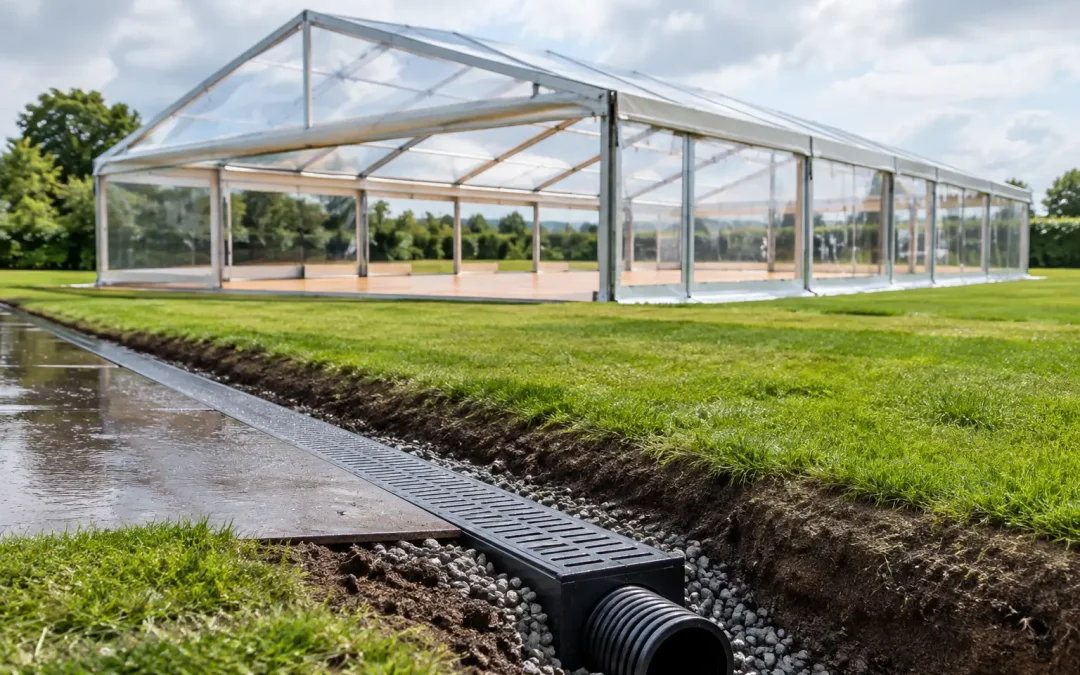
A marquee can be fully weatherproof and still fail operationally if the ground around it is holding water. Pooled rain at an entrance, a saturated service road or run-off directed towards the structure can quickly affect guest access, crew safety and the condition of the event space. Knowing how to plan marquee drainage means treating water management as part of the site design from the first survey, rather than as a response to a poor forecast.
For major events, drainage planning is rarely about one measure in isolation. It is about understanding the ground, retaining clear routes for people and vehicles, protecting the structure’s perimeter and agreeing a practical response if conditions deteriorate during the build or live event.
Start with the site, not the marquee layout
The natural fall of the site should shape the layout from the outset. Water follows levels, low points and existing channels, whether that is a shallow dip in a showground, a camber across a tarmac surface or a slope leading away from a hardstanding. A site that appears level from a distance can behave very differently after sustained rainfall.
A proper survey should identify where water is likely to arrive from, where it can collect and where it can safely leave the event footprint. Existing gullies, ditches, drainage runs and field drains may all be relevant, but they should never be assumed to have enough capacity for a large temporary event. Their condition, ownership and permitted use need checking before they form part of the plan.
Survey in realistic conditions
Where possible, review the site after rain or speak with the venue team, landowner and regular users about historic wet-weather issues. Agricultural showgrounds, parks and estates often have well-known areas that become soft or flood first. That local knowledge can prevent a costly repositioning of a marquee or entrance later in the programme.
The survey should also account for the construction phase. Lorries, forklifts, plant and delivery vehicles can compact grass and soil, creating ruts that hold water. A route that is workable on day one may become unusable after repeated traffic, particularly if the build overlaps with rainfall.
Keep access routes above the problem
Guest entrances, emergency exits, accessible routes and key back-of-house doors should not sit at the bottom of a slope or directly in a run-off path. If the preferred event layout places an entrance in a vulnerable position, it may be more cost-effective to move it than to engineer a solution around it.
The same applies to catering access, generator compounds, welfare facilities and production areas. These operational zones generate frequent traffic and need stable, safe footing throughout the event. Water at the wrong point can delay servicing, create slips or restrict emergency access.
Build drainage into the wider ground plan
The right solution depends on the event duration, site surface, anticipated footfall and weather exposure. A one-day corporate event on a drained hardstanding needs a different approach from a multi-day festival on grass in autumn. The aim is not necessarily to remove every drop of water from a site. It is to control how water moves and ensure it does not compromise the event operation.
Start by setting the marquee in the strongest available position. Avoid natural hollows and leave suitable space around the structure for perimeter access, gutter discharge and any temporary drainage measures. A tightly packed event footprint can leave nowhere for water to go except towards doors, service areas and adjoining structures.
Gutters and downpipes require particular attention on larger structures. A substantial roof area sheds a considerable volume of water in a short period during heavy rain. Water must be directed away from entrances and not discharged onto a pedestrian route, a neighbouring roof or an area where it will erode exposed ground. Controlled discharge points, temporary channels or collection arrangements may be appropriate, depending on the site and drainage permissions.
Ground protection and flooring are part of the drainage conversation, not simply an aesthetic choice. Trackway can preserve vehicle routes and reduce rutting, while suitable pedestrian flooring can keep guests above wet or softened ground. Within the structure, raised cassette flooring or sub-floor systems may provide a level, dry event surface where the ground is uneven or susceptible to moisture. These measures improve usability, but they do not remove the need to manage water beyond the marquee walls.
Where the ground is particularly wet, shallow temporary channels, pumps or sump arrangements may be considered. These need experienced planning. Any pumping arrangement must have a reliable power supply, appropriate supervision and an agreed discharge location. Pumping water into an unsuitable area simply moves the problem, and may create an environmental or land-management issue.
Protect the structure and the people using it
Marquee drainage is as much a safety issue as a comfort issue. Water pooling close to sidewalls can soften ground around anchoring points, undermine routes and make routine inspections more difficult. Standing water near electrical distribution, generators or temporary lighting also needs careful management through the project’s electrical and safety planning.
Do not rely on the marquee skirt to contain or divert water. The structure should remain properly tensioned and its perimeter kept clear, but water management needs to happen in the surrounding site design. Where a surface is impermeable, such as tarmac or concrete, run-off may travel faster and collect at thresholds. On grass, the challenge may be saturation and loss of bearing capacity. Both conditions demand different controls.
For public-facing events, consider the full visitor journey. A dry reception area has limited value if guests have to cross a muddy approach, queue in surface water or use an accessible route that becomes difficult for wheelchairs and pushchairs. Matting, trackway, handrails, covered walkways and clear route management may all form part of the answer, depending on the venue and audience.
Agree contingencies before the forecast changes
The best time to decide who will respond to heavy rain is before the build begins. Drainage controls should sit within the site plan, method statements and event operations plan, with clear responsibilities between the organiser, venue, ground contractor and marquee supplier.
A practical wet-weather plan should confirm the trigger points for action. This may include an agreed rainfall forecast, visible ponding at key locations, declining ground conditions on vehicle routes or rising water in a ditch or drain. It should also state who can authorise changes, such as closing a vehicle route, adding trackway, moving a queue line or deploying pumps.
The on-site team needs enough time and resource to act. Keeping a few spare metres of ground protection, suitable squeegees, drainage channels and additional matting can be sensible for exposed sites, but contingency stock should be proportionate to the risk. For a high-profile event with fixed opening times, a more developed response plan is justified. For a short event on a proven hardstanding, the priority may simply be monitoring gullies and keeping thresholds clear.
A useful site pack should include:
- a drainage and surface-water plan showing falls, discharge points and no-go areas;
- contact details for the venue, landowner, site manager and relevant drainage contractor;
- inspection records for entrances, vehicle routes, electrical areas and perimeter channels; and
- an escalation plan for severe weather, including decisions on vehicle movement and public access.
This level of preparation helps the whole delivery team make consistent decisions under pressure. It also avoids last-minute work that can damage a site, disrupt a build schedule or introduce unnecessary risk.
Plan for reinstatement as well as the event
Water management does not stop when guests leave. Temporary channels, trackway and concentrated footfall can all affect the ground, particularly on parks, estates and agricultural land. Agree reinstatement expectations before the event, including how damaged turf, compacted areas and temporary drainage measures will be dealt with.
At Purvis Marquee Hire, drainage is considered alongside structure positioning, vehicle access, flooring and live-site management. That joined-up approach is particularly valuable where a busy build, exposed terrain and a fixed event deadline leave little room for reactive decisions.
A well-planned drainage strategy will rarely be noticed by guests. They will simply arrive safely, move comfortably through the site and experience an event that continues to operate when the weather does what it often does in Britain.