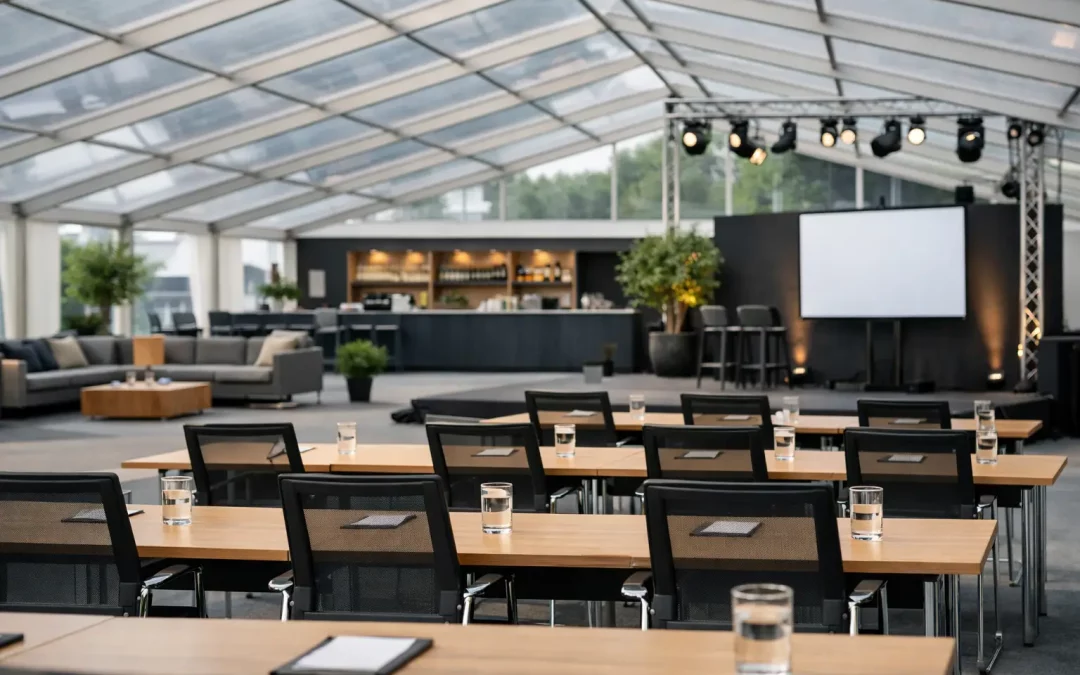
A marquee can look impressive from the outside and still fall short where it matters most. For event organisers, premium marquee interiors are not about dressing a structure with nicer finishes and hoping for the best. They are about building an internal environment that supports guest experience, staffing, brand standards and live operations from the first vehicle on site to final derig.
That distinction matters most on complex events. A hospitality enclosure at a concours event needs a very different interior approach from a registration space for a city-centre activation, a VIP lounge at a festival, or a temporary production office at a broadcast location. The structure may be temporary, but the expectations inside it are not. Guests still notice temperature, lighting levels, acoustics, queueing pressure, floor quality, sightlines and whether the space feels calm or improvised.
What premium marquee interiors really mean
In practical terms, premium marquee interiors sit at the point where finish meets function. Yes, interior linings, flooring, furniture and lighting all influence the look of a space. But at a professional event level, each of those choices also affects performance.
A boarded floor with a high-quality surface finish does more than improve appearance. It creates confidence underfoot, supports catering and bar operations, and helps maintain standards in poor weather. Interior linings do more than soften the shell of the structure. They influence ambience, acoustics and how well branding, furniture and feature lighting sit together. Heating and cooling are not decorative decisions either. They shape dwell time, guest comfort and staff performance, especially during long service periods.
That is why the interior conversation should start early. If it is left until the final stage of planning, the result is often a marquee that looks acceptable in photographs but creates pressure during build-up or live operation.
Why interiors need to be planned with the build
The strongest marquee interiors are designed alongside the infrastructure, not added once the structure footprint has been agreed. Internal layout affects entrance positions, emergency exits, service access, cable routing, plant location and usable capacity. If those relationships are ignored, the fit-out team ends up working around avoidable constraints.
Take flooring as one example. Ground conditions, site gradient and expected footfall should inform the floor build-up from the start. On a clean private lawn in summer, one specification may be suitable. On exposed showground, mixed terrain or a site with heavy equipment traffic, you may need a more engineered solution to keep the finish level and stable. That decision then affects programme, labour and vehicle sequencing.
Lighting works the same way. Decorative fittings may complete the visual brief, but task lighting, emergency lighting and power distribution have to be planned into the wider scheme. The same applies to bars, catering runs, reception desks, stage positions and toilet access. Good interiors feel effortless because the hard work has been dealt with before the doors open.
Finish without operational compromise
There is always a balance to strike. Event teams often want a high-end interior feel with minimal visual clutter, but live sites need cable runs, stock access, service zones and back-of-house routes. Hiding those functions is possible, but only if they are properly designed in.
This is where experience counts. A premium interior should not force caterers to work in cramped conditions, leave crew with no practical route to replenish stock, or create guest bottlenecks near entrances and bars. The smart solution is usually not the most decorative one on paper. It is the one that keeps the event moving while still meeting the expected standard.
The main elements of premium marquee interiors
Flooring is usually the foundation of the whole scheme. A quality floor changes how the space is perceived immediately. It affects comfort, furniture stability, access for service equipment and the confidence guests have when moving through the venue. At higher-spec events, uneven or soft flooring is noticed straight away, and not in a good way.
Linings and wall treatments help define the atmosphere. Clearspan structures offer flexibility, but the interior finish needs to suit the event type. A formal hospitality event may call for a cleaner, more refined treatment. A brand experience or festival hospitality area may need more visual character and stronger integration with scenic elements. Neither approach is better in isolation. It depends on audience, duration, budget and the standard expected on arrival.
Lighting has one of the biggest effects on whether a marquee feels polished or temporary. Daytime events still need careful lighting design, especially in reception areas, toilets, bars, kitchens and transition spaces. Evening events need layered lighting that supports mood while keeping service areas practical. If every part of the marquee is lit the same way, the result often feels flat. If style overtakes function, staff are left trying to operate in poor light.
Climate control is another area where organisers can underestimate the detail. A premium finish quickly loses its edge if the interior is too hot by mid-afternoon, too cold after sunset, or affected by draughts around openings. The right heating or cooling strategy depends on structure size, occupancy, season, internal equipment loads and how often access points will be used. It is not a one-size-fits-all decision.
Furniture, bars and counters also need to be considered as part of the infrastructure, not as a late styling layer. Their size, weight, service requirements and circulation impact all matter. A beautifully designed bar that creates a constant pinch point is not doing its job.
Premium marquee interiors for different event types
Not every event needs the same interpretation of premium. For corporate hospitality, the interior often needs to feel calm, composed and brand-aligned, with a strong arrival sequence and reliable service flow. For public-facing events, durability and throughput become more important. The finish still needs to be strong, but it has to cope with heavier use and variable weather conditions.
Agricultural shows and rural events bring their own demands. Access windows can be tight, ground can be exposed, and guests may move between indoor and outdoor areas all day. In those settings, premium does not mean delicate. It means resilient materials, sensible layouts and a finish that holds up under pressure.
For broadcast and production environments, the brief may lean less on hospitality aesthetics and more on controlled, high-function workspaces. Even then, interior quality still matters. Comfortable, well-planned spaces help teams work longer hours more effectively and present a more professional environment for talent, crew and stakeholders.
Where organisers often get caught out
The most common issue is treating the interior as a visual package rather than an operational one. That can lead to undersized back-of-house areas, poor guest flow, underpowered lighting schemes or a mismatch between finish level and site reality.
Another frequent problem is assuming that premium means adding more. More features, more furniture, more decorative items. In practice, strong interiors are often more disciplined. They allow proper spacing, clearer movement and better use of focal points. A room that can breathe usually feels more premium than one that is crowded with expensive elements.
Timings also matter. Late design changes to internal layout can affect power planning, heating, access routes and safety documentation. On large live projects, those changes are rarely isolated. They ripple through the whole build programme.
Getting better results from the outset
The best route is to define the purpose of the space before deciding how it should look. Start with who is using it, how long they are staying, what standards they expect and what operational teams need to deliver service properly. Once that is clear, the interior specification becomes much easier to shape.
It also helps to think in transitions, not just rooms. How does a guest arrive? Where do they pause? How do they move to catering, seating or toilets? Where are the quieter points and where are the natural pressure points? Premium marquee interiors are judged just as much by those moments between features as by the features themselves.
For larger projects, it is worth having one delivery partner who understands both the structure and the live event requirements behind it. That is often where problems are prevented early, before they become expensive on site. At Purvis Marquee Hire, that joined-up approach is a key part of making temporary spaces perform properly under real event conditions.
A well-planned marquee interior should do two jobs at once. It should reassure the organiser that the event can run cleanly, safely and on schedule, and it should make the guest feel that the space was built with purpose rather than assembled in haste. When those two things come together, premium stops being a styling label and starts becoming part of the event’s success.