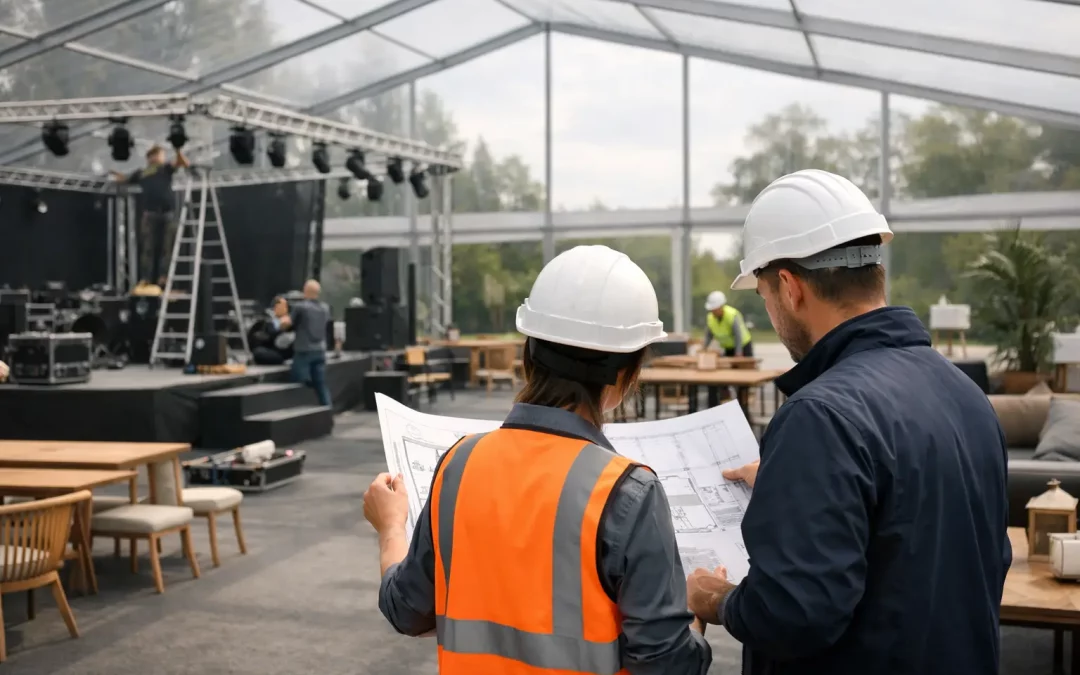
When a build programme starts before the site is fully available, while other contractors are still moving, and with public-facing deadlines fixed in stone, managing phased event build schedules stops being an admin task and becomes a delivery discipline. For major temporary structures, the difference between a calm build and a costly scramble usually comes down to how well each phase has been planned, protected and coordinated on the ground.
This is especially true on live event sites. A marquee build rarely happens in isolation. You may be working around venue restrictions, public access routes, broadcast compounds, catering fit-out, utility connections, local authority conditions and weather windows that can change the day faster than any programme update. A phased schedule has to reflect site reality, not just the ideal sequence on paper.
Why managing phased event build schedules is different
In a standard construction environment, access, scope and sequencing are often more stable. Events are different. Dates do not move easily, multiple suppliers are compressed into a short programme, and the structure itself is only one part of the operational setup. Flooring, power, lighting, heating, branding, fencing, toilet units and back-of-house areas all have their own dependencies.
That means phasing is not just about deciding what gets built first. It is about deciding what must be protected so later phases can happen without rework. If a hospitality structure goes up before the ground route for plant and lorries has been preserved, you can create your own access problem. If interior fit-out starts before final ballast positions or cable routes are agreed, trades begin working around each other instead of in sequence.
A good phased plan gives each contractor enough room to do the job properly while keeping the overall programme moving. Sometimes that means a slower start to avoid site congestion later. Sometimes it means bringing forward less visible infrastructure, such as trackway, generators or perimeter lines, because they unlock everything that follows.
Start with what the site will actually allow
The first question is not how quickly the structure can be built. It is what the site can physically support at each stage. Access width, turning circles, gradient, ground bearing capacity, overhead restrictions and shared vehicle routes all influence the build sequence long before the first frame is unloaded.
On a city-centre site, phased delivery may be driven by road closures, permitted delivery hours and tight storage limits. On a rural showground, the issue may be weather exposure, soft ground and long travel distances across the site. At a heritage venue, you may be balancing premium presentation with strict ground protection requirements and limited fixings. The programme has to reflect those conditions honestly.
This is where early site planning pays for itself. If the only hardstanding area is allocated to another supplier, your first phase may need to create temporary offload and laydown space. If access roads will degrade under repeated traffic, trackway may need to sit in phase one rather than later in the schedule. These decisions are not minor. They affect labour loading, plant requirements and whether the build stays efficient after day two.
Build the programme around dependencies, not wishful thinking
The strongest phased schedules are built backwards from critical dependencies. That means identifying what cannot start until something else is complete, signed off or made safe.
For example, the main clearspan may need to be erected before internal subdivisions, but the flooring sequence may depend on final levels being checked across the footprint. Power distribution may be designed early but cannot be fully installed until structure, access and equipment positions are confirmed. Branding elements may be quick to fit, but only once the structure is complete and no further lifting activity will put them at risk.
When people talk about efficiency, they often mean speed. On event sites, efficiency is more often about avoiding double handling, aborted visits and crew downtime. If a phase starts before its dependencies are genuinely clear, the programme may look active while actually losing time.
A practical way to manage this is to treat each phase as an operational handover point. Not a vague milestone, but a defined point where the next activity can begin without caveats. That might include ground acceptance, perimeter security in place, structure complete, ballast confirmed, power ready for connection, or interior safe for fit-out teams. Clear handovers reduce the grey areas where delays tend to grow.
Managing phased event build schedules on shared sites
Shared sites are where well-written programmes often come under pressure. Even when all contractors are competent, their priorities are not always aligned. A production team may need stage access. Caterers may need early kitchen install. A venue may still be operating around the event footprint. Local authority teams may need inspections at specific times.
In that environment, sequencing must be visible and agreed, not assumed. The most reliable build schedules make site logistics part of the programme itself. Vehicle routes, crane windows, storage zones, welfare positions and no-go areas should be treated as core planning items, because that is what they are.
This also helps with safety. A phased build becomes much easier to control when each zone has a clear status: active erection, restricted access, fit-out ready, or public-facing. Without that discipline, temporary works, plant movement and contractor crossover create unnecessary exposure.
There is a trade-off here. The tighter the site, the more valuable a detailed sequence becomes, but the less likely it is that every stage will run exactly as drawn. Good planning still needs flexibility. The point is not to produce a perfect document. It is to give the site team a working structure for decision-making when conditions change.
Labour, plant and deliveries need phasing too
One of the most common weaknesses in event programmes is treating labour and logistics as if they are constant throughout the build. They are not. Different phases demand different crew sizes, competencies and equipment.
Early ground preparation and trackway installation may need plant-heavy access and traffic management. Main structure erection needs experienced crews, lifting equipment and clear working space. Later phases may be lighter in plant terms but more crowded, with electricians, flooring teams, interior installers and branding contractors all moving at once.
If those requirements are not mapped phase by phase, you can end up with the wrong resource profile at the wrong time. Too many people on site before access is ready simply creates waiting time. Too few people at a critical structure stage pushes pressure into every following trade.
Delivery planning matters just as much. There is little value in having all materials on site early if they block access or require repeated movement. On constrained sites, timed deliveries are often more efficient than bulk arrival. On remote sites, earlier delivery may reduce transport risk but increase the need for secure storage and weather protection. It depends on the site, the asset and the exposure.
Keep compliance inside the programme, not beside it
Health and safety documentation, inspections, permits and sign-offs should not sit outside the build schedule as a separate stream. They need to be embedded into it. If a phase cannot be released until a structure check is complete or a cable route is approved, that needs to appear in the live programme.
This is particularly important for public events and high-profile environments where multiple stakeholders need confidence that the build is being controlled properly. A programme that ignores compliance points may look faster, but it is not more realistic.
The same applies to weather contingencies. In Scotland and the north of England, exposed conditions are not exceptional; they are part of the planning context. Wind can affect lifting operations, ground conditions can alter vehicle movement, and heavy rain can reshape the access plan in a matter of hours. A sensible phased schedule allows for that without pretending every day will be lost to weather. It is about tolerance, not pessimism.
The programme only works if the site team owns it
Even the best pre-event schedule will need adjustment once the build begins. That is why on-site management is so important. Phased programmes succeed when the people running the job can see the sequence, understand the dependencies and make practical calls quickly.
This is where experience shows. A strong site manager knows when to protect the sequence and when to flex it. If a fit-out team can move into one completed section while external works continue elsewhere, that may recover time. If allowing that access creates conflict with plant movement, it is a false gain. Good judgement matters more than blind adherence.
For clients, this is often the hidden value in working with an infrastructure partner rather than a narrow structure supplier. When one team is looking across access, build sequence, temporary services and site coordination together, decisions are cleaner and delays are easier to contain. That joined-up approach is central to how Purvis Marquee Hire manages complex event sites.
The practical aim is simple: every phase should leave the next one in a better position, not a more difficult one. If your build schedule does that, the event week becomes far more manageable for everyone involved.