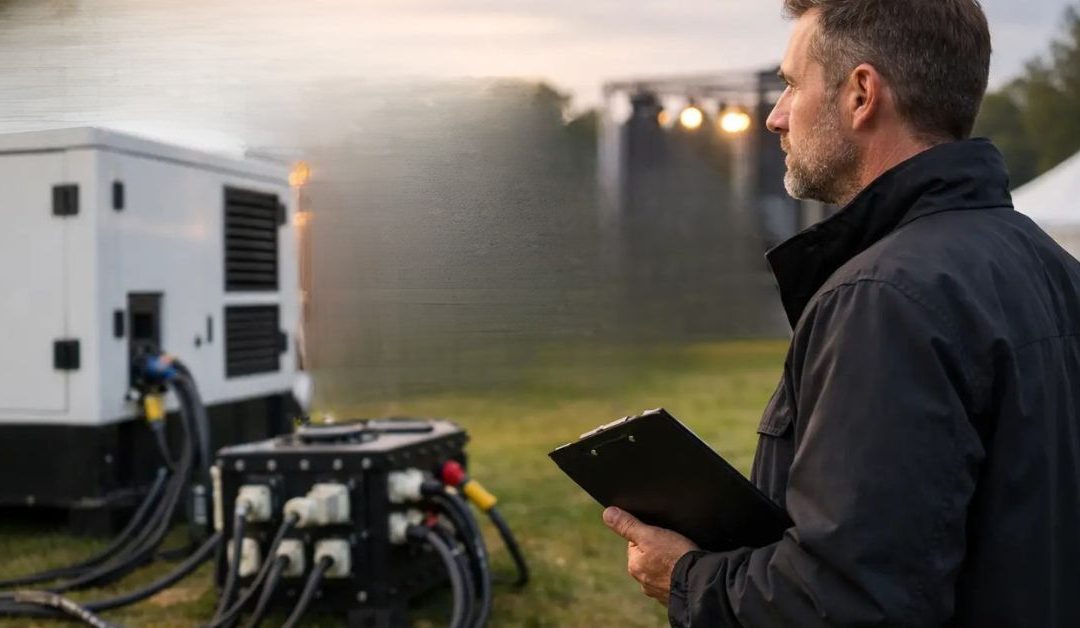
If the lights drop during a live awards presentation or the catering tent loses power just as service starts, nobody in the crowd cares whether the issue was fuel, load calculation or a badly planned cable route. They only see an event that has stopped working. That is why temporary power for events has to be treated as core infrastructure from the outset, not as a late technical add-on.
On larger sites, power affects almost every operational decision. It influences marquee layout, vehicle access, catering positions, stage orientation, welfare locations, lighting levels, refrigeration, broadcast compounds and the timing of the build itself. When organisers leave it too late, they usually end up paying more for a system that is harder to install, harder to manage and less resilient on the day.
What temporary power for events really involves
For professional event delivery, power is not simply a generator placed somewhere out of sight. It is a temporary electrical network designed around the realities of the site and the event programme. That network might include generators, distribution boards, cabling, cable protection, changeover arrangements, fuel management, load monitoring, emergency backup and on-site technical oversight.
The right solution depends on what is being powered and how critical each area is. A hospitality marquee, production control, toilet block and trade stand village all draw power differently. Some loads are steady and predictable. Others spike at key points in the day. Catering equipment, HVAC systems, stage lighting and refrigeration all bring different demands, and they do not always sit neatly on the same plan.
This is where experience matters. It is one thing to total up a list of wattages. It is another to understand diversity, startup loads, cable runs, weather exposure and what happens when an event moves from build phase to live operation.
Start with the site, not the kit
The most reliable power plans usually begin with a site walk and a practical conversation about how the event will function. Ground conditions, access routes and distance between zones all affect the electrical design. A generator location that looks sensible on a drawing may be impossible once lorries, fencing, public routes and fire lanes are taken into account.
Noise can also become a factor. At festivals and agricultural shows, this may be manageable if plant is positioned well away from audience areas. In hospitality settings, corporate environments or premium public events, generator placement needs more thought. Long cable runs can solve one problem and create another, especially if they cross vehicle routes, service corridors or soft ground.
There is also the question of build sequence. If structures go up before cable routes are planned, the result is often awkward workarounds. Good temporary power planning sits alongside the wider infrastructure plan, not behind it.
Load schedules need realism
One of the most common mistakes in temporary power for events is relying on incomplete load information. A basic equipment list rarely tells the full story. Organisers may know they need lighting, sound and catering, but the actual demands often change as suppliers are confirmed and production detail develops.
A realistic load schedule should separate essential services from convenience loads and identify anything that cannot fail. Refrigeration for catering stock, emergency lighting, comms, payment systems and broadcast feeds may all need a different level of resilience from decorative lighting or a phone charging point.
It is also worth allowing sensible headroom. Oversizing everything is not efficient, but designing a system with no margin leaves little room for operational change. Events are live environments. Last-minute additions happen, and power systems need enough flexibility to cope without becoming unstable or unsafe.
Distribution is where reliability is won or lost
People tend to focus on the generator because it is the visible part of the system. In practice, distribution is just as important. Poorly planned distribution creates cable congestion, trip hazards, difficult fault finding and uneven loading across the site.
A clean distribution design keeps routes logical and protects both the public and the build team. It also makes maintenance easier during the event. If a circuit trips in a busy hospitality structure or a back-of-house catering zone, the response has to be quick and controlled. That is far easier when the network has been laid out properly from the start.
Marquees and temporary structures add another layer of coordination. Cable entry points, flooring systems, kitchens, bars and feature lighting all need to be considered together. Retrofitting power after the structure and fit-out are fixed is rarely the best route.
Backup power depends on event risk
Not every event needs full redundancy, but many need more contingency than they first assume. The right level of backup depends on audience profile, event type, programme criticality and the consequence of failure.
For a private function, a short interruption may be inconvenient but manageable. For a public event, a televised production or a site with high-spec hospitality, power loss can affect safety, reputation and contractual obligations very quickly. In those environments, backup arrangements should be part of the original design rather than an emergency afterthought.
That could mean a standby generator, split supplies for critical loads, changeover capability or on-site technical cover during live hours. There is no single answer. What matters is matching resilience to risk, and being honest about what failure would actually mean on that site.
Fuel, access and refuelling are part of the power plan
A generator can be correctly sized and still become a problem if fuel logistics are poorly handled. Multi-day events, overnight operations and remote sites need a clear refuelling strategy. That includes safe access for service vehicles, realistic timings, bunded fuel arrangements where required and enough visibility over consumption to avoid guesswork.
In exposed or restricted locations, refuelling is not always straightforward. Service windows may be limited. Ground conditions may change with weather. Public access routes may affect when vehicles can move. These are practical issues, but they have a direct impact on reliability.
For larger events, power planning should account for operational rhythms. If catering peaks, evening production and overnight refrigeration are all drawing from the same system, fuel use may vary more than expected. Monitoring and active management make a significant difference.
Compliance is not paperwork for its own sake
Professional event buyers are right to ask about testing, certification, cable management and safety documentation. Temporary power systems sit in environments with staff, contractors, guests and the public moving through them. That means installation standards and documentation matter.
The practical side of compliance is what protects the event. Clear circuit labelling, proper protection, sensible routing, inspection records and competent installation all reduce risk and speed up problem solving if anything needs attention. On complex sites, that also helps other contractors work safely around the infrastructure during build and break.
For local authority events, city-centre sites and public sector projects, documentation often needs to align with wider event control processes. Power should support that process, not become a weak point within it.
Why integrated planning works better
Power is easier to deliver well when it is planned alongside structures, lighting, heating and cooling, welfare, toilets and ground protection. On real sites, these systems overlap constantly. Generator placement affects fencing. Cable routes affect flooring and access. HVAC loads affect the electrical design. Welfare and catering affect both water and power demand.
That is why many organisers prefer a supplier partner who understands the wider infrastructure picture, not just one technical package in isolation. Purvis Marquee Hire often sees the difference this makes on large, high-pressure projects. When structure, layout and operational services are coordinated from the same delivery mindset, the site tends to build more cleanly and run with fewer surprises.
It also creates a more realistic programme. Event managers do not need ideal-world plans. They need plans that work on uneven ground, under changing weather, with tight access windows and multiple suppliers arriving at once.
Common issues that are usually avoidable
Most power problems on event sites are not dramatic technical failures. They are planning gaps. Catering demand is underestimated. A late production request is squeezed onto an already stretched board. Cabling ends up crossing a route that later becomes a vehicle lane. A generator is placed where it cannot be refuelled efficiently. None of these issues are unusual, but all of them are easier to prevent than to fix live.
The earlier power conversations happen, the better the outcome tends to be. That does not mean every detail has to be fixed months in advance. It means the right questions need asking early enough to shape the site plan while there is still room to make sensible decisions.
For organisers, the useful test is simple. If a key area loses power for ten minutes, what happens next? If the answer is lost service, safety concerns, reputational damage or an expensive scramble, then the power strategy deserves more attention.
Well-planned temporary power is rarely noticed by guests, and that is exactly the point. When the site opens, every light, kitchen, heater, fridge, office and control point should simply work – quietly, safely and for as long as the event needs it to.