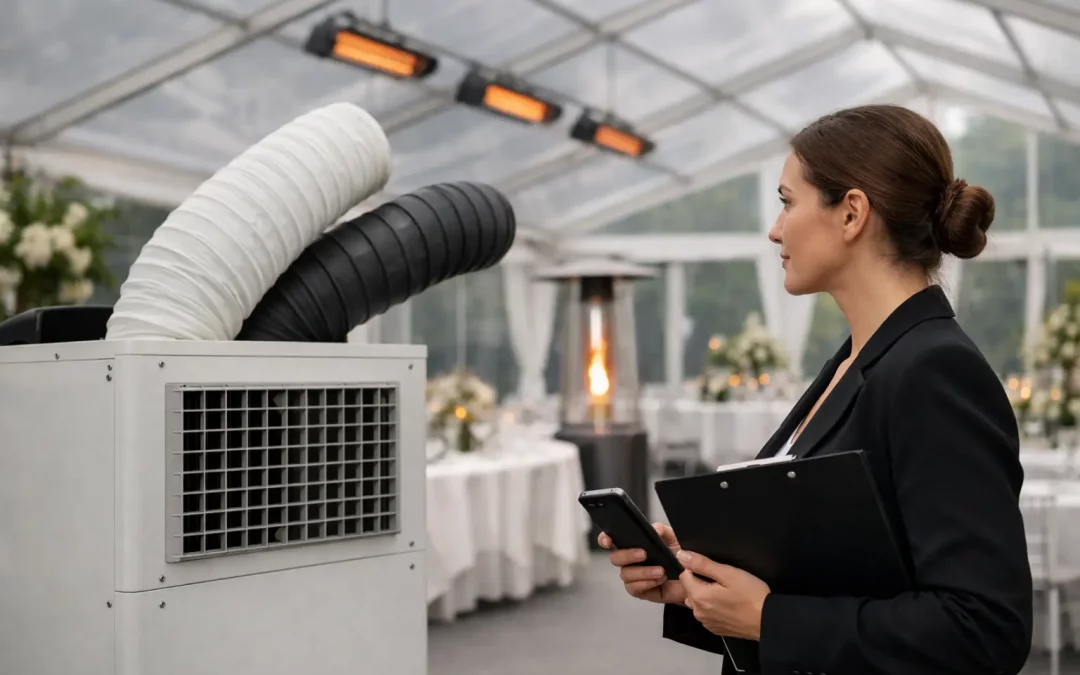
Anyone who has managed a live event in Scotland or the north of England knows the problem. The structure can be right, the flooring can be down, power can be live and branding can be in place, but if the internal temperature is wrong, the whole environment starts working against you. Marquee heating and cooling is not a finishing touch. It is part of operational planning from the start.
For professional event organisers, temperature control affects more than guest comfort. It has a direct bearing on dwell time, catering performance, staff welfare, equipment reliability and how well a space functions across a long event day. In hospitality settings it shapes the guest experience. In back-of-house and production areas it supports safe, workable conditions. At public events, it can be the difference between a venue that feels well run and one that feels improvised.
Why marquee heating and cooling needs early planning
Heating and cooling decisions are often left too late because they are seen as add-ons. On simple jobs that can sometimes be managed. On larger sites, it usually causes problems. By the time the structure is designed, entrances fixed, generators specified and internal areas allocated, the practical options become narrower.
The right approach is to treat climate control as part of the infrastructure package. That means considering the purpose of the space, expected occupancy, time of year, exposure, opening hours and what else is happening inside the marquee. A seated dinner in October needs a different strategy from a daytime agricultural show, and both are very different from a broadcast compound or a temporary accreditation area with doors opening constantly.
This is where experience matters. A marquee on an open rural site behaves differently from one in a sheltered city-centre location. Wind exposure, solar gain, ground conditions and site access all affect what kit is suitable and how it can be installed and operated.
What actually affects temperature inside a marquee
It is easy to assume that outside temperature tells you everything you need to know. In practice, internal conditions are shaped by several factors working together.
Occupancy is a major one. A full hospitality marquee with hundreds of guests, catering activity and lighting rigs will hold heat very differently from a lightly used exhibition space. The time of day matters as well. Cool mornings can give way to strong afternoon solar gain, especially in glazed or lighter-roofed structures.
The layout also changes performance. Partitioned areas, linked structures, low or high eaves, entrance frequency and the position of service zones all influence airflow and heat retention. A marquee with constant traffic through multiple openings will lose heat quickly in winter and be harder to keep comfortable in summer.
Then there is the operational brief. If guests are arriving in formalwear for an evening reception, expectations are different from those at a county show or sporting event. Temperature targets should reflect how the space will actually be used, not just a generic idea of comfort.
Heating a marquee properly
For cold-weather events, the main objective is not simply to make the space warm. It is to make it consistently usable from the first arrivals to the final clear-down. That means looking at warm-up time, heat distribution and recovery when doors are opened.
Indirect fired heaters are often the right choice for large event structures because they keep combustion outside the occupied space and deliver clean warm air internally through ducting. This suits hospitality, corporate and public environments where air quality and guest comfort matter. The system needs to be sized to the marquee volume and the level of heat loss expected from entrances, usage and weather exposure.
Placement is just as important as output. Poorly positioned ducting can create hot and cold spots, leave corners uncomfortable or interfere with front-of-house presentation. On busy sites, heater locations also need to work around pedestrian routes, service access, emergency egress and cable or hose runs. A technically correct solution that creates site-management problems is not a good solution.
Fuel planning should not be overlooked. On longer events or multi-day builds, refuelling access and safe plant positioning need to be considered early. If access becomes restricted after other infrastructure is in place, routine servicing becomes harder and risk increases. This is one of those details that tends to get missed until it matters.
Cooling a marquee in warmer conditions
Cooling is often more complex than clients expect. Unlike permanent buildings, marquees do not have the same insulation and fixed mechanical systems, so the goal is usually to control heat build-up and maintain workable comfort rather than create a tightly air-conditioned environment across every square metre.
Good marquee heating and cooling planning for summer starts with prevention. Shading, orientation, ventilation strategy and door management can all reduce internal temperature before any mechanical cooling is introduced. If a structure is likely to take heavy afternoon sun, that should be factored into the design and layout rather than treated as a surprise on event day.
In some cases, high-capacity fans and managed airflow will do the job, particularly in production, catering or public circulation areas. In others, especially premium hospitality, enclosed lounges or technical spaces, portable air conditioning may be required. That brings added considerations around power load, condensate management, ducting routes and noise.
There is always a trade-off. Strong cooling performance can need more plant, more power and more space for equipment. On constrained sites, especially urban ones, those requirements have to be balanced against access restrictions, visual presentation and neighbouring operations.
Matching the system to the event type
Not every marquee needs the same level of control, and over-specifying can be as unhelpful as under-specifying. The right answer depends on the operational purpose of the structure.
For corporate hospitality and formal events, guest comfort has a direct impact on the perceived quality of the whole occasion. Temperatures need to feel stable, not patchy, and equipment should stay discreet within the overall finish.
At festivals and agricultural shows, the brief may be broader. Reliability, resilience and practical performance often matter more than perfect uniformity, particularly where footfall is high and doors remain open for long periods. In those environments, the system must cope with variable usage and changing weather without becoming difficult to manage.
For film, TV and broadcast applications, there may be tighter requirements around equipment, acoustics or crew working conditions. Heat from technical kit, the need for quiet operation and the demands of long working days all shape the solution.
This is why a standard package is rarely enough on larger jobs. A proper specification should reflect the event profile, not just the footprint of the marquee.
Power, access and compliance considerations
Temperature control does not sit in isolation. Heating and cooling plant affects generator sizing, cable routes, fuel management, service access and site safety. If those elements are designed separately, coordination issues follow.
Power load is an obvious pressure point. Cooling equipment in particular can add significant demand, and if that has not been allowed for in the main electrical plan, you are left trying to retrofit capacity late in the programme. The same applies to plant access. Heaters, chillers and ducted systems need space to be delivered, positioned, protected and maintained.
There is also the matter of public interface. Any external plant must be managed so that it does not compromise emergency routes, create trip hazards or clash with fencing, branding or vehicle movements. On high-footfall sites, tidy installation is not just about appearance. It is part of safe delivery.
An experienced supplier will build this into the wider site plan. That includes documentation, method of installation and coordination with other contractors. Purvis Marquee Hire approaches heating and cooling in exactly that way – as part of a complete operational package rather than an isolated extra.
Common mistakes event teams try to avoid
The first is waiting until the weather forecast looks awkward. By then, equipment availability may be tighter, and design options may be limited by what has already been built.
The second is underestimating the effect of entrances and usage. A heated marquee with constant door traffic may never settle if the system has been sized only for static conditions.
The third is assuming that one area defines the whole structure. Front-of-house, catering, storage and production spaces often need different treatment. A single blanket approach can leave key working areas too hot, too cold or poorly ventilated.
Finally, there is the temptation to focus only on plant size. Capacity matters, but integration matters just as much. The best result comes from planning the environment alongside the structure, power, layout and live operation.
Getting it right on live sites
The strongest marquee heating and cooling plans are practical. They account for weather, yes, but also for lorry access, refuelling, pedestrian routes, show schedules, opening patterns and the simple fact that live sites rarely stay still.
That is why the conversation should start early, while there is still room to shape the layout and build the service plan around the event. A well-managed internal environment will rarely be the headline feature of the day, and that is usually a sign it has been done properly. Guests stay comfortable, crews can work, equipment performs as expected and the structure does its job without distraction.
If you are planning a large temporary venue, the smartest temperature-control strategy is usually the one that feels unremarkable on the day because the detail was handled well before the first vehicle arrived on site.