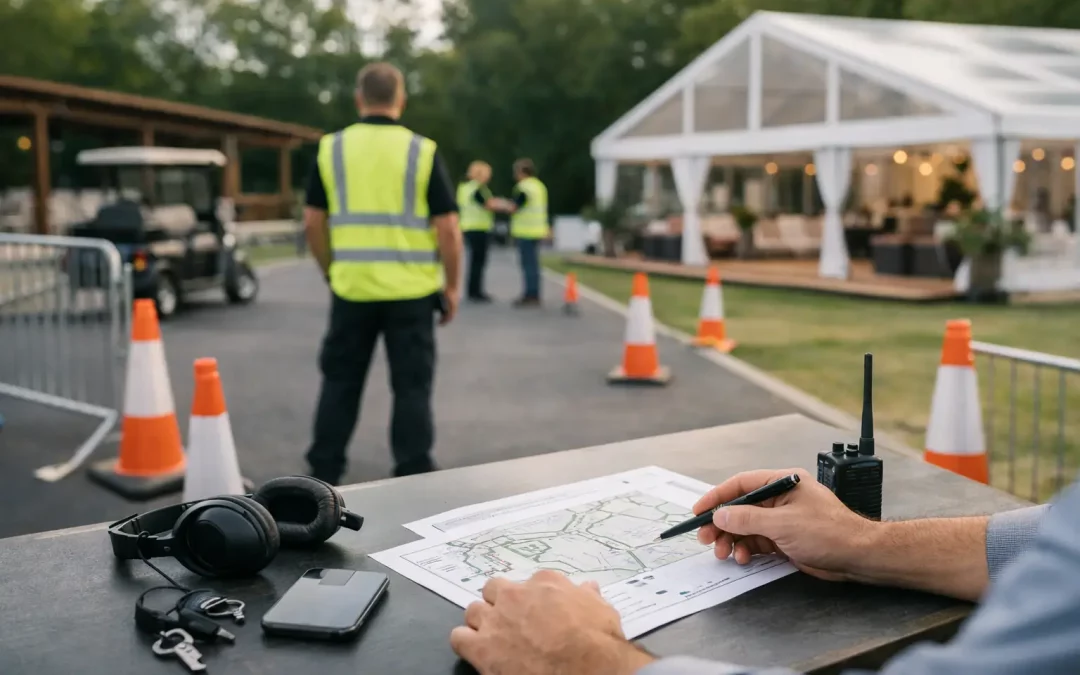
A site can look perfect on paper and still fail on day one because nobody properly thought through how vehicles, crew, guests and emergency services would move around it. That is why knowing how to plan event access routes is not a minor logistics task. It sits right at the centre of build efficiency, public safety and operational control.
For large temporary structures, festivals, agricultural shows, city-centre activations and corporate hospitality events, access planning affects almost every department. It shapes build times, ground protection, stewarding, fencing lines, toilet servicing, waste collection, catering deliveries and emergency response. Get it right and the event runs with far less friction. Get it wrong and small delays quickly become expensive problems.
Start with the site as it really is
The first step is to assess the site in real terms, not just from a venue plan or satellite image. A route that looks usable on a drawing may be too narrow for articulated lorries, too soft for plant movement, or too exposed once the weather turns. Gradients, pinch points, overhead obstructions, gate widths and turning circles all matter.
Ground conditions deserve particular attention. Grass parks, showgrounds and estate land can cope well in dry conditions but become high risk after sustained rain. Hardstanding may solve one problem but create another if pedestrian traffic and delivery vehicles are forced into the same zone. Site access needs to be planned for the conditions you hope for and the conditions you may actually get.
This is where an experienced site visit pays for itself. Walking the route often reveals practical issues that drawings miss, such as hidden cambers, soft verges, drainage channels or areas where event traffic will conflict with public arrival points.
How to plan event access routes by user type
One of the most common mistakes is treating access as one route for everyone. In practice, different users need different routes, timings and controls. If you are working out how to plan event access routes properly, start by separating who needs to move through the site and why.
Build and break traffic
Construction traffic needs direct, workable access to the build zone with enough space for unloading, reversing and plant operation. This includes marquee wagons, forklifts, generators, flooring deliveries, toilet units, fencing, catering infrastructure and waste services. These routes should prioritise practicality over appearance because they are there to make the event happen safely and efficiently.
Staff, suppliers and contractors
Not every contractor arrives in a heavy goods vehicle. Some arrive in vans, some on tight schedules, and some need controlled access during live event hours. Accreditation, arrival windows and holding areas help prevent congestion at the gate. If every supplier turns up at once, even a good route can become unusable.
Guests and VIP arrivals
Guest routes need a different standard of planning. They should feel clear, safe and intentional, with proper lighting, signage and protection from operational traffic. VIP, hospitality and accessible arrivals may also need separate drop-off points to avoid delay and preserve the front-of-house experience.
Emergency access
Emergency routes should never be an afterthought. They must remain unobstructed, clearly identified and suitable for the vehicles likely to use them. There is no value in marking an emergency route on a plan if it is then crossed by queuing guests, parked plant or temporary infrastructure.
Build the route plan around timing, not just layout
A route that works at 7am during build may fail completely at 1pm when guests are arriving. Timing is just as important as geography. Event access works best when movement is phased.
During build, the aim is usually to get heavy vehicles in and out efficiently while protecting the ground and keeping contractors safe. During live operation, the priority shifts towards pedestrian safety, controlled servicing and emergency readiness. During derig, fatigue and time pressure often create new risks, especially if multiple departments are trying to leave site at once.
For that reason, route planning should include a movement schedule as well as a site map. Delivery slots, plant restrictions, stewarded crossings and service windows all reduce conflict. It also helps to define the point at which a build route stops being a contractor route and becomes a restricted or public-facing area.
Think about width, turning and holding space
Access routes are often judged by whether a vehicle can technically get through. That is too simplistic. The real question is whether it can get through safely, repeatedly and without disrupting everything else.
A narrow gate may be usable for one careful arrival, but if ten vehicles need to pass through under pressure it becomes a bottleneck. Similarly, a route may be wide enough in a straight line but impossible once turning angles, parked vehicles, fencing runs and pedestrian barriers are in place.
Holding space is another detail that gets overlooked. Vehicles arriving early, waiting for unload instructions or going through accreditation all need somewhere to sit without blocking public roads or internal circulation routes. On constrained sites, a remote holding area can make the difference between controlled access and chaos.
Ground protection is part of access planning
If the route crosses turf, soft ground or sensitive surfaces, ground protection needs to be planned from the outset rather than added later as a rescue measure. This is particularly relevant for large marquee builds, plant access and service traffic over several days.
The right solution depends on axle loads, frequency of movement and weather exposure. A pedestrian trackway may be suitable for guest circulation but entirely inadequate for forklifts or loaded vehicles. Equally, over-specifying protection in low-risk areas can add unnecessary cost and labour. Good planning means matching protection to actual use.
For many event organisers, this is where working with a full-service infrastructure partner becomes valuable. Access routes do not sit separately from flooring, fencing, structures, power or welfare areas. They affect all of them.
Use signage, stewarding and physical controls
Even the best route plan can fail if people on site do not understand it. Clear communication matters. Drivers need precise arrival instructions before they travel, not once they are at the gate. Contractors need to know where to report, what route to take and whether reversing marshals are required. Guests need obvious wayfinding that does not rely on guesswork.
Physical measures also matter. Barriers, fencing lines, cones and gate control points help keep vehicles and pedestrians apart. Stewarding becomes particularly important where service routes cross guest flows or where visibility is limited. If a route depends entirely on people behaving perfectly, it is probably too fragile.
Plan for the awkward scenarios
Real sites rarely behave exactly as planned. Weather changes. A supplier arrives late in the wrong vehicle. A gate becomes blocked. Public attendance exceeds forecast. The practical test of how to plan event access routes is whether the system can absorb those issues without losing control.
Contingency planning should cover wet-weather alternatives, secondary access points where available, emergency vehicle override, and what happens if a primary route becomes unusable. For urban events, local authority restrictions, road closures and resident access also need close coordination. For rural events, towing capability, temporary trackway extension and recovery plans may be sensible.
There is always a balance to strike. Building too much redundancy into a route plan can be inefficient and expensive. Building none into it can leave the event exposed. The right level depends on event scale, site complexity, public risk and programme pressure.
Documentation and on-site control
A workable access plan should appear clearly in the event documentation, but paperwork alone is not enough. Method statements, traffic management plans, site rules and emergency procedures all need to align with what will actually happen on the ground.
It also helps to nominate clear ownership. If nobody is responsible for controlling access, multiple teams will make local decisions that undermine the wider plan. One person may wave a van through for convenience while another closes a route for guest arrivals. The result is inconsistency. A designated site lead or traffic coordinator keeps decisions joined up.
On complex live sites, radio communication and regular coordination meetings are often what hold the route plan together. They allow teams to adapt while maintaining control.
Why access planning needs to start early
Access is often treated as a later-stage operational detail, after structures, branding and guest experience have already been agreed. In reality, it should be part of the earliest site planning conversations. The route determines what can be built, how quickly it can be installed and what level of servicing the event can realistically support.
That is especially true for high-spec temporary structures and premium event environments, where aesthetics matter but the back-of-house still needs to function. A smart entrance is of limited value if the catering team cannot replenish stock without crossing guest areas or if toilet servicing has no protected route. Purvis Marquee Hire sees this regularly on projects where the visible event depends on a disciplined infrastructure plan behind it.
The strongest event sites tend to share the same trait. Their access routes are not improvised. They are measured, tested and managed with the same care as the structure layout itself. If you plan them early and treat them as a core operational system, the whole event becomes easier to build, safer to run and far more resilient when the pressure comes on.