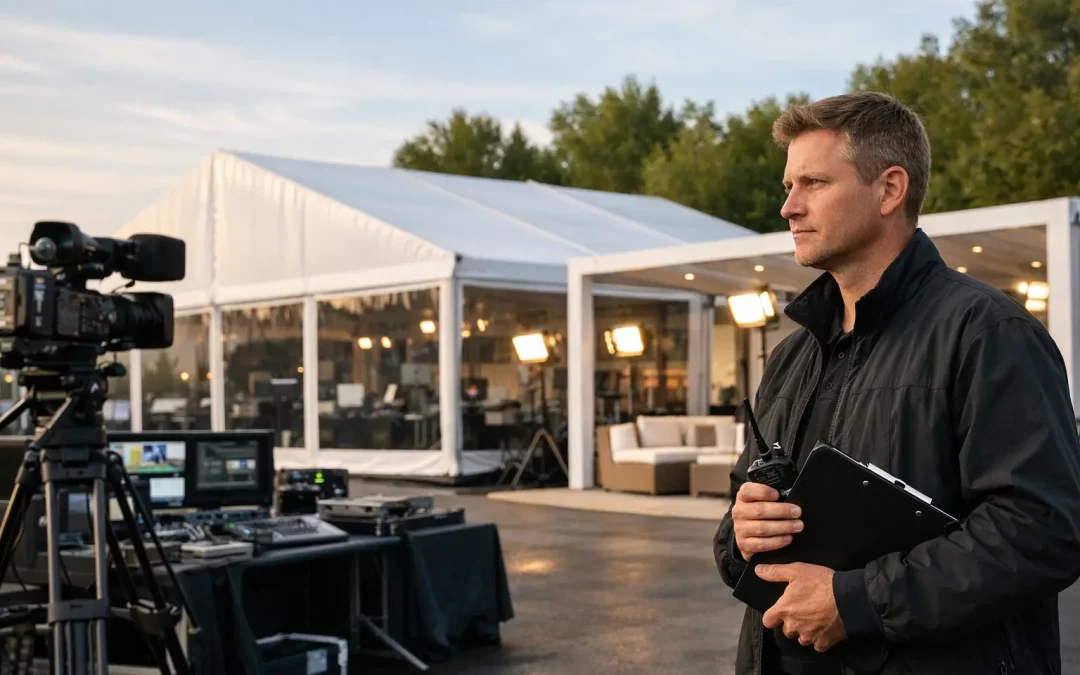
A live broadcast site looks calm on screen. Off camera, it is usually anything but. Vehicles are moving to tight schedules, power is being distributed across temporary compounds, weather is changing by the hour, and production teams need every space to function first time. That is why temporary structures for broadcast events are not just about cover. They are working environments that have to support technical delivery, crew welfare and operational control under pressure.
Broadcast projects tend to compress a great deal of complexity into a short programme window. A commentary unit may need acoustic control and reliable heating. A production office may need clear zoning, lighting and data routes. A hospitality area for sponsors or VIPs has a different finish and flow again. On top of that, many sites are exposed, space restricted or shared with public audiences. The structure package has to work with the event plan, not sit awkwardly beside it.
What temporary structures for broadcast events need to do
For experienced organisers, the question is rarely whether a temporary structure is required. It is what that structure needs to achieve on a live site. In broadcast, the answer usually goes well beyond shelter. These environments often need to support editorial teams, camera crews, rigging staff, engineers, presenters, security, catering and guests, all with different access needs and different working hours.
The practical requirement is straightforward. The building has to be safe, weather-resistant, correctly sited and ready when production arrives. The less obvious requirement is that it must also help the event run cleanly. Good layout planning reduces unnecessary footfall through technical areas, keeps cable routes sensible, and prevents vehicle movements from clashing with pedestrian circulation. Those decisions affect the whole programme, from build through to breakdown.
There is also the question of finish. Not every broadcast structure needs to look polished, but many do. A rights holder’s welcome space, a media centre or a branded interview backdrop may need to meet broadcast standards visually as well as operationally. It depends on the event, the audience and who will be on camera.
The site usually decides the solution
Broadcast events rarely happen on easy ground. One week it may be a city-centre location with strict access windows and limited storage space. The next, a rural showground with soft ground, long cable runs and changing weather. Temporary structures have to be selected with those realities in mind.
Clearspan structures are often the right starting point where usable internal space matters. They give production teams flexibility for desks, kit, control positions and partitioning without internal poles getting in the way. That matters in broadcast compounds where every square metre tends to be doing a job.
However, bigger is not always better. A structure that is oversized for the site can create delivery issues, increase plant requirements and complicate heating or cooling. In some cases, a series of linked structures works better than one large unit because it separates functions more effectively. Production, welfare, storage and hospitality often benefit from being close together but not mixed together.
Ground conditions matter just as much as footprint. If the site is uneven, waterlogged or sensitive, flooring and ground protection become part of the structure conversation early on. Leaving that discussion too late can affect access, build time and safety. For broadcast crews bringing in valuable equipment, a stable and level internal environment is not a luxury.
Back-of-house matters as much as the front
One of the common mistakes on broadcast projects is to focus heavily on the visible areas while underestimating the support spaces. Presentation zones, sponsor lounges and interview areas get the attention. Meanwhile, storage, welfare, drying space, technical prep and shift change facilities are squeezed into whatever is left.
That usually causes problems once the programme starts. Crew need somewhere practical to work, regroup and manage equipment. If there is no dry circulation route, if flooring is inadequate, or if access points are poorly positioned, the site becomes harder to operate very quickly. The smartest temporary structures for broadcast events are the ones that balance presentation with proper back-of-house planning.
Power, climate and lighting cannot be afterthoughts
A structure is only one part of a working broadcast environment. Once teams move in, they need power distribution that reflects actual use, not rough guesswork. Production offices, lighting loads, catering kit, charging stations, heaters, air conditioning units and specialist technical equipment all place different demands on the system.
The same applies to climate control. Broadcast schedules do not pause because the temperature has dropped or the sun has come out unexpectedly. Internal comfort affects concentration, equipment performance and the general pace of the operation. In Scotland and the north of England especially, external conditions can shift quickly, so heating and cooling plans need to match the season, the occupancy and the build specification.
Lighting also needs a practical approach. General illumination is one thing. Task lighting, emergency lighting and out-of-hours access lighting are another. If crews are arriving before daylight or wrapping after dark, the structure and its surrounding routes need to remain safe and functional throughout.
Compliance and documentation are part of delivery
Professional buyers do not need to be persuaded that health and safety matters. What they need is confidence that the temporary infrastructure provider understands the documentation, sequencing and on-site controls that sit behind a compliant build.
Broadcast environments can involve public interfaces, restricted zones, temporary electrics, working at height, plant movement and compressed installation periods. That means method statements, risk assessments, build schedules and site-specific planning need to be coordinated properly. A structure supplier should be able to support that process, not simply drop a building onto the plan and leave the production team to resolve the rest.
This is particularly important where local authorities, venues or rights holders require detailed pre-event submissions. The earlier the infrastructure team is involved, the easier it is to align structure locations, emergency access, crowd routes and service connections before they become last-minute issues.
Timing is rarely generous
Broadcast builds often work to fixed dates that cannot move. The event is on, the transmission slot is booked, and the site has to be ready. That puts pressure on access sequencing, labour allocation and contingency planning.
In those conditions, reliability matters more than promises. A good structure partner will look closely at delivery routes, vehicle turning areas, crane or telehandler needs, and the interaction between their build and other contractors on site. If the ground is poor, if access is shared, or if the site must remain partially live during installation, that should be planned in from the start.
There is rarely much room for improvisation once the programme clock is running. Calm, experienced site management makes a noticeable difference.
Why a full-service approach tends to work better
Many organisers can source structures, toilets, fencing, flooring, power and branding from separate suppliers. Sometimes that is the right approach, particularly on sites where procurement is already fixed. But for broadcast projects with tight timelines and interdependent infrastructure, a single coordinated delivery model often reduces risk.
When one team is handling layout design, structure installation, flooring, temperature control, lighting, fencing and site coordination, the interfaces are clearer. It becomes easier to spot clashes before build starts and easier to adapt when the site changes. That joined-up view matters when access is tight, weather turns, or the production footprint grows late in planning.
This is where specialist experience pays for itself. A supplier that regularly supports high-pressure live environments will understand that a structure is not an isolated product. It is part of an operational system. At Purvis Marquee Hire, that practical, project-led mindset is what allows temporary event infrastructure to perform properly in demanding conditions.
Getting the brief right from the outset
The best outcomes usually come from straightforward conversations early in the process. Not just the number of people expected, but how the site will work hour by hour. Who needs vehicle access? Which areas need branding? What needs to stay dry, warm, secure or camera-ready? Where are the pinch points? What changes if the weather deteriorates?
Those details shape the right specification far more than a simple floorplan ever will. They help determine whether the answer is a large clearspan structure, a series of linked units, or a combination of production, welfare and hospitality spaces with different finishes and services.
There is no standard broadcast package because no two event sites behave in exactly the same way. The right structure solution is the one that supports the programme, the people and the pressures around it.
When temporary infrastructure is planned properly, nobody notices it on the day – and that is usually the point. The broadcast goes out, the crew can work, the guests are looked after and the event team stays in control. For organisers working to public deadlines and high expectations, that kind of quiet reliability is what counts.