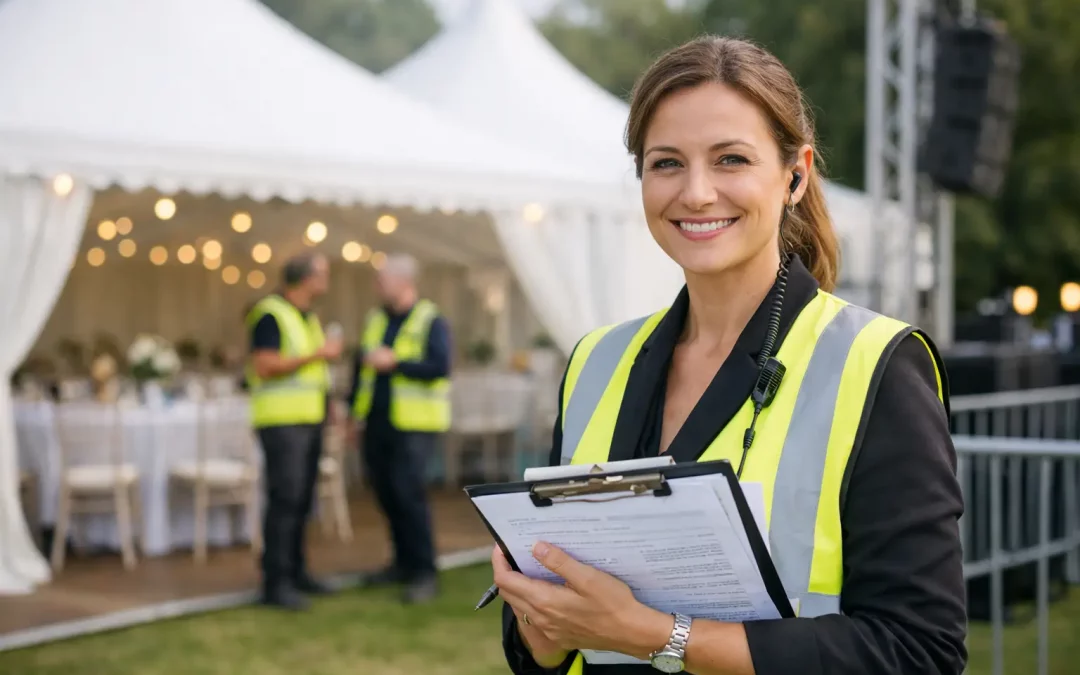
When a local authority asks for your paperwork two weeks before build, or a venue suddenly wants revised access plans after heavy rain, event safety documentation requirements stop being an admin task and become part of delivery. For large public events, temporary structures and complex sites, the quality of your documentation often decides how smoothly the project runs before the first vehicle even arrives on site.
For experienced organisers, the issue is rarely whether documents are needed. It is knowing which documents matter, who owns them, and how detailed they need to be for the scale of the event. A small private function and a city-centre public event will not be treated the same way, and nor should they be. The right approach is proportionate, site-specific and tied to actual operational risk.
What event safety documentation requirements usually cover
At a practical level, event safety documentation requirements exist to show that the event has been properly planned, the main risks have been assessed, and the people delivering each element understand their responsibilities. That includes not just the organiser, but also structure suppliers, power contractors, production teams, caterers, security providers and traffic management teams.
For events using marquees or other temporary infrastructure, documentation often sits across several layers. There will usually be an event-level plan covering public safety, crowd considerations, emergency arrangements and site management. Alongside that, individual contractors should provide their own technical and safety documents for the parts they are installing or operating.
This is where gaps often appear. An organiser may have a solid event management plan, but no clear method statement for the structure build. Or a supplier may provide a risk assessment for installation, but the wider event paperwork does not reflect vehicle movement during live operations. On paper, both sides have done some of the work. In practice, the handover between them is weak.
The core documents most organisers will need
The exact pack depends on the event, venue, local authority and licensing position, but most sizeable events will require a combination of an event management plan, risk assessments, method statements and emergency procedures. If temporary demountable structures are involved, you will also usually need structural information, fire safety details and proof of inspection or sign-off.
A risk assessment should not read like a generic spreadsheet copied from the last job. It needs to reflect the actual ground, access routes, public interface, build sequence and weather exposure. If the site is sloping, soft, remote, constrained or shared with the public during build, that should be visible in the document.
Method statements are equally important. They explain how work will be done safely, in what order, with what plant and labour, and under what controls. For marquee installation, that may include delivery sequencing, staking or ballast arrangements, exclusion zones, lifting operations, welfare provision and traffic separation.
For larger or more scrutinised events, organisers may also need fire risk assessments, medical plans, crowd management plans, traffic management plans, waste management details and contingency procedures for adverse weather. Not every event needs the full set, but many public-facing events do.
Temporary structures need their own level of detail
Marquees, clearspan structures, temporary seating, staging and ancillary back-of-house areas are often where documentation becomes more technical. A venue or authority will typically want confirmation that the structure is suitable for the intended use, installed correctly and supported by the right certification.
That can include structural calculations, engineering sign-off, layout drawings, flame-retardancy certification, ballast details, anchorage plans and handover paperwork once the build is complete. If flooring, ramps, generators, distribution, heating or linked units are part of the structure package, those interfaces should also be accounted for.
It is worth being realistic here. A premium hospitality build on an exposed showground carries different documentation demands from a modest garden marquee. The more public load, technical equipment and operational complexity involved, the more scrutiny there tends to be.
Who is responsible for producing the documents?
This is one of the most common points of confusion. The organiser is usually responsible for the overarching event documentation and for making sure competent contractors are in place. Individual suppliers are then responsible for producing documentation relevant to their own scope of works.
That sounds straightforward until responsibilities overlap. For example, who covers emergency egress from a temporary hospitality structure connected to a wider event site? Who owns vehicle movement controls during build if several suppliers are arriving through the same gate? Who updates the risk assessment if the ground conditions change after a week of rain?
The only workable answer is coordination. Documentation should not be treated as isolated attachments sent in by separate contractors. It needs to be reviewed as a set, with the interfaces checked properly. That is especially true where structure, power, flooring, fencing and public circulation all interact.
On more demanding projects, this is where a delivery-led supplier adds value. A company used to managing large temporary infrastructure packages can often identify missing links before they turn into site delays or compliance issues.
Event safety documentation requirements for licensing and approvals
Many organisers first feel pressure around documentation when a premises licence, temporary event notice, SAG review or venue approval process starts moving. At that stage, missing detail tends to cause two problems. Either decisions are delayed, or the event team ends up producing rushed paperwork that is technically complete but operationally thin.
Authorities and venues are not usually asking for documents for the sake of it. They want confidence that the event can be delivered safely in the real conditions of the site. If your plan shows guest routes but ignores contractor access, or your emergency procedure looks polished but does not reflect the actual layout, that lack of detail is often picked up quickly.
A better approach is to build documentation around the operational reality from the start. If there are restricted access windows, note them. If there is a live road nearby, show how separation will work. If part of the structure is on trackway due to poor ground bearing, record it clearly. Specificity creates confidence.
Weather, ground and access are often under-documented
For outdoor events in Scotland and the north of England, weather and ground conditions can change the practical risk profile of a job very quickly. Yet these are still areas where paperwork is often too generic.
A risk assessment that mentions bad weather in one line is not enough for an exposed site. Wind management procedures, structure monitoring, drainage concerns, vehicle recovery planning and revised pedestrian routing may all need to be considered, depending on the event.
The same applies to access. If build vehicles are crossing public routes, reversing in confined spaces or working on soft ground, those controls should be visible in the documents. These details matter because they affect how the site is actually managed, not just how it is described in pre-event meetings.
How detailed should the documents be?
There is no benefit in producing a 60-page pack if half of it is copied from older events and no one on site uses it. Equally, a short and vague document set will not stand up well for a high-footfall public event. The right level of detail is enough to show competent planning, clear responsibilities and site-specific controls.
Good documentation is readable, accurate and consistent. Terminology matches across plans. Site maps reflect the current layout. Contractor scopes align with the event plan. Revision control is clear. If something changes, the pack is updated and redistributed properly.
This sounds basic, but it is where many projects come unstuck. The issue is not always that documents are missing. Sometimes they exist in several versions, with inconsistent information across them. That creates confusion during build and weakens confidence with venues, clients and authorities.
Getting ahead of the paperwork
The easiest way to manage event safety documentation requirements is to start earlier than feels necessary. As soon as the site layout, structure scope and operational model begin to take shape, the document plan should start as well. Waiting until the last fortnight usually means avoidable pressure, especially where multiple contractors are involved.
It also helps to decide early who is reviewing the full pack for consistency. That may sit with the organiser, production manager or principal supplier, depending on the project. What matters is that someone is checking how the pieces fit together.
For complex temporary infrastructure, documentation works best when it is tied closely to delivery. The people writing it should understand the physical realities of the build, from plant movement and ground conditions through to handover and live-event support. That is where paperwork stops being a compliance burden and starts doing its actual job.
On a well-run event, the documents do not sit in a folder untouched. They shape decisions, clarify responsibilities and reduce surprises when the pressure is on. That is usually the difference between a project that feels controlled and one that spends the final week reacting.