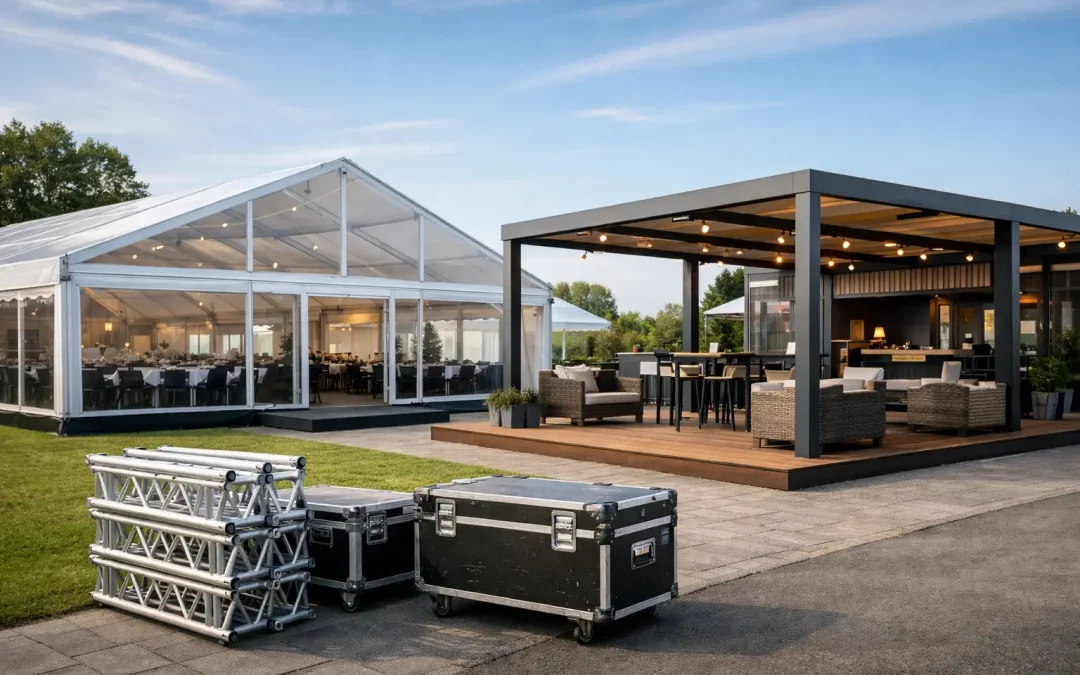
A site can look perfect on a recce and still become difficult the moment build vehicles arrive, the weather turns, or multiple contractors start working to the same deadline. That is why a guide to temporary venue infrastructure needs to go well beyond the structure itself. For professional event organisers, the real challenge is creating a venue that is safe, functional, on brand and deliverable under pressure.
Temporary infrastructure is often treated as a late-stage procurement item. In practice, it should be part of event planning from the earliest stages. The size of a marquee or clearspan structure matters, but so do access routes, ground conditions, welfare provision, power distribution, crowd movement and the practical sequence of the build. When these elements are planned together, the venue works. When they are not, problems usually show up on site, where fixes are slower and more expensive.
What temporary venue infrastructure really includes
In broad terms, temporary venue infrastructure is the package of systems that allows a site to operate as a venue for the duration of an event, production or commercial programme. The structure is the most visible part, but it is only one part. A usable temporary venue may also need flooring, sub-flooring, doors, linings, lighting, heating or cooling, generators, distribution, fencing, toilets, trackway, branding, furniture support, back-of-house areas and protected service routes.
The right package depends on the job. A hospitality enclosure at a major sporting event has different needs from a greenfield agricultural show, a city-centre consumer event or a broadcast compound. Some sites need a polished front-of-house finish. Others need hard-working operational space that can cope with vehicles, crew traffic and long working days. Most need both.
Start with the site, not the structure
The best guide to temporary venue infrastructure always begins with the ground beneath it. Before discussing layout or specification, you need a realistic understanding of the site. That means topography, surface condition, drainage, underground services, tree cover, gradients, access restrictions and nearby infrastructure all need to be considered properly.
A flat field is not automatically simple. If the ground is soft, waterlogged or heavily trafficked, you may need ground protection or a different build approach. If access is narrow, vehicle movements and delivery sequencing become critical. If the site is exposed, wind loading and anchoring methods need careful review. Urban sites bring their own issues, including restricted working hours, tight compound space and the need to protect existing surfaces.
Early site assessment saves time later. It also helps avoid a common mistake: specifying a venue layout that looks good on a plan but does not work with real-world build logistics.
Layout planning is operational planning
Event layouts should do more than fit the required footprint. They need to support how people, equipment and services move throughout the event lifecycle. That includes build, live operation and breakdown.
Guest arrival routes, emergency egress, catering access, waste management, power runs and toilet positioning all affect the success of the site. So does the relationship between public areas and back-of-house space. If these zones are squeezed too tightly, the venue becomes harder to service and less safe to operate.
This is where experience matters. A technically correct plan is not always an efficient one. Sometimes a slightly different orientation improves wind resilience. Sometimes moving a structure by a few metres opens up better access for plant or avoids a drainage issue. Good temporary infrastructure planning is rarely about chasing the neatest drawing. It is about making the venue work under event conditions.
Temporary venue infrastructure and access planning
Access planning deserves its own focus because it affects every stage of delivery. Lorry routes, gate widths, turning circles, overhead restrictions and unloading zones all need to be mapped in advance. On busy sites, timing matters just as much as route choice.
Large temporary structures do not arrive as one simple delivery. They arrive as a sequence of materials, plant, crew and supporting services. If access is poorly planned, installation slows down, trades overlap and site safety becomes harder to manage. The same applies during breakdown, when fatigue and weather can make a site more difficult than it was on build day one.
For public events, access planning also extends to visitor flow, staff parking, production compounds and emergency vehicle routes. There is always a balance to strike between maximising usable event space and preserving the circulation the site needs to function properly.
Power, lighting and environmental control
Power is one of the most underestimated parts of temporary venue delivery. It is not just about having a generator on site. It is about understanding total load, phase requirements, cable routes, redundancy, refuelling access and separation between public and operational areas.
A venue with catering, production, heating, refrigeration and feature lighting will have very different demands from a daytime exhibition or registration space. If power planning is done late, you often end up with inefficient cable runs, added distribution points and avoidable cost.
Lighting should be designed for use, not just appearance. Front-of-house areas need ambience, but back-of-house routes, welfare units, plant areas and fire exits need practical illumination. Heating and cooling also depend on the season, occupancy levels, structure type and how long the venue is in use. In Scotland and the north of England, planners are often dealing with variable conditions in a short timeframe. Building in resilience is not overengineering. It is sensible preparation.
Flooring, trackway and ground protection
The ground underfoot changes the feel and function of a temporary venue more than many clients expect. Flooring is not only about presentation. It creates stability, improves accessibility and protects against the disruption caused by poor weather.
On uneven or soft ground, sub-floor systems can create a level internal surface where a simple carpeted finish would not be enough. Outside the structure, trackway and ground protection may be needed for pedestrians, service vehicles, plant or temporary compounds. This becomes especially important on greenfield sites and heritage venues where surface protection is a priority.
There is a cost decision here, of course. Not every event needs the highest-spec floor build-up throughout. But cutting too far can create bigger problems later, from poor guest experience to damaged ground or delayed servicing.
Compliance, documentation and build management
No professional event organiser needs reminding that temporary venues must be properly documented and competently managed. Still, this is often the area where procurement decisions show their true value.
Risk assessments, method statements, structural calculations, fire planning, emergency routes and relevant certification all need to be in place and coordinated with the wider event plan. For local authority sites, broadcast compounds, public events and premium hospitality environments, documentation is not an administrative extra. It is part of the delivery.
Just as important is who is managing the work on site. A strong build team does more than erect a structure. It coordinates sequencing, deals with site changes, manages interfaces with other contractors and keeps the project moving safely. That calm, practical control is what protects timelines when conditions shift.
Matching infrastructure to event type
Different event formats place different demands on temporary infrastructure. A festival may prioritise resilience, service access and back-of-house capacity. A corporate hospitality event may need stronger emphasis on finish, branding and guest flow. An agricultural show may require broad footprint planning across mixed terrain. Film and TV projects often need flexible covered space, blackout options and highly practical support areas.
That is why one-size-fits-all packages rarely serve larger events well. The better approach is to specify infrastructure around how the venue will actually be used, what the site will tolerate and where the operational pressure points sit.
For complex projects across Scotland and the north of England, that usually means working with a supplier that can see the whole picture, not just one line item. Purvis Marquee Hire operates in that space because temporary infrastructure at this level is never just about hire stock. It is about planning, logistics and dependable delivery when the margin for error is slim.
Choosing the right delivery partner
If you are procuring temporary venue infrastructure, the key question is not only what can be supplied. It is how the supplier thinks about delivery. Ask how they assess access. Ask who handles site coordination. Ask what happens if ground conditions change, weather worsens or another contractor slips behind programme.
Capability matters, but so does judgement. A good partner will challenge assumptions early, flag risks before they become problems and build a specification that suits the event rather than inflating it. They should also be comfortable working alongside production, venue, catering and authority stakeholders without creating unnecessary friction.
The strongest temporary venues are rarely the ones with the most components. They are the ones where every component has been chosen, positioned and managed with purpose. Get that right, and the site feels controlled from the first vehicle movement to the final breakdown – which is exactly what a live event needs.