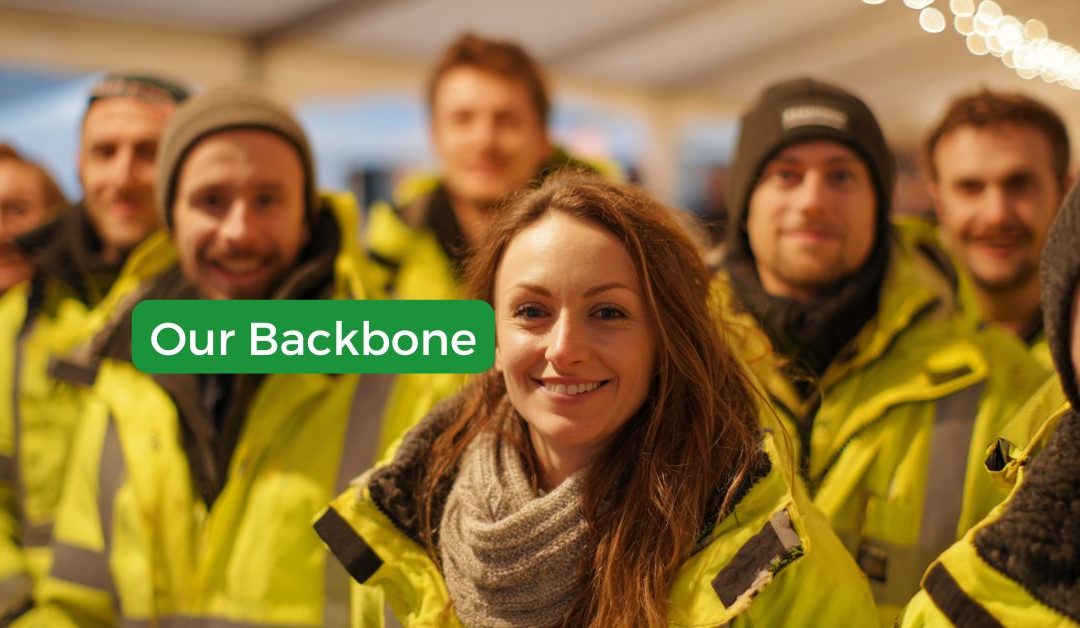
The Backbone of Successful Builds
I’ve always believed you can feel the quality of an event build long before the structures take shape. Not by looking at the ground, or the plan, or the equipment, but by watching the crew as they arrive on-site.
You can see it immediately.
The way people talk to each other.
The pace of their movements.
The small gestures, a hand lifting a cable, a nod across a field, a shared joke at 6am over cold tea from a flask.
These are the signs of a site with a strong culture. And in my experience, a build is only ever as good as the welfare, mindset and morale of the people delivering it.
The Human Side of Temporary Infrastructure
We talk a lot about engineering and logistics in this industry, wind calculations, anchoring, sequencing, transport routes, risk assessments but the truth is, none of it happens without the people who turn plans into reality.
I’ve been on sites where the welfare planning was flawless, proper rest areas, toilets that weren’t afterthoughts, warm spaces, food that wasn’t just convenience but actual nourishment. Those builds always ran smoother. Not by magic, but because well-looked-after people make good decisions.
And I’ve seen the opposite too.
The builds where the crew had nowhere warm to step out of the rain.
Where breaks were squeezed, or skipped.
Where communication was patchy and energy drained faster than the fuel.
Those are the sites where mistakes happen, not out of ignorance, but fatigue.
The Day I Learned the Value of Crew Welfare
Years ago, we were building a large temporary venue on a site with rough weather rolling through all week. Everything took longer. The wind slowed the skinning. The rain softened the ground. The cold made even simple tasks feel heavier.
One morning, I arrived expecting the team to be behind. Instead, they were ahead.
Why?
Not because the weather eased, it didn’t.
Not because we cut corners, we didn’t.
But because John, early in the planning process, made the decision to invest in a proper welfare setup:
• heated break space
• decent catering
• dry kit storage
• sheltered briefing area
• and enough people to rotate tasks before fatigue crept in
The crew weren’t fighting the environment; they were supported through it. And that changes everything.
Culture Is Built in the Small Moments
You can’t force good culture onto a site.
You build it, daily in quiet ways:
- A foreman who checks in before someone looks tired.
- A lead rigger who explains rather than shouts.
- A site manager who listens when someone says a process feels unsafe.
- A cup of tea handed across a field in pouring rain.
People underestimate how far small acts of respect travel.
But when you’re cold, wet, or lifting structures for the tenth hour straight, dignity matters as much as PPE.
Where Safety and Culture Meet
If you want a safe site, build a respectful one.
Crew welfare isn’t just kindness, it’s risk mitigation.
People who feel valued:
• move more carefully
• take instructions more seriously
• report issues sooner
• communicate more clearly
• support each other instinctively
Culture does the work even when you’re not looking.
It shows up in how people stack equipment.
How they secure ballast.
How they tighten every strap because they want the build to last.
The Future of This Industry Is Human
I’ve been saying for years that the events industry will face a skills shortage if it doesn’t protect its people.
You don’t get experienced crew by accident, you earn them.
You keep them by creating sites they want to return to.
You grow them by giving them mentors, structure, and the space to take pride in their craft.
Good culture lasts longer than any marquee.
Good welfare outperforms any weather forecast.
And good people build the events that audiences remember long after the lights go down.
Your Turn
If you’ve seen incredible crew culture on a site, or if you’ve ever had a welfare setup that transformed a difficult build, share it.
Our industry is powered by people.
Their experiences deserve to be heard just as much as the stories about the weather, the logistics, or the spectacle of the final event.