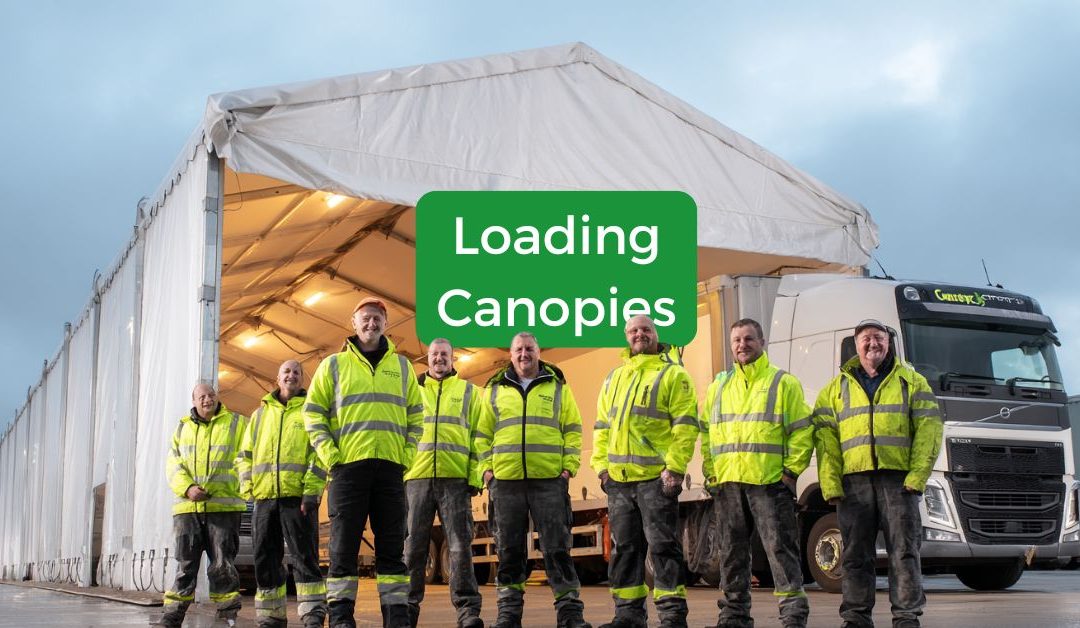
There’s a strange contradiction on many busy sites. Thousands, sometimes millions, are invested in buildings, vehicles, equipment and systems and yet the most exposed part of the operation, the point where goods, people and machinery interact most intensely, is left at the mercy of the weather.
The loading bay.
It’s where schedules tighten. Where safety risks increase. Where productivity is either protected or quietly eroded. And it’s often completely uncovered.
We’ve walked onto sites where everything inside the building runs like clockwork, but the moment you step outside to load or unload, conditions dictate the pace.
- Rain slows movements.
- Wind disrupts handling.
- Ice changes behaviour.
- Heat exhausts teams.
None of this is dramatic. It’s cumulative. And it costs more than most people realise.
The Hidden Cost of Exposure
Loading and unloading is one of the most repeated activities on any operational site. That repetition magnifies inefficiency. A few minutes lost per delivery becomes hours over a week. Slower handling increases manual risk. Damaged packaging leads to claims. Weather delays create knock-on effects across the operation.
What’s often accepted as “just part of the job” is actually a controllable problem.
Why Loading Canopies Change Everything
A loading canopy does one simple thing extremely well. It removes weather from the equation. Once that happens, behaviour changes immediately. Teams move more confidently. Vehicles are positioned more accurately. Handling becomes safer and more predictable. Schedules stabilise. It’s not about comfort alone, although comfort matters. It’s about consistency.
A covered loading area allows operations to run at the same standard in January as they do in July.
Designed for Movement, Not Storage
The most effective loading canopies are designed around flow.
- Clear spans.
- Defined vehicle routes.
- Safe pedestrian zones.
- Enough height to accommodate varied vehicle types.
- Lighting positioned for early mornings and late finishes.
They don’t obstruct. They enable. Crucially, they can be sized and configured to match how a site actually works, rather than forcing teams to adapt to fixed constraints.
Health, Safety and Welfare
From a health and safety perspective, loading canopies address several risks at once.
- Reduced slip hazards in wet or icy conditions.
- Better visibility in poor weather.
- Lower fatigue caused by exposure.
- Clearer separation between vehicles and people.
They also send a signal. That the organisation has thought about how work is done, not just where it happens.
Why Many Sites Delay the Decision
Loading canopies are often overlooked because they sit between categories. They’re not a full building. They’re not a vehicle. They’re not a piece of equipment. As a result, they fall through procurement gaps. Everyone assumes someone else will raise it. But once installed, they’re rarely questioned. The improvement is immediate and obvious. Teams notice it. Managers notice it. The operation feels calmer.
Flexibility Without Commitment
Like all well-designed temporary structures, loading canopies don’t force long-term decisions. They can be installed quickly, adapted as layouts change, and removed or relocated if requirements shift. That flexibility matters in uncertain years, when committing to permanent construction feels premature, but doing nothing carries real cost.
A Small Change With Disproportionate Impact
Not every operational improvement needs to be transformational. Some of the most effective upgrades are simple, practical and focused on everyday work.
Loading canopies sit firmly in that category. They protect people. They protect goods. They protect productivity. And they do it quietly, every day.
Your Experience
If weather has ever slowed your loading operations, damaged stock, or made a routine task harder than it needed to be, you’ve already seen the problem.
The solution doesn’t need to be complex. Sometimes, the most overlooked upgrade is the one that makes everything else work better.