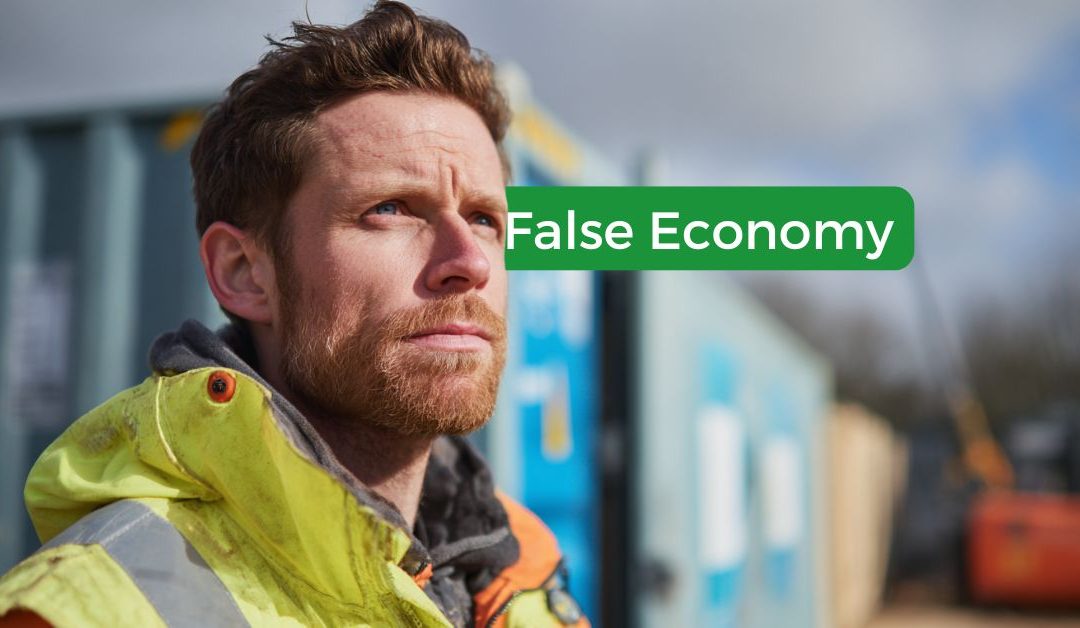
Walk onto almost any construction site and you’ll see them. Rows of steel containers lined up along the perimeter. Practical. Familiar. Seemingly inexpensive.
For decades, containers have been the default answer to site storage. If materials need protecting, if tools need locking away, if stock needs covering, a container is ordered almost automatically.
But default does not always mean efficient. In many cases, containers quietly become a false economy.
The Illusion of Low Cost
On paper, containers look cheap. Hire rates feel manageable. Delivery is straightforward. Placement is simple. But the visible cost is only part of the picture.
Limited internal space means stacking and reshuffling. Access is restricted to a single door. Materials often end up double handled. Multiple containers are ordered as stock increases.
What begins as one container often becomes three, four or six. The site footprint grows, but operational efficiency does not. The hire cost may appear low, but labour time rises.
Handling risk increases. Productivity slows.
Access Dictates Efficiency
The biggest constraint with containers is access. One narrow door means one point of entry. Forklifts struggle. Larger items require awkward manoeuvring. Teams queue while waiting to retrieve materials. In poor weather, access becomes slower still.
On busy construction sites, where timing and sequencing are critical, these small delays compound. Temporary storage should support the build, not obstruct it.
Weather Protection Is Only Half the Story
Containers protect from rain. That’s clear. But they don’t always support workflow. Materials stored deep inside require unpacking and repacking. Ventilation can be limited. Organisation becomes harder as stock rotates. Visibility of inventory reduces.
In contrast, a clear-span temporary structure allows defined zones, better layout, and efficient vehicle access. Materials can be positioned logically. Forklifts move safely. Teams spend less time navigating cramped spaces and more time building.
Protection is important. But protection without flow creates friction.
Site Footprint and Safety
Multiple containers scattered across a site consume valuable space. They create blind spots. They interrupt vehicle routes. They increase congestion. As the project progresses and stock fluctuates, container positioning often becomes reactive rather than strategic.
Temporary structures, properly planned, centralise storage. They create controlled entry and exit points. They improve sightlines. They reduce unnecessary movement across the site. In high-pressure environments, safety improves when space is deliberate rather than improvised.
Scaling Up Without Fragmentation
Construction sites rarely remain static. Materials increase. Deliveries surge. Weather shifts. Deadlines tighten. Adding more containers to meet demand feels logical.
In reality, it fragments storage further. Different items in different boxes. Lost time locating stock. Additional handling. A single, scalable temporary structure adapts more intelligently. It can expand in footprint. It can be reconfigured. It can support loading access under cover. It can integrate with site workflow rather than fight against it.
The difference is cohesion.
Capital vs Productivity
The appeal of containers is simplicity. Order, deliver, use. But construction is rarely simple. When evaluating storage, the real question is not “what is cheapest to hire?” It is “what protects productivity?” If teams lose minutes every time they access stock, those minutes cost more than the container hire ever did. If materials are damaged because storage is cramped or disorganised, that cost multiplies further. Temporary structures are not about appearance. They are about efficiency. They are about reducing friction in environments already under pressure. Rethinking the Default
Containers will always have a place. They serve a purpose. But treating them as the automatic solution for all site storage ignores the reality of modern construction workflows.
Temporary storage structures provide:
- Greater internal space
- Better access Improved safety
- Weather protection that supports movement
- Flexibility as projects evolve
Sometimes the cheapest visible option becomes the most expensive operational choice.
Your Experience
If you’ve ever struggled to retrieve materials from a packed container, waited for access, or worked around a row of steel boxes that didn’t quite fit the site, you’ll recognise this pattern. Storage should simplify the build, not complicate it.
Sometimes the smarter solution is the one that feels less familiar.