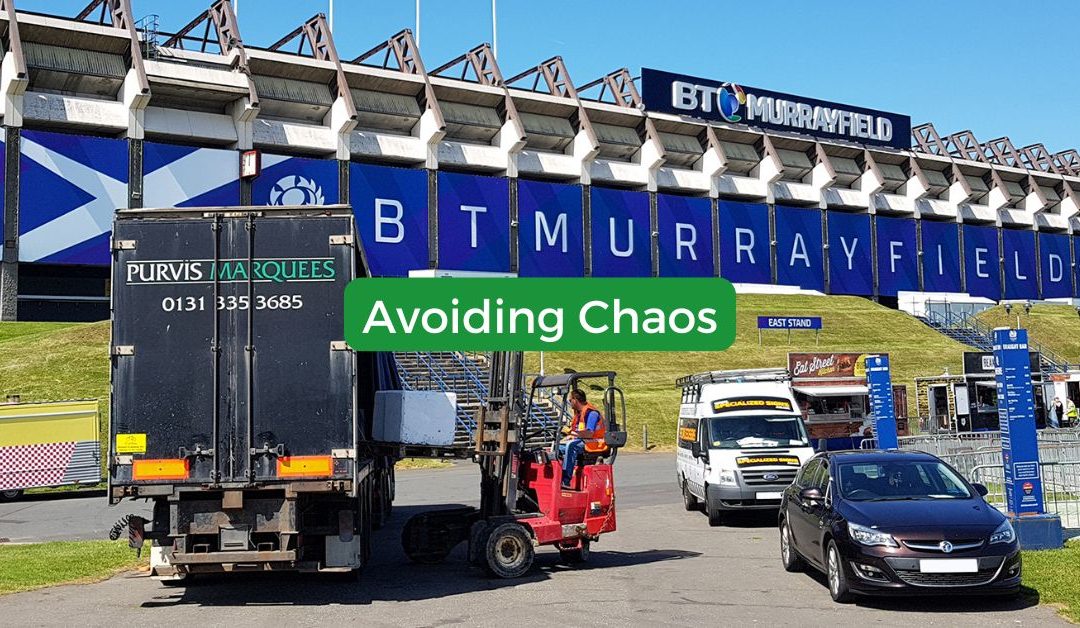
Avoiding Chaos on Event Week
There’s a particular atmosphere on event week. It’s hard to describe unless you’ve lived it. The site is still half imagination, half reality. Trucks arrive in quiet convoys, crew move with unspoken purpose, and the ground under your boots tells you more than any spreadsheet ever could.
And then there’s the clock, always ticking, always louder than the machinery.
I’ve walked onto sites where everything feels calm, organised, almost peaceful. I’ve also stepped onto sites where the moment you arrive, you can sense the tension. Too many vehicles waiting for access. Too many suppliers arriving early, or late, or all at once. Too many decisions being made on the fly because no one quite knows who’s meant to be where.
Load-in and load-out will make or break an outdoor event long before the public show up. Most audiences never think about it, but every event manager knows the truth: event week is where the real work happens.
And the difference between smooth delivery and controlled chaos? It’s in the planning you do before the first truck ever sets off.
The Anatomy of a Good Load-In
I’ve seen load-ins run like clockwork. They don’t happen by accident. They start weeks earlier in a meeting room where someone asks the question that matters most: “What do we need to build first so everything else can move?”
Everything else flows from that.
The ground protection arrives before the heavy kit.
The first marquee frame goes up where the site vehicles need to turn.
The power and water teams get clear routes before the catering units start to appear.
And the traffic marshals have a plan they actually understand, not something written in a document no one has time to look at.
In the best load-ins, every arrival has a purpose. Every vehicle has a place to go. Every supplier knows what they’re coming into.
It doesn’t mean things won’t change. They always do. But when the foundations are thought through, the changes don’t feel like emergencies, they feel like adjustments.
The Chaos Moments
Now, I’ve been on the other side too.
The load-ins where five trucks turn up at once because everyone left the yard late.
The site where the ground is too soft for delivery four but no one told delivery five.
The moment a supplier rings and says they’re stuck in traffic, while another arrives unscheduled and needs to drop in the exact spot blocked by the first.
There’s a particular sound that captures it, the overlapping beeps, the contradictory calls on the radio, the muttered two-word phrases that tell you the day just got more complicated.
But chaos doesn’t usually come from bad luck. It comes from bad sequencing.
And that’s something you can control.
The Rhythm of Load-Out
People talk a lot about load-in. They don’t talk as much about load-out, even though it’s just as important.
Load-out is different. The adrenaline is gone, the audience has left, and the exhaustion is beginning to settle in.
But this is where safety matters even more. This is where tempers shorten and corners are tempted to be cut.
This is where the ground is already worn, sometimes soft, sometimes muddy, sometimes littered with the remnants of a long weekend.
A good load-out is patient.
It respects the order of dismantling.
It doesn’t rush the unpicking of a structure that took days to build.
It plans vehicle movements with the same discipline as load-in.
And above all, it trusts the crew, the same people who kept everything calm on the way in, to keep everything safe on the way out.
Why Experience Wins This Stage
Load-in and load-out are where experience speaks the loudest.
Anyone can draw an access plan.
Anyone can create a timetable.
But only people who have stood on grass with a radio in their hand understand how fragile a schedule is once wheels hit the field.
We’ve been there in good weather, in bad weather, in sideways weather.
We know how the light changes in late afternoon and how that affects the pace.
We know when to push and when to slow down.
And we know that the best load-ins and load-outs aren’t defined by speed — they’re defined by control.
Share Your Event Week Wisdom
If you’ve lived through an event week where everything just clicked, or one where everything went sideways, share the story.
Someone else is preparing for their load-in right now, and your experience could save them hours, stress, and maybe even a full rebuild.
And if there’s one thing our industry does well, it’s learning from the people who have been there, boots on the ground, making it happen.