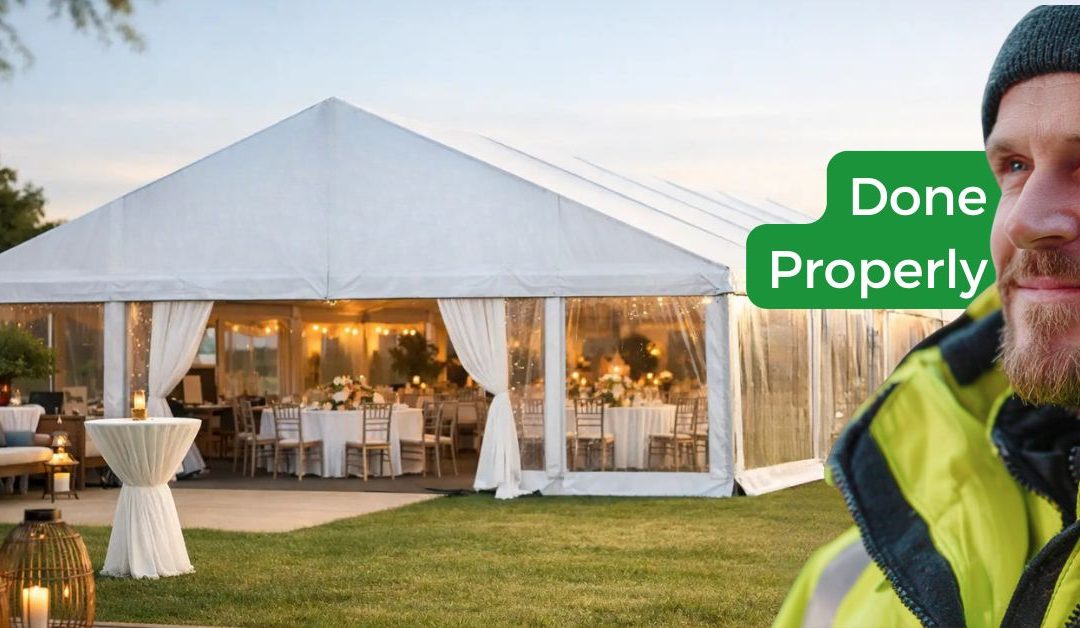
When a large-scale event is under pressure, the marquee is rarely the difficult part on its own. The real challenge in large event marquee hire is making sure the structure, the site, the schedule and the operational detail all work together without slowing the event down. For experienced organisers, that is the difference between a straightforward build and a project that starts creating problems before the first vehicle arrives.
At this level, marquee hire is not a simple matter of choosing a size and booking a date. A major temporary structure has to function as part of a wider event plan. It needs to suit the ground conditions, support the audience flow, allow for technical infrastructure, meet safety requirements and fit the access constraints of the venue. If any of those elements are treated as an afterthought, costs rise quickly and timelines start to tighten.
What large event marquee hire really involves
For public events, corporate hospitality, agricultural shows, sporting fixtures and broadcast environments, the structure is only one part of the delivery. The practical questions usually come first. How do build vehicles get in and out? Is the ground suitable for the proposed footprint? What happens if the weather changes? Where do welfare, catering, plant and back-of-house facilities sit? How do power distribution, lighting and branding integrate with the layout?
That is why large event marquee hire should be approached as infrastructure planning rather than equipment rental. A well-run project considers guest experience and operational function in the same conversation. Front-of-house spaces may need to feel polished and premium, but they also need proper flooring, climate control, service access and safe circulation routes. Back-of-house areas need to work just as hard, even if the public never sees them.
The bigger the event, the less room there is for assumptions. A structure that looks right on paper may not work once vehicle routes, emergency access, production compounds and public ingress are mapped properly. This is where detailed pre-planning protects both programme and budget.
Why scale changes the risk profile
A large marquee on a complex site brings a different level of responsibility. There may be higher visitor numbers, stricter licence conditions, more agencies involved and a narrower build window. The structure must not only be erected correctly, but integrated into a live environment where multiple contractors are working to the same deadline.
That has a direct effect on how the project should be managed. Ground loading matters more. Wind exposure matters more. Traffic management matters more. Even something as simple as where articulated vehicles can turn or unload can affect the viability of the layout. In city-centre locations, access restrictions and working-hour controls can become as important as the design itself. On rural sites, soft ground, uneven terrain and weather exposure usually take that place.
Experienced organisers know that the safest option is rarely the cheapest line on a quote. It is the supplier that can see the pressure points early, plan around them and keep control once the build starts. Large event delivery depends on foresight as much as stock capacity.
The planning questions that matter early
The most productive marquee projects usually start with the site, not the structure. Before a final design is agreed, it helps to understand how the event needs to operate over the full programme – build, live days and derig.
Capacity is one part of that, but not the whole story. A dining event, a public exhibition, a premium hospitality enclosure and a production base all use space differently. Ceiling height, span width, exit positioning and internal zoning all change depending on how the structure will function. If staging, rigging, catering or broadcast equipment are involved, those requirements need to be accounted for from the outset rather than squeezed in later.
Then there is the site itself. A level grass field may look simple, but drainage, underground services and access width can still create limitations. Hardstanding can help with vehicle movement, but it may affect anchoring methods. Sloping ground can often be managed, though it usually requires extra planning and sometimes additional flooring or substructure. None of this means a site is unsuitable. It simply means the technical approach should be shaped around real conditions.
Large event marquee hire and the value of a full package
For smaller private functions, clients sometimes coordinate separate suppliers for power, toilets, heating, fencing and finishes. On major events, that approach can create unnecessary friction. Too many interfaces on a tight programme often lead to confusion over sequencing, responsibility and access.
A full-service delivery model reduces that risk. When one team is managing the marquee, internal layout, power, lighting, flooring, temperature control, branding elements, fencing, toilet provision, ground protection and on-site coordination, the project becomes easier to control. Decisions are made in context rather than in isolation.
That matters most when conditions change. If weather affects the site, if a vehicle route needs revising, or if a client requirement changes late in the programme, an integrated supplier can adapt more quickly because the operational detail sits under one roof. It is not simply about convenience. It is about maintaining momentum when the schedule is tight and the event has no spare days.
This is where a specialist operator such as Purvis Marquee Hire can add real value, particularly on projects where the structure needs to perform as part of a wider temporary infrastructure plan rather than as a standalone product.
Compliance, safety and documentation are part of the job
Professional event buyers do not need to be told that health and safety matters. What they do need is a supplier that treats documentation and compliance as part of delivery, not a paper exercise added at the end.
For large temporary structures, that means clear technical information, method statements, risk assessments, build sequencing and coordination with the wider event plan. It may also include fire safety measures, emergency exit planning, load considerations, wind management procedures and liaison with venue teams, production managers or local authority officers.
The quality of this process has a practical effect on site. Good documentation supports better communication between contractors. It allows issues to be spotted before they become delays. It also gives event organisers confidence that decisions are being made properly, especially where public access, VIP use or high-profile stakeholders are involved.
There is a balance to strike here. Overcomplication slows projects down, but a casual approach creates exposure. The right supplier is methodical without becoming obstructive, and understands how to support event teams that are already managing multiple moving parts.
Why site logistics often decide success
Many marquee projects are won or lost on logistics rather than design. A structure may fit perfectly within the event plan, but if build vehicles cannot reach the location efficiently, the programme will suffer. The same applies if storage areas are too small, traffic routes conflict with public operations, or plant movement has not been thought through.
This is especially true on prestige venues, estates, town-centre sites and multi-zone event grounds. Access windows may be limited. Surfaces may need protection. Other contractors may already be on site. In these environments, build management is not an administrative extra. It is essential.
Well-managed logistics keep labour productive and reduce avoidable risk. They also help protect the client relationship, because the site feels controlled rather than reactive. For organisers working with sponsors, partners, exhibitors or public-sector stakeholders, that level of control matters.
Choosing a supplier for large event marquee hire
At this level, the best buying decision is rarely based on brochure appeal. It comes down to whether the supplier understands complex delivery and can demonstrate it calmly. Ask how they approach difficult access, exposed ground, phased builds and live-event pressure. Ask who manages the project on site. Ask what sits within their scope and what would need third-party coordination.
It is also worth looking at the type of events they regularly support. Experience with festivals, city-centre builds, agricultural shows, hospitality programmes or broadcast compounds tends to show how well a team handles real-world constraints. Premium finish matters, of course, but it should sit alongside practicality, not instead of it.
The strongest marquee partner is the one that helps you remove uncertainty early. That may mean challenging an initial layout, recommending a different structure format or flagging access issues before the schedule is fixed. Good advice is not always the fastest route to sign-off, but it usually leads to a better event.
If you are planning a major event, the most useful starting point is not the structure size. It is an honest conversation about what the site needs to do, how the programme will run and where the pressure points are likely to appear.