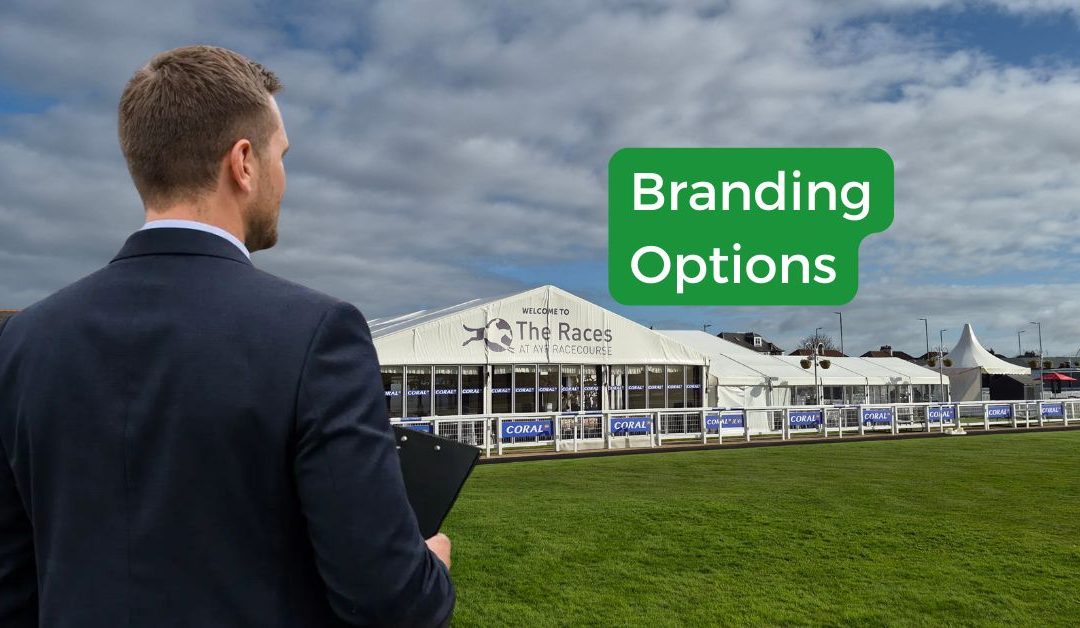
A marquee can do two jobs at once. It has to function as reliable event infrastructure, and it often needs to carry the brand story for the organiser, sponsor or client. That is where marquee branding options become part of the build plan rather than an afterthought. If the structure is front and centre on a showground, in a city-centre location or within a hospitality compound, the branding needs to work visually and operationally.
For experienced event teams, that usually means asking a different set of questions from the start. Not just what should the marquee look like, but where will branding be seen from, how will it be fixed, what weather will it face, and what is realistic within the programme. Good branding is rarely about adding more graphics. It is about putting the right message in the right place on a structure that still has to be built safely, accessed properly and handed over on time.
What marquee branding options actually cover
When people talk about marquee branding options, they can mean several different elements. Sometimes it is a printed gable or fascia carrying a clear event name above the main entrance. Sometimes it is large-format external branding designed to be seen from distance across a site. In other cases, the focus is internal, with branded linings, partition walls, bars, stages or hospitality areas creating a controlled guest experience.
The key point is that branding on a temporary structure is not one single product. It is a coordinated package made up of graphics, materials, fixing methods and sightline decisions. A solution that works for a sponsor village at a golf event may not suit an agricultural show ring, and what works for a television compound may be completely wrong for a premium drinks reception.
That is why the best approach is to treat branding as part of infrastructure planning. It needs to sit alongside the layout, entrances, crowd movement, lighting positions, power routes and fire exits. If those conversations happen early, the result is cleaner and far easier to deliver.
External marquee branding options
External branding carries the heaviest pressure because it often has to work at distance and in changeable conditions. A branded entrance gable is one of the most common choices because it gives the structure a clear identity without overcomplicating the build. It works particularly well for public-facing events where visitors need immediate visual confirmation that they are in the right place.
Printed fascias and valances can also be effective, especially on structures used for catering, ticketing or sponsor activation. They are straightforward, visible and usually easy to integrate into the front elevation. The limitation is scale. If the marquee sits within a large open site, smaller fascia branding may disappear once the crowd arrives.
For larger events, banner frames, mesh panels and full-height printed walling can create much stronger impact. These are useful where the marquee itself forms part of the site backdrop or where the sponsor package depends on high visibility. The trade-off is practical. Larger branding areas need proper wind consideration, suitable fixing points and accurate sizing. They also need a cleaner programme, because late artwork or last-minute changes can quickly affect print production and installation.
Full wraps are sometimes the right answer, but only in the right setting. They can be highly effective for broadcast environments, premium launches and enclosed compounds where the entire structure needs to become a branded asset. They can also be expensive, harder to amend and less forgiving if the site layout changes. In many cases, a more selective approach delivers better value and fewer operational compromises.
Internal branding and guest experience
Some of the most effective branding is not visible from outside at all. Inside the marquee, branding can shape how guests experience the event once they are through the door. This matters particularly in hospitality, corporate events and premium public areas where the brief is about environment as much as visibility.
Printed wall panels, branded bars, entrance features and stage backdrops can help carry a consistent identity across the space. Flooring choices, furniture finishes and lighting colour can also reinforce the brand without relying on heavy graphic coverage. In a well-planned scheme, these quieter elements often do more than a wall full of logos.
Internal branding also allows for tighter control. There is less exposure to weather, fewer concerns about long-distance legibility and more freedom to build a polished finish. That said, the same operational logic still applies. Graphics must not interfere with emergency signage, access points, catering routes or working areas behind the scenes. If a marquee is serving several functions at once, hospitality at the front and event operations at the rear, the branding strategy needs to reflect that split.
Choosing the right branding for the site
Not every site wants the same answer. A rural showground with long approach roads gives you more opportunity for bold external identification. A tight urban site may need branding to do more wayfinding work than promotional work. A corporate hospitality enclosure may need restraint rather than maximum coverage.
This is where context matters. Viewing distance changes everything. A graphic that looks perfect on a screen can feel underwhelming when placed on a 15-metre elevation facing an open field. Equally, a design created to shout across a crowd can feel clumsy inside a premium reception space.
Wind exposure, ground conditions and vehicle access also play a part. If branding needs specialist frames, lifting equipment or extra installation time, that has to fit the broader build sequence. On busy event sites, access windows can be tight and several contractors may be working around the same structure. The practical question is never just can this be branded. It is can it be branded properly, safely and without creating pressure elsewhere on the programme.
Planning artwork, production and installation
The earlier branding enters the project, the better the outcome tends to be. That is partly about design quality, but mostly about delivery. Event teams often work to moving targets with sponsor approvals, changing footprints and evolving guest numbers. Marquee branding sits right in the middle of those changes, so it benefits from clear ownership and realistic deadlines.
Artwork needs to be prepared to the correct dimensions for the structure, not estimated from a generic plan. Printed panels, tensioned graphics and branded skins all depend on accurate measurements and fixing details. If the design team is working from old drawings or provisional layouts, errors tend to show up late, when there is least time to resolve them.
Print production also needs breathing room. Large-format items are not the sort of thing to leave until the week of the build if quality matters. Materials, weather resistance, colour consistency and finishing details all affect the result. The installation plan matters just as much. Some branding can go in during the structure build, while other elements are better fitted after flooring, lighting or interior lining is complete.
For high-pressure projects, this coordination is often where an experienced infrastructure team proves its value. The marquee, the branding and the build sequence all need to work together. Purvis Marquee Hire regularly sees the difference between branding that has been folded into the delivery plan and branding that arrives as a late extra. One usually looks calm and deliberate. The other usually creates unnecessary site pressure.
Common mistakes with marquee branding options
The most common mistake is designing for appearance alone. Branding has to look right, but it also has to survive the site, suit the structure and remain legible in real conditions. Fine detail, poor contrast and overcomplicated layouts often fail once they are scaled up.
Another issue is trying to brand every surface. More printed area does not automatically mean more impact. In fact, too much coverage can make the structure feel cluttered and reduce the visibility of the messages that actually matter. A cleaner hierarchy usually works better, with one or two key branding moments supported by secondary detail in the right places.
Late decision-making is another frequent problem. If branding is left until the structure is already designed and scheduled, choices become limited. Fixings may be compromised, costs may rise and the final finish may not match the ambition of the event.
When simple is better
There are plenty of events where a straightforward branding package is the right call. Clear entrance identification, a strong internal focal point and carefully branded hospitality areas can be enough to deliver a professional result. This is especially true where budget is under pressure or where the site already contains multiple visual elements competing for attention.
The best marquee branding options are not always the biggest or most expensive. They are the ones that fit the site, support the event’s purpose and can be delivered without adding friction to the programme. When branding is planned with the same care as access, power and layout, the marquee does more than shelter the event. It starts working as part of the event identity from the moment people see it.