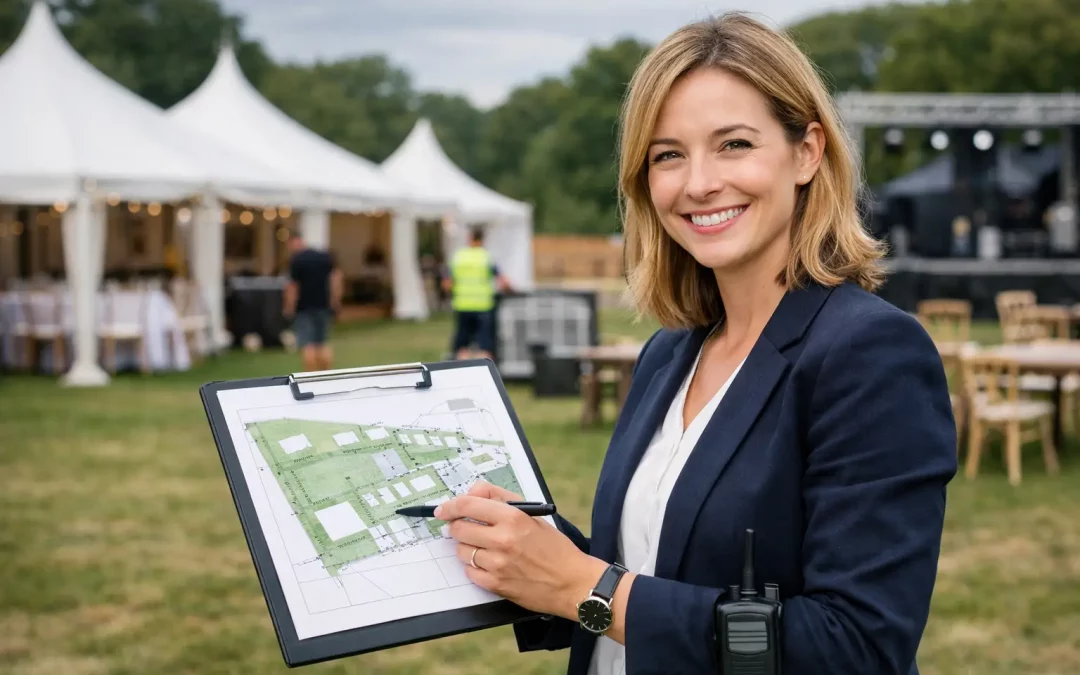
When a site plan looks tidy on paper but falls apart during build, the problem is rarely the drawing itself. It is usually that event site layout planning started too late, or focused on what should go where before dealing with how the site will actually function under pressure. On live projects, access routes, ground conditions, service runs, public flow and build sequencing matter just as much as the footprint of the structure.
For professional organisers, layout planning is not a presentational exercise. It is an operational decision that affects programme, compliance, contractor movement, attendee experience and budget. A strong layout helps everyone work faster and safer. A weak one creates friction from the first vehicle arrival through to breakdown.
What event site layout planning really needs to achieve
At its best, a site layout does three jobs at once. It creates a workable environment for the public, a manageable environment for staff and suppliers, and a buildable environment for the infrastructure team. Those three aims overlap, but they are not always identical.
A hospitality enclosure might want the best view line and the shortest guest route from arrivals. The power team may need a different position to reduce cable runs. The build crew may need clear plant access and enough working room around the structure. Event site layout planning is about balancing those requirements early, before they become expensive compromises on site.
That balance is especially important on temporary event sites because few locations are neutral. A showground may have easy access but uneven ground and restricted tie-in points. A city-centre event may have level surfaces but tight delivery windows, public interface issues and limited plant movement. Rural sites can offer space, but weather exposure and ground protection quickly become central to the plan.
Start with the site, not the structure
One of the most common mistakes is choosing marquee positions, compound areas or hospitality zones before the site has been properly interrogated. A recce should do more than confirm available square metreage. It should establish how the site behaves.
Ground condition is one of the first variables. A field that is acceptable for public use may still be problematic for heavy vehicles, forklifts or temporary flooring. Slopes, soft patches, underground services and drainage all affect where structures can sit and how they can be built. If the event relies on ground protection, that requirement should inform the layout from the outset rather than being added as a late fix.
Access is the next pressure point. It is not enough to know where the gate is. You need to know whether artics can turn in, whether there is space for waiting vehicles, whether build traffic conflicts with public roads, and how emergency access will be maintained once the event is live. Many site issues come down to route width, turning circles and timing rather than headline capacity.
Then there is exposure. Open sites can look ideal until wind direction, rainwater movement or poor shelter for guest arrivals are factored in. Positioning structures with weather in mind can improve comfort and reduce strain on operational areas such as catering entrances, crew welfare and production compounds.
Build the layout around movement
A good event feels easy to navigate because the hard work has been done behind the scenes. Guests should understand where to go without being funnelled into obvious pinch points. Suppliers should be able to reach service areas without crossing main public routes. Staff should not have to improvise because storage, welfare or back-of-house access was squeezed out of the plan.
This is where circulation matters more than footprint. It helps to think in layers. Public flow needs enough width, clear sightlines and natural decision points. VIP and hospitality routes may need to feel more controlled and direct. Back-of-house routes should be practical rather than pretty, with enough clearance for replenishment, waste removal and technical support.
The trade-off is space. Every route, set-back and service corridor uses area that could otherwise be given to audience capacity or premium structures. But reducing circulation to gain floor space often creates a poorer event and a harder build. If a catering team cannot restock efficiently, if accessible routes are awkward, or if emergency egress is compromised by furniture or fencing lines, the original saving was never a saving.
Event site layout planning for infrastructure, not just attendance
Event plans often give plenty of attention to front-of-house experience and not enough to what sits behind it. Temporary infrastructure needs room to operate properly. That includes plant access, generator positions, toilet servicing, waste handling, storage, and clear runs for power, lighting, water and drainage where required.
These support functions should not be treated as afterthoughts tucked into leftover corners. Generator placement affects noise, cable distance and refuelling logistics. Toilet units need practical servicing access as well as sensible user proximity. Fencing lines can improve crowd management, but they also shape vehicle movement and emergency response routes.
Large temporary structures also need working room during build and strike. A marquee position may fit perfectly once complete, yet still be wrong if there is insufficient space to unload, assemble and install safely. This is particularly relevant on tight urban sites, venue lawns, and heritage locations where access and ground loading are constrained.
For complex events, the best layout is usually the one that considers build sequence early. Not every area of the site becomes available at the same time, and not every contractor arrives in the same order. A layout that works in the live event phase but ignores the build phase can still fail.
Safety, compliance and live-site control
Safety planning should be visible in the layout, not buried in separate paperwork. Emergency routes, fire points, sterile areas, crowd barriers, vehicle restrictions and staff-only zones all need to appear clearly and function in practice.
This matters because compliance is rarely about whether an item exists. It is about whether it is usable when the site is busy, dark, wet or under pressure. An emergency access lane that doubles as an overflow storage area is not an emergency access lane. A fire exit route that depends on furniture staying exactly where planned is a risk waiting to appear.
For public events, local authority and stakeholder expectations often extend beyond minimum compliance. They may want reassurance on crowd segregation, ingress and egress, blue light access, traffic interface and protected surfaces. The site layout becomes a shared working document, not just an internal plan.
That is one reason experienced delivery teams challenge layouts before build begins. It is easier to adjust positions on a drawing than to move structures, reroute power or rebuild fencing once the programme is live.
Why collaboration early on saves time later
The strongest layouts are usually developed with input from multiple disciplines early in the process. Event management, production, infrastructure, catering, security and venue representatives all see different risks. None of them on their own has the full picture.
There is a practical discipline to this. Not every project needs endless rounds of planning. But the right conversations at the right stage can remove weeks of avoidable friction. If the infrastructure team flags a poor access route early, the organiser can rethink contractor scheduling. If production identifies sightline conflicts with a hospitality marquee, that can be resolved before branding, power distribution and guest flow are built around the wrong position.
For high-pressure projects, this joined-up approach is often the difference between a site that feels controlled and one that spends the build chasing revisions. Companies such as Purvis Marquee Hire are often brought in at this point because layout planning is not just about placing a structure. It is about making the whole temporary environment work as an operational system.
Common layout issues that cause avoidable problems
Most site failures are not dramatic. They show up as delays, small safety workarounds, awkward guest journeys and crews losing time. The same issues appear again and again: compound areas too small for actual deliveries, service roads blocked by parked vehicles, toilets positioned without servicing access, and hospitality spaces that look right but ignore wind, noise or drainage.
Another regular issue is underestimating what back-of-house needs to function. Event teams rightly focus on audience experience, but the public-facing result depends on invisible space being protected. If staff welfare, storage, waste handling and technical support are all squeezed into residual areas, the event starts to lean on improvisation.
There is also the question of flexibility. Some layouts are so tightly optimised that they leave no room for change. That can be risky on sites where weather, revised attendance figures or late stakeholder requests are likely. A little resilience in the plan is often worth more than theoretical efficiency.
Getting the plan right before boots hit the ground
The aim is not to create the most elaborate site drawing. It is to produce a layout that can be built safely, operated efficiently and adapted sensibly if conditions shift. That means starting with real site constraints, testing movement and service needs properly, and making sure each area works in relation to the others.
Experienced organisers know this already: the site always tells you what is possible. Good planning listens early. If the layout reflects how the event will genuinely be built and run, the rest of the project has a far better chance of staying calm when the pressure comes on.