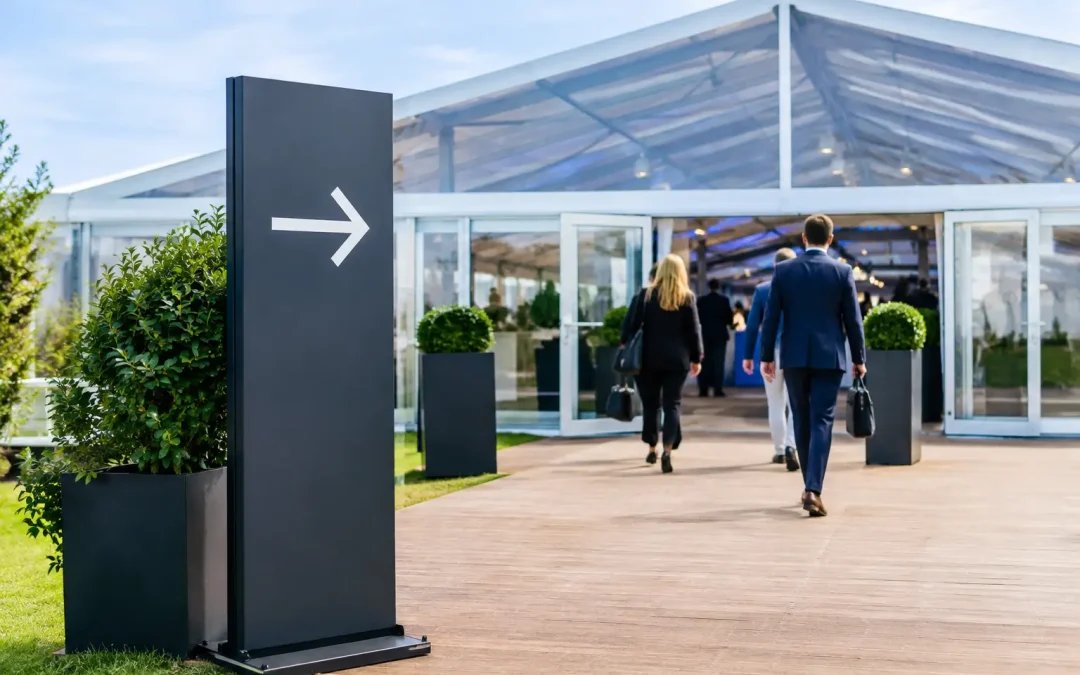
A guest who misses a turning at a large event does not simply lose a few minutes. They can join the wrong vehicle queue, enter through an unsuitable gate, walk against service traffic or arrive frustrated at a hospitality area. The best event wayfinding signage prevents those problems before they become a radio call, a crowd pinch point or a poor first impression.
For major outdoor events, wayfinding is an operational system rather than a finishing touch. It must work for visitors arriving in unfamiliar surroundings, suppliers unloading under time pressure, staff moving between zones and emergency teams needing clear access. The signage plan needs to reflect how the site will operate in reality, including changing ground conditions, vehicle movements, temporary structures and the volume of people expected at each point.
What makes the best event wayfinding signage?
The strongest schemes start with the journey, not the sign design. An organiser should be able to trace every key user group from the public highway or venue boundary to their final destination, then identify the decisions they must make along the way.
For a county show, that may mean separating public parking, exhibitors, livestock transport, accessible drop-off and service access long before vehicles reach the main gate. At a corporate garden party, the priority may be directing guests from arrival and security screening to reception, cloakroom, hospitality marquees and toilets without disrupting the presentation of the site. A festival has a different challenge again, with arrival waves, camping, welfare, arena entrances and late-night movement all requiring consideration.
Good wayfinding answers one question at a time. At a junction, people need a clear direction. At an entrance, they need reassurance they are in the correct place. Once inside, they need consistent information that confirms their route and points them towards the next decision. Trying to show every facility on every sign creates hesitation rather than confidence.
Begin at the approach route
The event experience often begins several miles from the event boundary. Temporary directional signs, advance notices and appropriately agreed road signage can reduce late turns and unnecessary traffic on local roads. These elements require early discussion with landowners, highways teams, venues and event control, particularly where a site relies on narrow rural roads or limited turning space.
At the site entrance, vehicle and pedestrian instructions must be distinct. A sign that is legible to a driver moving through a busy ingress point is not necessarily suitable for a pedestrian leaving a car park. Consider sightlines, speed of approach, queuing arrangements and whether staff will need to give instructions beside the sign. Positioning is as important as the wording.
Design wayfinding around actual site flows
A site plan on a screen can appear orderly while the live event tells a different story. Fencing lines change, a gate moves to accommodate an emergency route, a wet patch affects pedestrian access or a production compound expands. The best event wayfinding signage is designed alongside the wider infrastructure layout, not added after marquees, generators, toilets and catering units have been fixed in place.
Start by mapping the principal routes: public arrival, VIP or hospitality arrival, exhibitors, staff, contractors, emergency access and waste or servicing. Where these routes cross, decide whether they can be separated through fencing, timed movements or stewarding. Signage should support that decision, never be the only control measure.
A useful site walk before print and installation will identify issues that drawings cannot always show. Is a sign obscured by a hedge, parked vehicle or queue? Will a marquee wall or branded façade block the view from the approaching path? Does the route remain usable after dark? Can wind catch a freestanding panel? These practical checks avoid expensive last-minute changes.
Give every zone a clear identity
Large temporary sites are easier to manage when areas have simple, consistent names. Use those same names on maps, radio briefings, ticket communications, staff instructions and physical signs. If the reception marquee is called the “Main Pavilion” on one plan, “Hospitality” on another and “Guest Lounge” on signage, guests and crew will lose time trying to translate the information.
Zone names should be short, distinctive and easy to communicate over radio. Colours can help, especially where the audience is moving between multiple halls, marquees or activity areas, but colour should not carry the instruction on its own. Clear text, symbols and directional arrows remain essential for accessibility and low-light conditions.
Make signs readable in live-event conditions
Legibility is a technical requirement. Type size, contrast, arrow design, mounting height and viewing distance need to match the setting. A small sign may work at the entrance to a meeting room but will fail beside a busy pedestrian thoroughfare. Equally, oversized panels can clutter a premium hospitality environment if their location and message have not been considered carefully.
Use high-contrast lettering and straightforward language. Avoid internal terminology that means little to the public. “Accreditation”, for example, may be familiar to a production team but may need further direction or a clearer label for visitors. Where a symbol is used, it should be widely understood and supported by text where there is any risk of ambiguity.
Weather and lighting also matter. Scotland and the north of England can deliver rain, wind and low light in the same event day. Materials, fixings and ballast must be appropriate to the exposure and ground conditions. Signs need to remain secure without creating trip hazards, and any temporary electrical illumination should be planned with the wider power distribution and cable management arrangement.
Balance branding with clarity
Wayfinding presents a valuable branding opportunity, particularly at corporate events, premium hospitality programmes and public-facing festivals. However, a sign is not a poster. Heavy graphics, sponsor messaging and low-contrast colour palettes can make the actual instruction difficult to find.
The practical approach is to establish a hierarchy. The directional message should be immediately visible, while branding supports the experience without competing with it. Repeating a small number of visual cues across welcome signs, maps, flags, information points and marquee entrances creates a more coherent site than treating each item as a separate design exercise.
There is also a trade-off between polished presentation and flexibility. Printed, fully branded boards can look exceptional but are harder to amend when the layout changes. For complex or multi-day sites, a combination of branded primary signage and adaptable inserts, panels or overlays can give organisers more control. This is particularly useful where final tenant locations, sponsor activations or programme details are still being confirmed during the build.
Plan for safety, accessibility and the back of house
Public wayfinding receives the most attention, but operational signage is equally important. Clear identification of first aid, welfare, accessible toilets, emergency exits, muster points and lost-child or information points supports both visitor confidence and incident response. These signs must be visible when the site is busy, not hidden behind queues, furniture or temporary displays.
Accessibility should be built into the route plan from the start. That means considering gradients, surface conditions, crossing points, turning areas, step-free entrances and the distance between key facilities. A sign directing someone towards an accessible entrance is only useful if the route beyond it remains accessible in wet weather and after the site has been dressed.
Back-of-house signs help protect public areas and keep deliveries moving. Loading entrances, crew parking, production offices, catering service points, waste areas and plant compounds should be clearly identified. On a large build, these details reduce unnecessary vehicle circulation and make it easier for suppliers to reach the correct area without crossing public routes.
Install early, then inspect again
Wayfinding should be installed early enough to support contractors and crew during the build, not only before gates open. It gives delivery teams confidence that they are entering the right route and reduces pressure on gate staff. Some public-facing signs may need to wait until the final dressing stage, but core directional and operational signage should be part of the site mobilisation plan.
Before opening, walk the route as a first-time visitor, then as a supplier and as a member of staff responding to an incident. Check the approach from each relevant car park, gate and transport drop-off point. Review signs in daylight and after dark, and ask whether a person can understand the next action without needing to stop and search.
Once the event is live, retain a process for updates. A closed path, relocated activity or changed entry point must be reflected quickly through signs, staff briefings and any digital visitor communications. Temporary events are dynamic by nature, and a well-managed wayfinding system allows the site team to respond without confusing the audience.
For complex sites, the most effective signage is rarely the most decorative. It is the signage that has been planned with access routes, temporary structures, crowd movement and the realities of a live build in mind. When every person can find the right place without asking, the whole event feels calmer, safer and better managed.