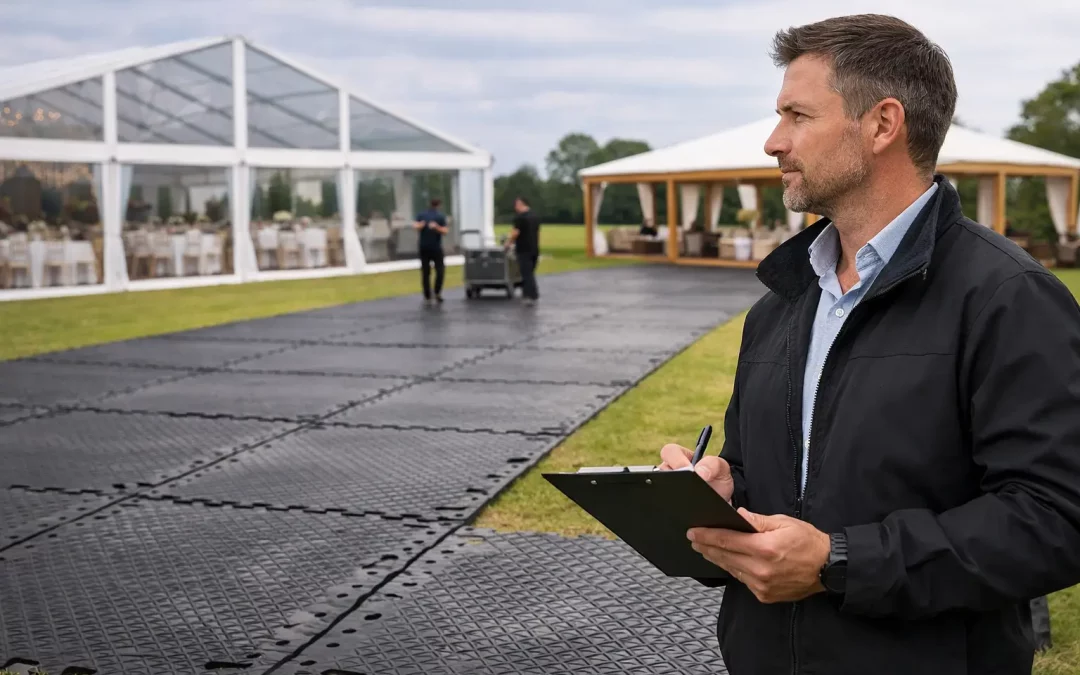
A heavy hospitality unit arriving on wet grass can turn a well-planned build into a recovery job in minutes. That is why ground protection mats events teams use are not an optional extra on many sites – they are part of the infrastructure plan from the outset. When vehicle access, public safety, turf protection and programme certainty all matter, the ground beneath the event needs just as much attention as the structure above it.
For organisers working across parks, estates, sports grounds, showfields and temporary city-centre locations, ground conditions are rarely consistent. One part of a site may carry plant and lorries comfortably, while another softens after a night of rain or breaks up under repeated traffic. That variation creates risk not only for access, but for reinstatement costs, build speed and the overall professionalism of the event delivery.
Why ground protection mats events teams plan early
The biggest mistake is treating mats as a last-minute fix when the forecast changes. By that stage, routes may already be congested, deliveries scheduled too tightly and ground damage starting to appear. Planning earlier allows the matting layout to support the whole build sequence, from first vehicle movements through to de-rig.
On a live event site, mats often do more than protect grass. They can establish clean access routes for forklifts, telehandlers and service vehicles, stabilise pedestrian areas, create back-of-house working zones and reduce churn at loading points. If the event includes premium hospitality, broadcast compounds, public queuing or welfare units, those high-traffic areas tend to show wear first. Protecting them early is usually far cheaper than repairing them later.
This matters particularly on sites with multiple stakeholders. A local authority, private estate, racecourse or sports venue will often have clear expectations around reinstatement and surface care. When access planning is thorough, those conversations are easier because the organiser can show how ground loading, route protection and recovery risk are being managed.
What ground protection mats for events actually solve
At a practical level, matting helps spread load and reduce direct pressure on sensitive ground. That is useful, but it is only part of the picture. Good ground protection also improves traction, keeps vehicle movements more predictable and reduces the chance of a lorry or plant item getting bogged down halfway through a build.
For event managers, the operational benefit is often time. A delayed delivery because access has failed can affect several trades at once. Flooring, catering equipment, toilets, generators, fencing and production kit all rely on dependable movement across site. If one key route breaks down, the programme starts to tighten very quickly.
There is also a public-facing issue. Churned grass, muddy crossings and uneven pedestrian areas do not just look poor – they can create slip and trip hazards, especially in wet weather. For public events, agricultural shows and festivals, that has a direct bearing on visitor experience as well as site safety.
Not all sites need the same matting strategy
A flat private lawn for a short corporate event is very different from a multi-day festival on mixed terrain. The right approach depends on the ground type, expected weather, weight of vehicles, duration of use and the density of traffic.
On some sites, a few protected access lanes are enough. On others, compounds, service roads, plant areas and pedestrian interfaces all need separate treatment. Soft ground near gateways is a common failure point because it carries concentrated traffic from the first hour of build to the last hour of de-rig. Slopes, turning circles and repeated delivery points also need careful review.
There is a trade-off to consider here. Over-specifying matting adds cost and can complicate installation if areas are protected that never see meaningful traffic. Under-specifying can be more expensive still if access fails, turf is damaged or plant has to be recovered. The sensible approach is to match the protection to the actual load paths and site behaviour rather than applying a one-size-fits-all plan.
Vehicle access and plant movement
The heaviest risk usually comes from vehicle movements rather than footfall. Artics, rigid lorries, forklifts, telehandlers, cherry pickers and service vehicles all impose different loads and turning pressures. A route that works for vans may fail completely once plant starts moving across it repeatedly.
This is where site knowledge matters. It is not only about the static weight of a vehicle, but how it will move, stop, turn and queue. Reversing areas and pinch points often suffer more than straight runs. If access is tight, matting may need to extend further than expected simply to support manoeuvring.
Public areas and finish quality
Front-of-house use needs a different eye. In pedestrian zones, the concern is often stability, cleanliness and presentation as much as ground loading. Routes to marquees, toilets, catering zones and entrances need to feel safe and well considered. For premium events, that finish matters. Guests may never think about the surface underfoot unless it is poor.
How matting fits into broader event infrastructure
Ground protection works best when it is planned alongside the rest of the infrastructure package, not separately from it. Access routes affect where marquees can be built, how plant reaches the structure, where generators sit, how toilets are serviced and how waste is removed. If each element is designed in isolation, conflicts appear on site.
A well-managed build programme will consider the order of installation, the space needed for trades to work safely and how routes change as the site develops. For example, a delivery lane that works on day one may become obstructed once flooring, fencing or plant compounds are in place. Matting layouts need to reflect that sequence.
This is one reason experienced event infrastructure teams treat site access as a planning discipline in its own right. At Purvis Marquee Hire, ground protection is typically considered as part of the wider delivery model, alongside structures, plant access, safety paperwork and on-site coordination. That joined-up approach reduces the number of surprises when the build is under pressure.
Common planning points organisers should not overlook
The first is weather tolerance. A site that looks firm during a recce can behave very differently after sustained rain, especially if it has a clay base or poor drainage. Planning for average conditions is rarely enough on exposed outdoor sites in Scotland or the north of England.
The second is timing. Mats need to go down before damage starts, not after. If they are installed only once rutting begins, access may already be compromised and the protected route less effective.
The third is reinstatement responsibility. Venue owners are understandably focused on what the site will look like afterwards. Clear ground protection planning, backed by sensible route design, helps avoid disputes over damage and gives confidence that the event is being delivered responsibly.
The final point is coordination. Ground protection interacts with fencing lines, emergency access, cable runs, welfare locations and traffic management. It is not a standalone decision. The more complex the event, the more valuable it is to have one delivery team considering those dependencies together.
When ground protection mats events depend on most
There are certain scenarios where matting moves from useful to essential. Large public attendance on grass, premium temporary hospitality, broadcast compounds, agricultural events, winter programmes and sites with limited hardstanding all sit firmly in that category. So do events where vehicle movement continues during live operation, such as service access to catering, toilets or production areas.
It also becomes critical where reputation is on the line. High-profile events are judged on finish as well as function. A slick structure and polished branding lose some impact if approach routes are muddy and service vehicles leave scars across the venue.
For experienced organisers, that is the real value of proper ground protection. It protects the surface, certainly, but it also protects the schedule, the site relationship and the standard of delivery.
The best event infrastructure plans are usually the ones nobody notices on the day. Guests arrive, suppliers move, the venue stays intact and the build team are not fighting the ground at every turn. If the site has vulnerable surfaces, mixed terrain or any chance of difficult weather, ground protection is not an add-on. It is part of building an event that works properly from first delivery to final clear-down.