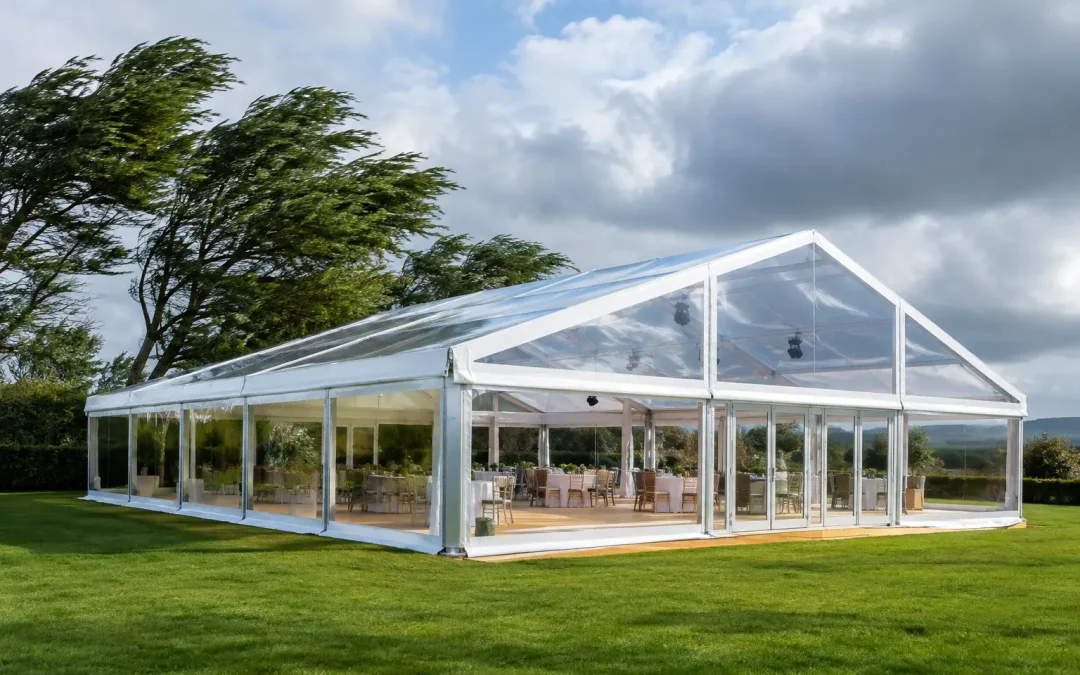
A gust front moving across an exposed showground can change site conditions in minutes. So, are marquees safe in wind? Yes – when the structure is correctly specified, installed to the manufacturer’s requirements, suitably anchored and actively managed as part of a proper weather plan. A marquee is not simply a cover placed on a field. For a public event, it is temporary infrastructure with engineering, operational and crowd-safety considerations attached.
For event managers, the useful question is not whether a marquee can withstand wind in general. It is whether this particular structure, on this ground, with this layout and this operational plan, is suitable for the forecast conditions. That assessment should begin well before the first lorry reaches site.
Are marquees safe in wind? It depends on the full system
A professionally installed marquee can be designed for significant wind loads, but its safety relies on the complete system working as intended. The frame, roof covers, leg profiles, anchoring method, ballast, sidewalls, doors, flooring and any attached equipment all affect performance.
Wind creates more than a simple sideways force. It can lift roof sections, place pressure on gable ends, move loose doors and create changing loads where one side of a structure is more enclosed than another. Gusts can be more demanding than a steady breeze, particularly around buildings, trees, grandstands or changes in ground level where wind can accelerate or change direction.
This is why a wind rating should never be treated as a blanket promise. The applicable limit depends on the manufacturer’s specification and on the exact build configuration. Adding a run of leg extensions, opening multiple sidewalls, fitting banner skins, connecting structures or placing a marquee beside a larger building may change how the structure behaves. Any decision should be based on the approved design and current site conditions, not a rule of thumb from a previous event.
The structure must suit the site
Site choice and orientation are among the earliest safety decisions. An open agricultural showground, a coastal hospitality area and a city-centre square may all present very different exposure levels, access constraints and anchoring options.
Where ground conditions allow, stakes or ground anchors can provide an efficient fixing method. Their suitability depends on the ground itself and on confirmation that underground services are identified and protected. Hardstanding, heritage surfaces, paved areas and some venue sites may require a ballasted solution instead. Ballast must be calculated, positioned and secured for the structure being built – not improvised with whatever is available on site.
A competent supplier will also consider drainage, levels and vehicle routes. Saturated ground can affect access and anchoring performance. Uneven ground may require careful levelling and floor design. Lorries, plant and delivery vehicles need a managed route that does not undermine newly installed anchors, damage flooring or create conflict with the live event footprint.
At Purvis Marquee Hire, that practical planning is treated as part of the build rather than an administrative exercise. A clear site plan helps the installation team work safely, but it also gives the event team a reliable basis for security, catering, production and guest-flow decisions.
Design details matter more than many organisers expect
Large clearspan marquees and temporary event structures are designed as systems. Altering one element without considering the rest can introduce avoidable risk.
Sidewalls are a good example. They provide weather protection, privacy and a finished presentation, but they also affect wind loading. Doors, sliding panels and gable-end openings need to be used as intended and kept properly secured. If a door is repeatedly left open during high winds, the internal pressure and movement within the structure can differ from its planned configuration.
Branding and production additions deserve the same attention. Large graphics, flags, temporary signs, lighting trusses, cable runs, heaters, air-handling equipment and suspended décor all need to be considered within the structural and operational plan. A lightweight item can still become hazardous if it is poorly fixed; a heavier item may introduce a load that requires approval before installation.
The same applies to linked structures. Entrance canopies, catering tents, walkways and back-of-house units are often essential to a working event site, yet they create junctions and interfaces that must be designed properly. The objective is not just to keep each individual unit standing, but to ensure the whole temporary environment performs safely in changing weather.
Weather monitoring needs a named owner
A forecast checked during the planning meeting is useful, but it is not a weather plan. Conditions can change quickly, particularly on Scottish and northern English sites where local topography and passing fronts can produce sharp gusts and heavy rain.
Before the event, the organiser and infrastructure supplier should agree who is responsible for monitoring conditions, how information will be shared and who has authority to make operational decisions. That includes decisions to close doors, secure loose equipment, pause activity, clear an area or, where necessary, evacuate a structure.
On a major event, this should sit within the wider event management plan alongside communications, security, medical provision and emergency access. Site teams need a straightforward route for escalating concerns. If a member of staff notices movement in a sidewall, a loose banner or pooling water around an entrance, they should know exactly who to contact and what happens next.
Wind speed alone does not tell the whole story. Direction, gust strength, rainfall, ground condition and the stage of the event all matter. A structure may be sound, but a busy entrance, an exposed queue line or unsecured furniture outside it could still present a problem. Operational response should therefore look at the guest environment as well as the frame.
Build quality and inspection cannot be separated
The safest specification on paper can be undermined by poor installation. Frames must be assembled correctly, covers tensioned, pins and connections checked, anchors installed to plan, ballast secured and drainage managed. Once the build is complete, the structure should be inspected before handover and checked again throughout the event where conditions warrant it.
Event activity can alter a site after the initial inspection. Catering teams may move equipment. Production crews may add cable ramps or drape. Deliveries can affect an entrance area. Public use can put pressure on doors, flooring and barriers. Regular walk-rounds by people who understand the site are a sensible control, especially during high winds, overnight periods and changeovers.
There is also a clear distinction between a temporary structure that is physically standing and one that is ready for public use. Fire exits, emergency lighting, access routes, signage and crowd-management measures must remain functional. In severe weather, keeping routes clear and communications calm is as important as the marquee itself.
When should an event team take action?
Action thresholds should be agreed in advance, based on the structure’s documentation, forecast information and the event risk assessment. They should not be invented at the point pressure is highest.
A sensible wind action plan sets out what happens at increasing levels of concern. Early actions may include securing doors, removing external furniture, pausing work at height and checking anchors or ballast. At higher thresholds, teams may restrict access to particular areas, close a structure or implement an evacuation plan. The exact measures will vary, but the principle remains the same: act early, communicate clearly and do not wait for visible damage before responding.
This is especially relevant for public-facing events with packed schedules. A delayed opening or short interruption can be frustrating, but it is preferable to asking staff and guests to remain in an environment that is no longer operating within its planned conditions. Experienced event delivery is often about making calm decisions before a situation becomes dramatic.
Choose a supplier that plans beyond the frame
For complex events, marquee safety in wind should form part of supplier selection from the outset. Ask how the proposed structure will be anchored, what information is needed about the ground, how weather will be monitored, what documentation will be supplied and how on-site changes will be controlled. A capable partner should be comfortable discussing access, plant movements, floor levels, emergency procedures and build sequencing as readily as roof profiles and interior finishes.
The most useful preparation is to involve the structure provider early enough to influence the site plan. With the right design, fixing method, weather response plan and on-site management, a marquee can provide dependable accommodation in demanding conditions. The earlier those decisions are made, the more options the event team has when the forecast turns.