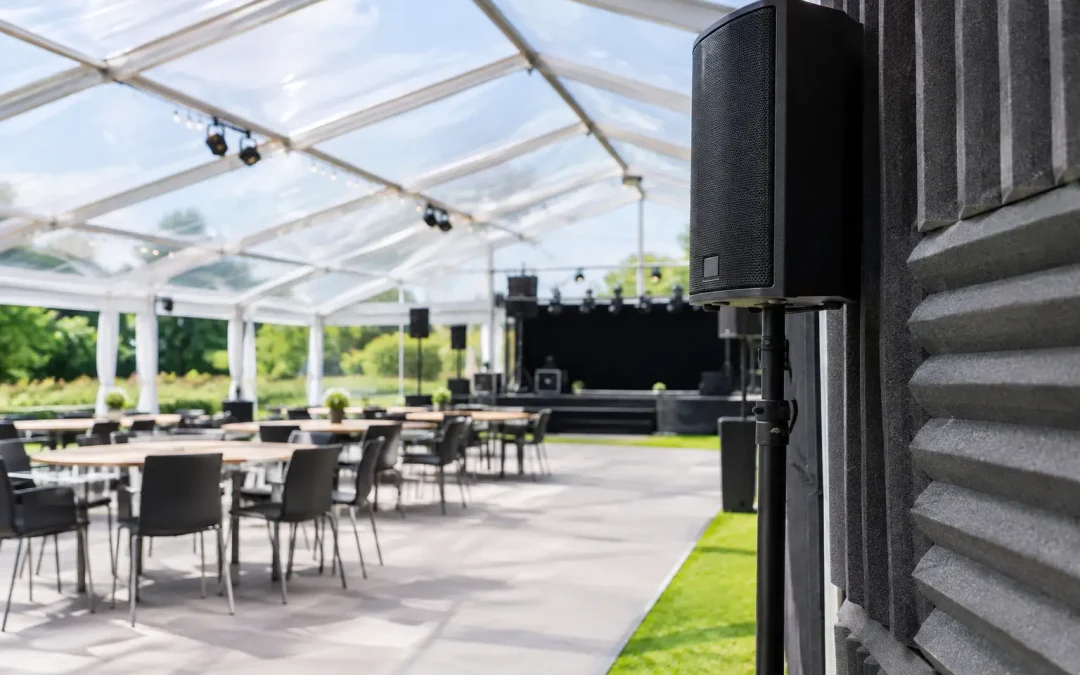
A late change to a stage position, an open marquee side facing housing, or a generator placed behind a hospitality area can turn a well-planned event into a noise complaint. This guide to event noise control is written for organisers who need to protect the audience experience while meeting licence conditions, maintaining good neighbour relations and keeping the site operational.
For major public events, noise is rarely only an audio issue. It is affected by site layout, wind direction, operating hours, temporary structures, crowd movement, plant, deliveries and the way separate contractors work together. The most reliable approach starts well before the first speaker, band or PA system arrives on site.
Start noise control at the site-planning stage
The first question is not simply how loud the programme will be. It is where sound will travel, who may be affected, and what activity will take place at different points in the day. A rural showground, a city-centre square and an estate event can all require very different controls, even where audience numbers and entertainment are similar.
Begin with a clear site plan that identifies stages, bars, catering compounds, generators, welfare units, entrances, exits, car parks and neighbouring properties. Include both public-facing and back-of-house noise sources. A site may have a tightly managed music system but still cause disruption through refrigeration plant, vehicle reversing alarms, crew radios, bottle disposal or overnight loading.
Topography matters. Sound can carry surprisingly far across open ground, water or hard surfaces. Buildings, banks, mature trees and temporary structures may offer some screening, but they should not be treated as a guaranteed acoustic barrier. Wind direction and atmospheric conditions can also change during a multi-day event, altering where sound is most noticeable.
Where a local authority has identified sensitive receptors, such as homes, care settings, schools or places of worship, map them early. This gives the production team time to adjust stage orientation, speaker locations, operating times or the event footprint before infrastructure is committed.
A guide to event noise control through layout and structure
Temporary event structures influence how sound behaves. A marquee can contain and reflect sound, particularly when it has hard flooring, linings and closed sidewalls. Equally, an open-sided structure can direct sound out towards neighbouring land if the orientation is wrong.
For a live music, awards or corporate programme, the choice of structure and layout should be discussed alongside the sound design. Consider where the stage sits, which elevations remain open, where entrances are positioned and whether speaker arrays are aimed into the audience rather than across the site. A smaller change to the layout on paper can prevent a difficult operational problem later.
There is a trade-off. Closing sides may reduce breakout in one direction but can make a space warmer and increase internal reverberation. That may lead to higher PA levels if speech clarity suffers. Heating, ventilation and audience comfort therefore need to be planned with acoustics rather than treated as separate workstreams.
Large marquee sites also benefit from separating noisy operational zones from quieter guest and neighbour-facing areas. Place generators, service yards and waste handling as far as practical from hospitality, accommodation and site boundaries. Where distance is limited, purpose-built acoustic treatment or screening may be appropriate, subject to safe access, ventilation and fire requirements.
Set realistic limits and agree who is in control
Noise limits should be established through the event licence, premises licence, landowner requirements and any discussions with environmental health officers. The wording can vary. Limits may apply at a site boundary, at the nearest residential façade, within a venue, or at a mixing position. They may also specify different limits by time of day or distinguish between music noise and other sources.
Do not leave interpretation to the show day. Agree the monitoring locations, measurement method, permitted levels and escalation process in writing. The sound engineer needs the same information as the event manager, site manager, production manager and security lead.
A useful noise management plan will identify the person with authority to request a reduction in level, the person who communicates with performers or technicians, and the route for logging decisions. When a concern is raised, there should be no uncertainty over who owns it.
It is also worth setting programme expectations with artists, presenters and production suppliers in advance. A headline act may require a different technical specification from a daytime acoustic performance, but neither should arrive to discover restrictions that could have been dealt with during contracting and advancing.
Monitor conditions, not just decibels
A sound level meter provides evidence, but it does not replace experienced listening. Numbers need context: the type of sound, its duration, bass content, time of day and how it is perceived at a sensitive location all matter. Low-frequency sound in particular can remain intrusive even when an overall reading appears acceptable.
Take baseline readings before the event begins where possible. This helps distinguish event sound from traffic, local activity or other background noise. During live operation, monitor at agreed points and keep a timed log of readings, wind conditions, programme activity and any adjustments made.
Monitoring should not be confined to the main performance. Check the site during sound checks, doors-open periods, changeovers, crowd egress, cleaning and close-down. A well-managed headline set can be undermined by an avoidable spike from post-event plant or late-night vehicle movements.
For larger or higher-risk events, appointing a dedicated acoustic consultant or competent noise monitor may be proportionate. This depends on the licence conditions, proximity of neighbours, event scale and programme. Their role is most effective when they can speak directly to the sound desk and the event control team, rather than reporting through several layers.
Control the quieter sources that generate complaints
Music is the obvious concern, but complaints often come from cumulative site noise. Good operational discipline can make a material difference, especially over several days of build, live operation and breakdown.
Plan delivery slots to avoid unnecessary early-morning or late-evening movements near residences. Brief drivers on approach routes, waiting areas, engine idling and prohibited access points. A lorry reversing in a constrained compound may be unavoidable, but repeated manoeuvring can often be reduced through proper traffic management and banksman support.
Specify quieter plant where available and position it carefully. Generators need suitable separation from occupied structures, safe fuel management and ventilation, but they should not be placed as an afterthought. Check temporary power distribution, refrigeration units, air handling equipment and lighting towers as part of the same review.
Crew behaviour matters too. Keep radio volumes controlled, designate smoking and break areas away from boundaries, and avoid bottle disposal or metal handling outside agreed hours. These details are straightforward, yet they demonstrate respect for the surrounding area and reduce the chance of a small issue becoming a formal complaint.
Prepare for concerns and keep good records
Even careful planning cannot remove every risk. A clear community and incident-response process gives the team a better chance of resolving issues quickly. Where appropriate, provide nearby residents or stakeholders with accurate event dates, core operating hours and a contact route for genuine concerns. Do not promise silence. Be clear about the nature of the event and the controls in place.
At event control, log every complaint with the time, contact details where provided, location, description of the issue, prevailing conditions and action taken. Send a competent person to assess the position rather than relying solely on a report relayed across site. If action is required, record the adjustment and follow up to confirm whether it has improved the situation.
This record is valuable if the local authority requests information, but its main purpose is practical: it helps the team spot patterns. Several reports from the same direction may indicate a speaker alignment issue, a temporary opening in the structure, or a plant item that has not been considered properly.
Build noise management into the event team
Noise control works best when it is part of the build plan, not a document produced for licensing and then set aside. Include it in contractor briefings, daily production meetings and site inspections. The infrastructure provider, sound team, power contractor, security manager and traffic management team all influence the result.
For complex sites, the value lies in coordinating those decisions early. At Purvis Marquee Hire, that means considering structure orientation, access routes, temporary power locations and operational zones as one site-delivery plan, with the needs of the event, the public and neighbouring community in view.
A well-run event does not need to feel constrained by noise management. It needs clear decisions, capable people and enough time to make adjustments before the site is under pressure. Put those controls in place early, and the sound people remember will be the programme you intended them to hear.