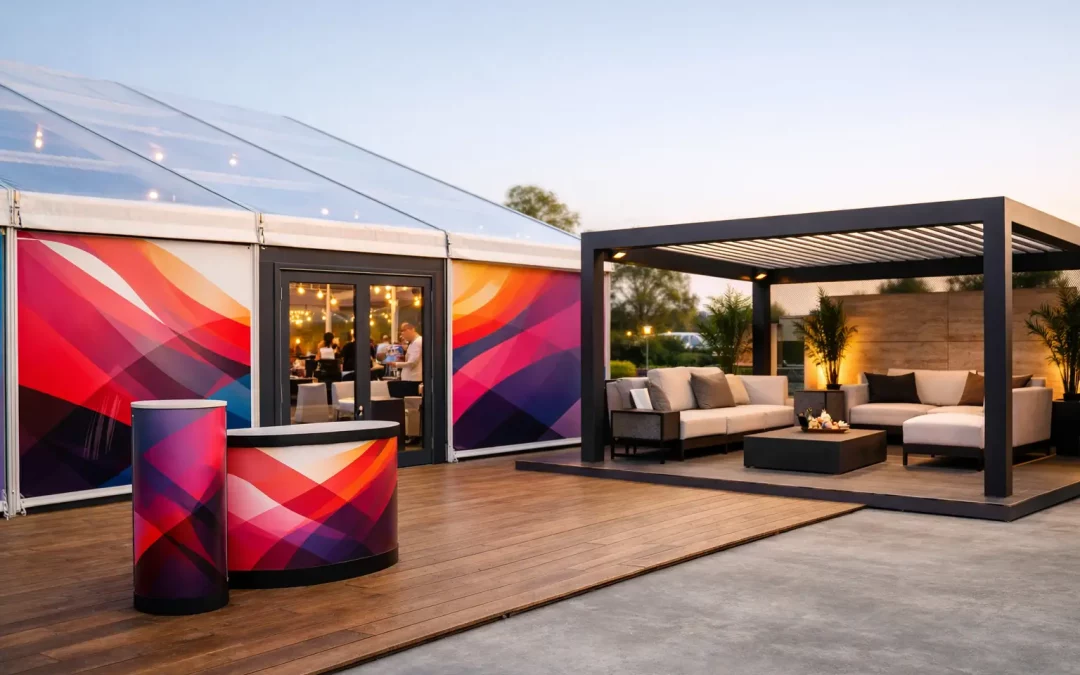
A branded event structure has to work harder than a banner on a wall. It must make the right impression from the approach, guide guests once they are on site and withstand weather, traffic and a live operational environment. Knowing how to brand event structures means treating branding as part of the infrastructure plan, not a final decorative layer added once the build is complete.
For a corporate hospitality enclosure, agricultural show, festival, city-centre activation or broadcast compound, the strongest result comes when the brand, site plan and construction programme are considered together. That avoids the familiar problems: graphics obscured by equipment, entrances that are difficult to find, poorly lit signs, or vinyls that look tired after one wet and windy day.
Start with the visitor journey, not the artwork
Before selecting branded panels, flags or printed fascias, map how people will arrive, enter, move through and leave the site. A guest may first see the structure from a car park, a pedestrian route or across a busy showground. The branding needs to be legible at that distance and from that angle.
This is particularly relevant on large sites where temporary structures sit alongside fencing, catering units, toilets, service vehicles and other suppliers’ infrastructure. A well-designed entrance treatment can establish the event identity, but it also needs to manage queues, protect emergency access and make the correct route obvious. The best branding supports wayfinding rather than competing with it.
Think about the audience in stages. Exterior branding should be bold enough to identify the destination. At the entrance, it should confirm arrival and provide clear directional cues. Inside, it can become more detailed, helping to distinguish reception, hospitality, exhibitor areas, meeting spaces, cloakrooms and back-of-house routes.
Choose branding that suits the structure and site
Not every surface should carry a graphic. A large clearspan marquee offers valuable branding opportunities across gable ends, fascia boards, internal linings, doors, windows and flooring, but covering every available area can make a premium environment feel cluttered. The scale of the message should match the viewing distance and the purpose of the zone.
Printed gable-end graphics and external fascia treatments are effective for high-visibility identification. They work well for sponsors, event names and campaign messages that need to be seen from across a public site. Internal wall graphics, branded linings and partition panels are better suited to hospitality spaces where guests will be closer to the detail.
Flags, tension-fabric systems and freestanding displays can add movement and visibility around an entrance or perimeter. They are useful where the main structure is set back from the public route. However, they need proper ballast, safe positioning and a realistic assessment of wind exposure. An exposed Scottish showground in October requires a different solution from a sheltered courtyard event in summer.
Floor graphics and branded carpet can be effective in reception areas, though they need to be selected with footfall, weather and cleaning in mind. At a public event, a pale branded floor may look excellent at opening time but can become difficult to maintain after several thousand visitors have walked in from wet ground. Sometimes a more durable neutral floor with focused branding at key touchpoints is the more practical choice.
Use the structure’s geometry to your advantage
Marquees and temporary structures have a clear rhythm of eaves, bays, doors and support points. Good graphic design recognises that geometry. A logo positioned across a join, door opening or gutter line can lose impact quickly. Likewise, a message that relies on a continuous flat surface may not translate well onto a curved or sectional structure.
Provide the structure supplier with artwork early, along with dimensions, preferred locations and any brand guidelines. The supplier can then advise where graphics will sit cleanly, how they will be fixed and whether access is needed during the build. This is more efficient than asking a crew to adapt a concept on site when the event programme is already under pressure.
Build branding into the technical plan
Branding is physical work. It affects loading, access, electrical requirements, build sequencing and safety management. A large printed panel may require lifting equipment or a specific installation order. Illuminated signage needs power distribution, cable routes and protection from public access. Suspended branding must be assessed for its fixing method and load, particularly where wind, temporary roof systems or public areas are involved.
The earlier these requirements are known, the better the build can be planned. On a constrained venue, lorry access and unloading slots may determine whether branded elements arrive with the main structure, with the production contractor or at a later stage. If the site has limited hardstanding, ground protection may be needed before vehicles, plant or installation teams can reach the correct position.
There is also a balance between visual ambition and programme certainty. Bespoke features can create a memorable arrival, but they often have longer lead times and tighter tolerances than standard branded materials. For a one-day event with restricted access, a well-executed fascia and entrance package may offer a stronger return than a complex installation that leaves little room for contingency.
Plan lighting alongside the graphics
Branding disappears if it cannot be seen. Exterior logos and entrance signs need to be assessed in both daylight and darkness, especially for winter events, evening receptions and venues where the public route is poorly lit. Lighting should reveal the brand without causing glare for guests, road users or camera crews.
Inside, lighting can set the tone for a branded environment, but it must still serve the practical needs of the room. Registration teams need clear working light. Catering staff need safe back-of-house illumination. Filming and photography may require controlled colour temperatures. A wash of coloured light across a white lining can look impressive, but it may also alter the appearance of printed colours, food presentation or sponsor logos.
Keep public safety and operations visible in the plan
The most successful branded environments feel considered because the operational elements have not been ignored. Fire exits, emergency signage, extinguisher positions, first-aid points and accessible routes must remain clear and compliant. No graphic treatment should obscure mandatory signs or make an exit look like a private door.
For large public events, the route from the branded frontage to the structure matters as much as the space itself. Fencing, queue lanes, barriers and gate systems can be branded selectively while still allowing stewards to manage entry safely. A branded queue system can make a necessary control measure feel purposeful, rather than like an afterthought.
Consider maintenance too. Weather, mud, wind-blown debris and high footfall can affect finishes throughout the event. Agree who is responsible for checking signs, re-tensioning materials, cleaning surfaces and replacing damaged items. Where branded structures are open over several days, an on-site team with clear responsibilities prevents small visual issues becoming noticeable to clients or visitors.
Coordinate every supplier around one layout
Branding often touches several contractors: the structure provider, graphic producer, event production team, lighting contractor, caterer, furniture supplier and client marketing team. Without a single approved layout, there is a risk of blocked views, duplicated messages and conflicts over power, space or installation access.
A coordinated drawing should show the structure footprint, entrances, escape routes, branded elevations, internal zones, furniture, power points, lighting positions and service areas. It does not need to remove every decision from site, but it gives every contractor a common reference point and allows practical issues to be resolved before build day.
At Purvis Marquee Hire, branding is considered alongside the structure, flooring, power, lighting and site logistics because these elements are rarely separate in a live-event environment. A sign is not just a sign if it affects an access route, requires plant to install or needs to remain secure through changing weather.
How to brand event structures for different event types
The right approach depends on what the structure needs to achieve. At a premium hospitality event, restrained exterior identification and carefully finished interiors may be more effective than extensive sponsor coverage. The aim is to create confidence and a sense of arrival without interrupting the guest experience.
At a festival or agricultural show, visibility and durability usually carry more weight. Visitors need to find entrances, information points and activity areas quickly across a busy site. Clear high-level branding, colour-coded zones and practical directional signage will generally do more for the event than intricate graphics that can only be read at close range.
For a corporate launch or brand activation, the structure may be the campaign’s main physical expression. In that case, bespoke finishes, controlled lighting and immersive internal treatment can be justified, provided the site programme allows for them. The key is still to protect the essentials: safe access, weather resilience, service routes and a reliable build sequence.
A branded temporary structure should look intentional from the first guest arrival to the final departure. Start early, share the practical requirements with every supplier and leave enough time to test how the site reads in real conditions. When the brand and the build are planned as one job, the result is more than a good backdrop – it is an environment that performs under pressure.