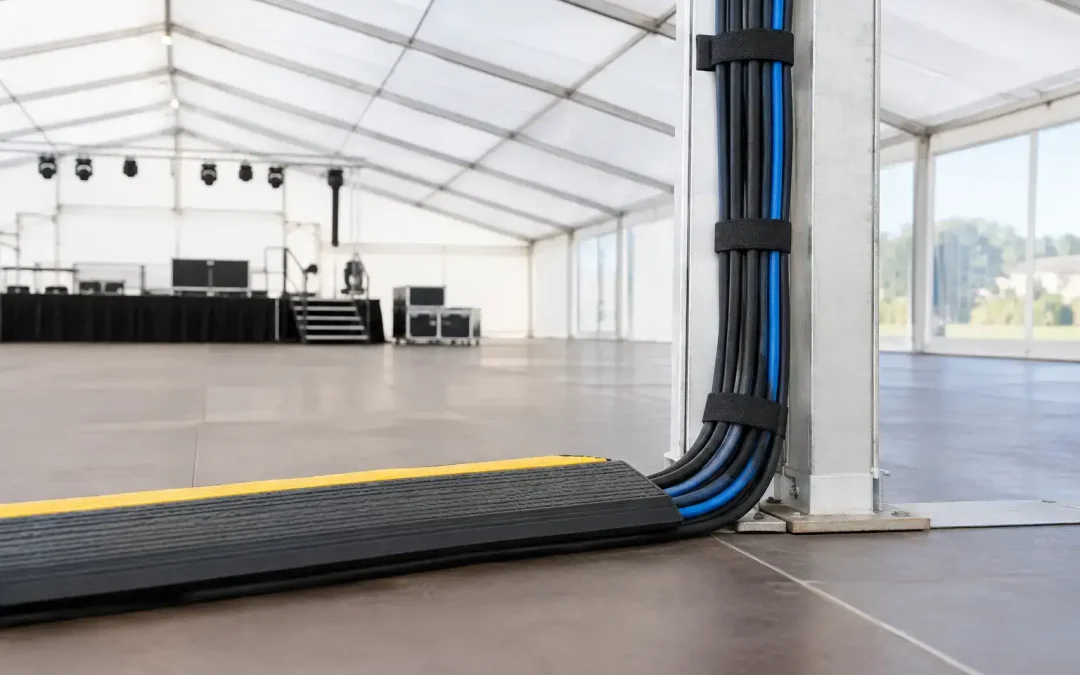
A guide to temporary cable management is rarely about making a site look tidy. At a live event, cable routes affect public safety, vehicle access, emergency egress, power reliability and the speed at which crews can respond when something changes. A poorly planned run can turn a straightforward build into a trip hazard, a blocked service route or an avoidable power failure just as doors open.
For large marquees, festival compounds, agricultural shows and city-centre installations, cable management needs to be treated as part of the infrastructure plan from the outset. It should sit alongside access, flooring, fencing, lighting positions, generator locations and the operational layout of front and back-of-house areas.
Why temporary cable management needs early planning
Temporary sites are not fixed buildings. Ground conditions vary, routes change as suppliers arrive, and a cable that is safely positioned during the build may become exposed once catering units, barriers, furniture or queue lines are installed. The challenge is not simply getting power from A to B. It is maintaining a controlled, protected route for the life of the event.
Early planning allows the project team to identify where power is needed, how it will be distributed and which routes can remain protected from people, vehicles and weather. It also prevents the common last-minute problem of extension leads being added across circulation routes because a final piece of equipment has not been accounted for.
A proper plan should distinguish between power, lighting, data, broadcast and control cables. They may share parts of a route, but they do not always have the same protection requirements or separation needs. A temporary event with public Wi-Fi, payment terminals, production equipment and emergency lighting has more to manage than a single power feed to a marquee.
Start with the site, not the cable
The most dependable cable route is usually the one designed around how the site will operate. Before cable lengths, ramps or distribution boards are specified, map the movement of people and vehicles through the site.
Consider delivery lanes, emergency access, plant movements, pedestrian entrances, staff routes, catering service areas, toilet units and waste collection points. A cable run across an access road may be unavoidable, but it should never be an assumption. In some cases, relocating a generator, changing the distribution position or adjusting the layout of a temporary structure will remove several crossings and make the whole site easier to manage.
Ground conditions matter too. A level hardstanding behaves very differently from wet grass, uneven parkland or compacted stone. Cable ramps need stable support and must sit correctly with no rocking, gaps or exposed cable at either end. On soft or saturated ground, ground protection may be required before a cable route can be properly secured.
For public events, keep routes away from entrance thresholds, queue systems, bar counters and busy pedestrian pinch points wherever possible. These are areas where people are looking ahead, carrying drinks or moving in groups, not checking the ground beneath them.
Plan distribution to reduce long runs
Long cable runs are harder to protect, harder to inspect and more likely to be disturbed. They can also introduce electrical considerations that need to be assessed by the competent electrical contractor. The practical answer is often to bring distribution closer to the areas of demand rather than continually extending leads from one central point.
This is particularly useful in large marquees with separate hospitality, kitchen, production and welfare requirements. A well-positioned distribution plan can serve each zone through short, logical routes, keeping connections accessible to authorised crew while removing unnecessary cable from guest areas.
Generator location should be considered at the same time. It needs suitable access for delivery, refuelling and servicing, adequate separation from guests, and a route for power cables that does not compromise the wider site plan. The quietest-looking location is not always the most operationally effective one if it forces every cable across a public route.
Temporary electrical systems should be designed, installed, inspected and managed by competent people, with the appropriate documentation and testing in place. Standards such as BS 7909 are commonly relevant to temporary electrical systems for entertainment and similar purposes, but the exact requirements depend on the nature of the installation and the site.
Choose protection for the actual crossing
Not every cable needs the same form of protection. Cables running behind a counter or within a controlled production area may be safely contained and secured without a heavy-duty ramp. A public walkway, vehicle route or emergency service lane is a different proposition.
Pedestrian crossings
Low-profile cable ramps can work well across controlled pedestrian routes, provided they are rated for the use, clearly visible where necessary and securely laid. The ramp should be wide enough for the full cable bundle without crushing, pinching or forcing cables out at the sides. Its edges must sit flush to the surrounding surface to reduce the trip risk.
Avoid creating a series of small crossings where one planned route would do. Several ramps through a marquee entrance or along a busy walkway make the space harder to navigate and can affect wheelchair users, people with pushchairs and staff moving equipment.
Vehicle and plant crossings
Vehicle crossings require purpose-designed protection with an appropriate load rating. This needs to reflect the heaviest anticipated movement, not just the cars expected during the event. Forklifts, telehandlers, catering lorries, waste vehicles and emergency vehicles may all impose different loads.
The crossing must be positioned so drivers approach it squarely where possible. A ramp placed on a bend, slope or narrow gate can shift under repeated use and creates a risk to both cables and vehicles. It should also be checked after every significant plant movement, particularly during the build and breakdown when vehicle activity is highest.
Internal marquee routes
Inside a marquee, flooring can provide a clean and effective means of containing cables when the design allows for it. Cable routes beneath cassette flooring or within planned service channels keep guest spaces clear and protect the installation from casual interference. However, access points for testing, fault-finding and later changes should still be considered. A concealed route is only helpful if it remains manageable.
Installation is not the end of the job
Cable management often fails because it is viewed as a one-time installation task. On a changing event site, it needs inspection and ownership throughout the build, live period and derig.
Assign responsibility for checking routes during daily site walks and after key changes. This should include looking for lifted ramps, damaged lids, cables escaping from protection, standing water, loose temporary flooring and new equipment connected without agreement. Any alterations to the power plan should be controlled through the electrical team, rather than solved with an unplanned extension lead.
Clear labelling also helps. Distribution points, isolation locations and principal routes should be identifiable to the crews who need them, without making sensitive operational details unnecessarily public. For complex sites, marked-up service drawings give the event manager, production team and site crew a common reference when a route needs to be checked or a fault investigated.
Build cable management into the handover
A handover should confirm more than that power is live. The responsible site team needs to know where cable crossings are located, which areas must remain clear, who can authorise changes and what to do if protection is displaced or damaged.
This is especially valuable when several suppliers occupy the same footprint. Catering, production, security, exhibitors and venue teams may all need power, but individual changes can affect the whole installation. A short operational briefing prevents well-meaning adjustments from creating avoidable hazards.
For public-facing sites, cable crossings should also be considered within the wider accessibility and crowd-management plan. A route that is acceptable during a quiet site walk may be unsuitable once a queue forms, lighting levels reduce or wet weather increases footfall through a single entrance.
At Purvis Marquee Hire, cable routing is considered alongside the temporary structure, flooring, power and site logistics because each element affects the others. The best result is rarely the most visible one. It is the route that stays protected, accessible and dependable while the event team gets on with delivering the day.
A well-managed cable route gives nobody a reason to notice it. That is exactly the point: guests move safely, crews can work efficiently, and the infrastructure continues to perform when the pressure is on.